
A question from life
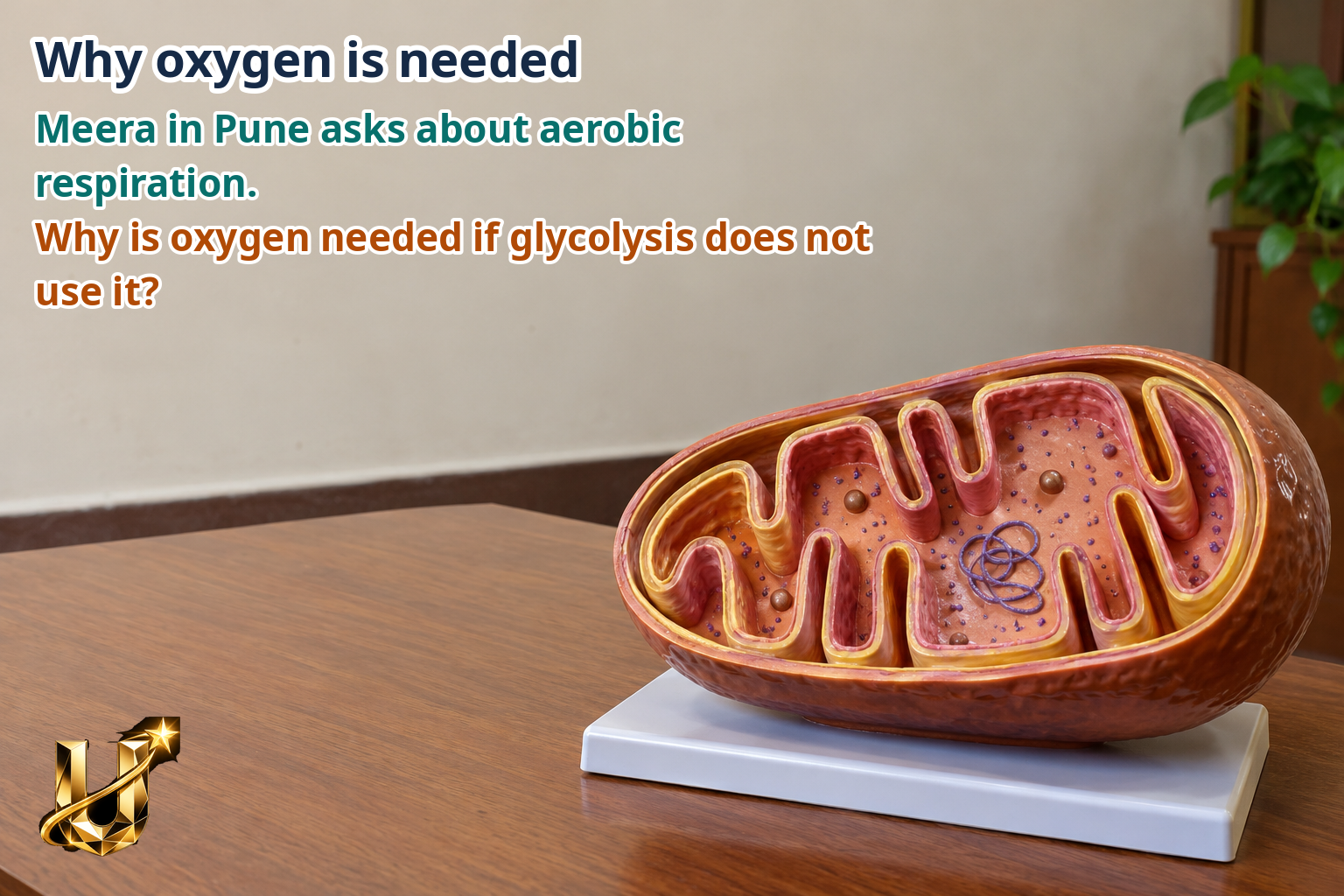
Enlarge image
Meera in Pune asks why oxygen is needed for sustained aerobic respiration even though glycolysis does not directly consume it.
Working review group 6; official unit label pending
Meera in Pune asks why oxygen is needed for sustained aerobic respiration even though glycolysis does not directly consume it.
Loss of electrons or reducing equivalents in the described chemical process.
Review lesson not available yet.
Meera in Pune asks why oxygen is needed for sustained aerobic respiration even though glycolysis does not directly consume it.
In typical aerobic eukaryotic cells, pyruvate processing forms acetyl-CoA and CO₂; the citric-acid cycle oxidises acetyl-derived carbon and regenerates intermediates. NADH/FADH₂ carry reducing equivalents and some ATP-equivalent production occurs directly. Locations differ in prokaryotes.
A supplied record gives 6 units CO₂ released and 6 units O₂ consumed on the same basis.
Where is the typical eukaryotic respiratory electron-transport chain?
Electron transfer in the inner mitochondrial membrane supports a proton gradient. ATP synthase couples gradient relaxation to ATP formation, and oxygen is the final electron acceptor forming water in the usual aerobic chain. Actual ATP yield depends on coupling, shuttles, transport and assumptions rather than one universal count.
A chain diagram transfers electrons toward oxygen.
What is oxygen's usual aerobic-chain role?
Respiratory pathways provide and receive intermediates for biosynthesis as well as breakdown, so they have amphibolic roles. Respiratory quotient RQ is CO₂ released divided by O₂ consumed over a defined interval; substrate and conditions influence it. A simple glucose complete-oxidation model has RQ = 1.
A problem explicitly assumes 30 ATP per glucose for 4 glucose.
Map carbon and electron-carrier routes on supplied diagrams and calculate RQ from hypothetical data. Keep model yields and locations explicit.
Aerobic respiration combines carbon oxidation with electron transport and chemiosmosis. Oxygen, carrier cycling and ATP yields must be interpreted through the model and conditions.