
A question from life
Enlarge image
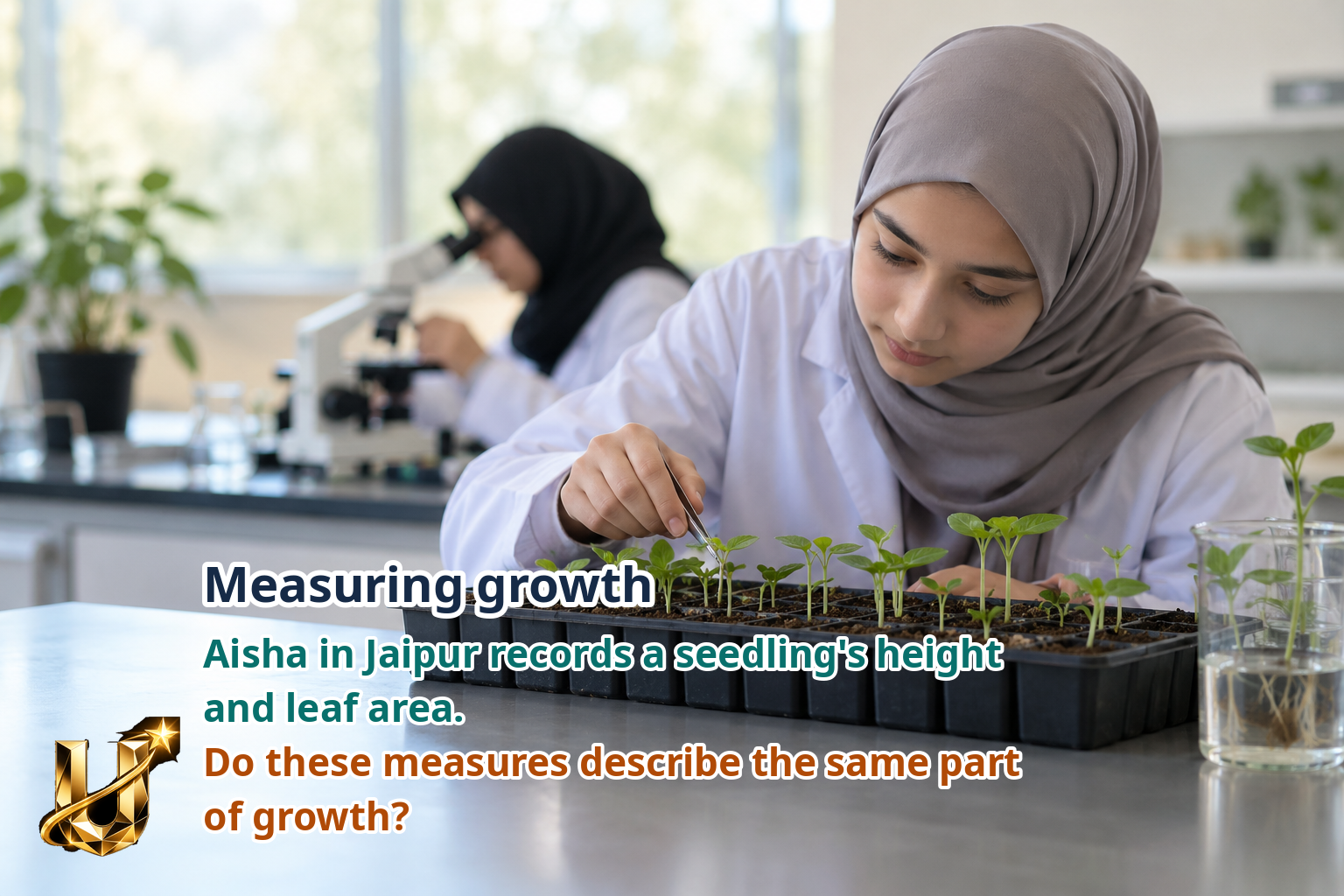
Aisha in Jaipur records a seedling's height, leaf area and dry mass on prepared cards. Do these measurements describe exactly the same aspect of growth?
Working review group 7; official unit label pending
Aisha in Jaipur records a seedling's height, leaf area and dry mass on prepared cards. Do these measurements describe exactly the same aspect of growth?
Development of specialised cell structures and functions.
Review lesson not available yet.
Aisha in Jaipur records a seedling's height, leaf area and dry mass on prepared cards. Do these measurements describe exactly the same aspect of growth?
Plant growth is a lasting increase in size or material associated with living development. Measures can include length, area, cell number and dry mass, each answering a different question. Water uptake can change fresh mass without the same increase in dry matter.
A hypothetical seedling grows from 4 to 10 cm in 3 days.
Why specify the growth measure?
Absolute growth rate is change in a selected measure per time; relative growth considers the initial size. Arithmetic and exponential models describe limited patterns, while many whole-growth records show a sigmoid trend with constraints. A model should not be extrapolated indefinitely.
Plants A and B each add 2 cm, starting at 2 and 10 cm.
What is average length-growth rate from 5 to 11 cm in 2 days?
Development includes growth and differentiation. Cells acquire specialised functions; some regain division capacity under suitable conditions, termed dedifferentiation, and later specialise again. Environmental conditions and internal signals interact with genetic programmes.
A supplied leaf takes up water and fresh mass rises rapidly.
Analyse prepared growth tables with named measures. Calculate absolute and relative changes, then state one limit of the model without growing or chemically treating plants.
Growth needs a defined metric and rate basis. Development includes specialisation, and models must respect biological and environmental limits.
Germination resumes embryo growth after dormancy when species-appropriate conditions permit it. Water uptake,oxygen and suitable temperature commonly matter; light requirements vary. The radicle commonly emerges before the shoot. Stored reserves support early growth before the seedling has enough photosynthetic tissue. A living dormant seed need not germinate immediately,so failure in one trial does not by itself prove it was dead.
A prepared seed grows only when both moisture and oxygen are available at suitable temperature. Does adding unlimited water always improve germination?
Early seedling growth before adequate photosynthesis is commonly supported by: