
A question from life
Enlarge image
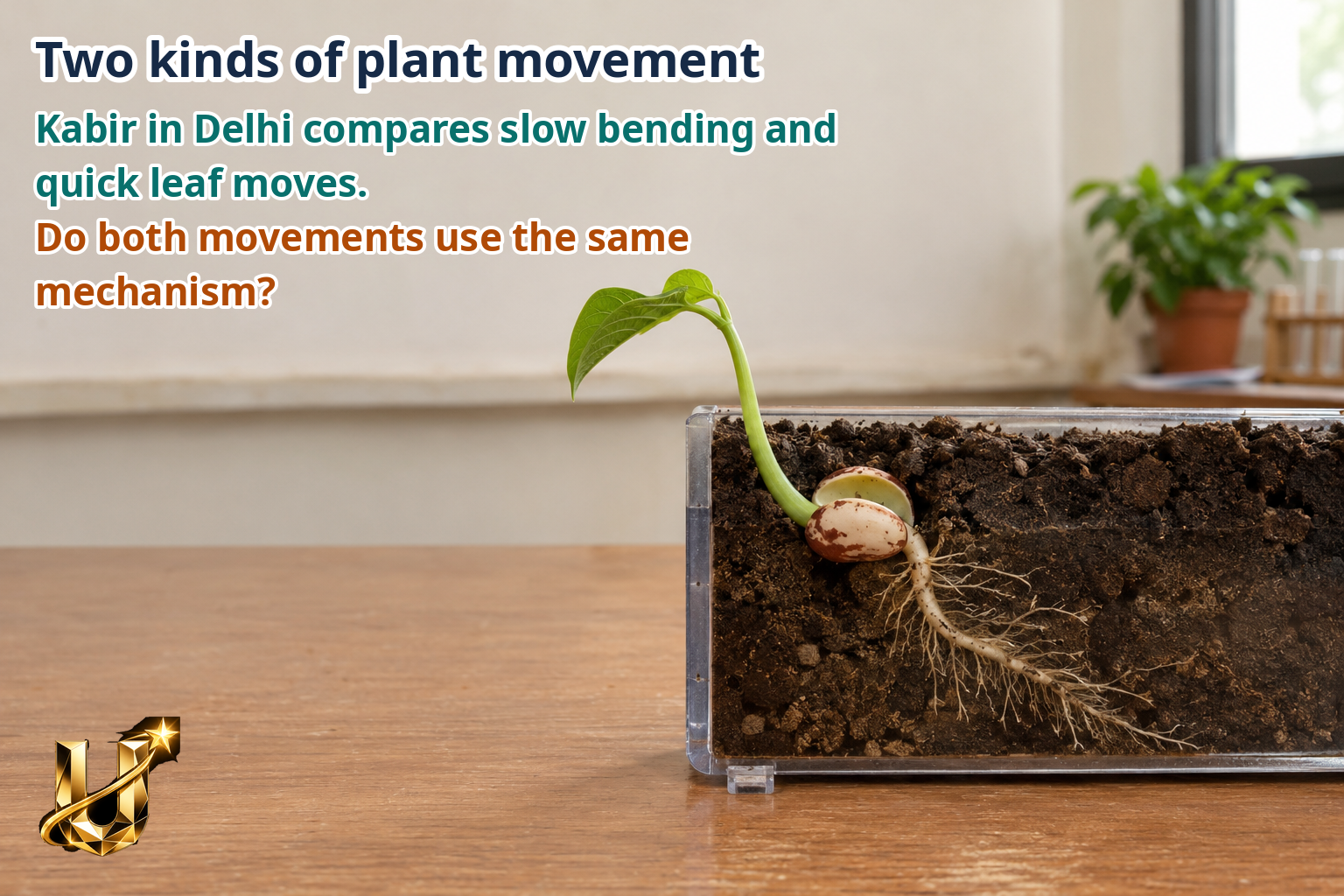
Kabir in Delhi compares a shoot bending toward light over days with a leaf changing position quickly. Do both movements require the same mechanism?
Working review group 7; official unit label pending
Kabir in Delhi compares a shoot bending toward light over days with a leaf changing position quickly. Do both movements require the same mechanism?
Development of specialised cell structures and functions.
Review lesson not available yet.
Kabir in Delhi compares a shoot bending toward light over days with a leaf changing position quickly. Do both movements require the same mechanism?
Auxins, gibberellins, cytokinins, abscisic acid and ethylene influence overlapping aspects of growth, stress responses and development. Their effects depend on tissue, concentration, stage and other signals; one hormone does not have one universal exclusive effect.
A supplied shoot model shows greater elongation on the shaded side.
Why qualify a plant hormone's effect?
Tropisms are directional growth responses related to stimulus direction, such as shoot phototropism. Nastic movement direction is not determined in the same way by stimulus direction; mechanisms can involve turgor or growth depending on the example. Plants need no animal muscles for these responses.
A prepared sensitive-leaf diagram shows changing cell turgor.
What defines a tropism here?
Photoperiodic flowering responds to day/night patterns in a species-dependent system, often with the uninterrupted night length important. Vernalisation is a suitable cold exposure promoting later flowering in responsive plants. Neither treatment guarantees every plant flowers under every condition.
A supplied responsive cultivar flowers after a required cold period and later suitable conditions.
Compare recorded tropic/nastic and flowering-response cards. State the responsive plant model and conditions; do not apply hormones or expose plants to damaging treatments.
Plant regulators and environmental signals coordinate development. Directional growth, nastic movement and seasonal flowering responses have different mechanisms and limits.