
A question from life
Enlarge image
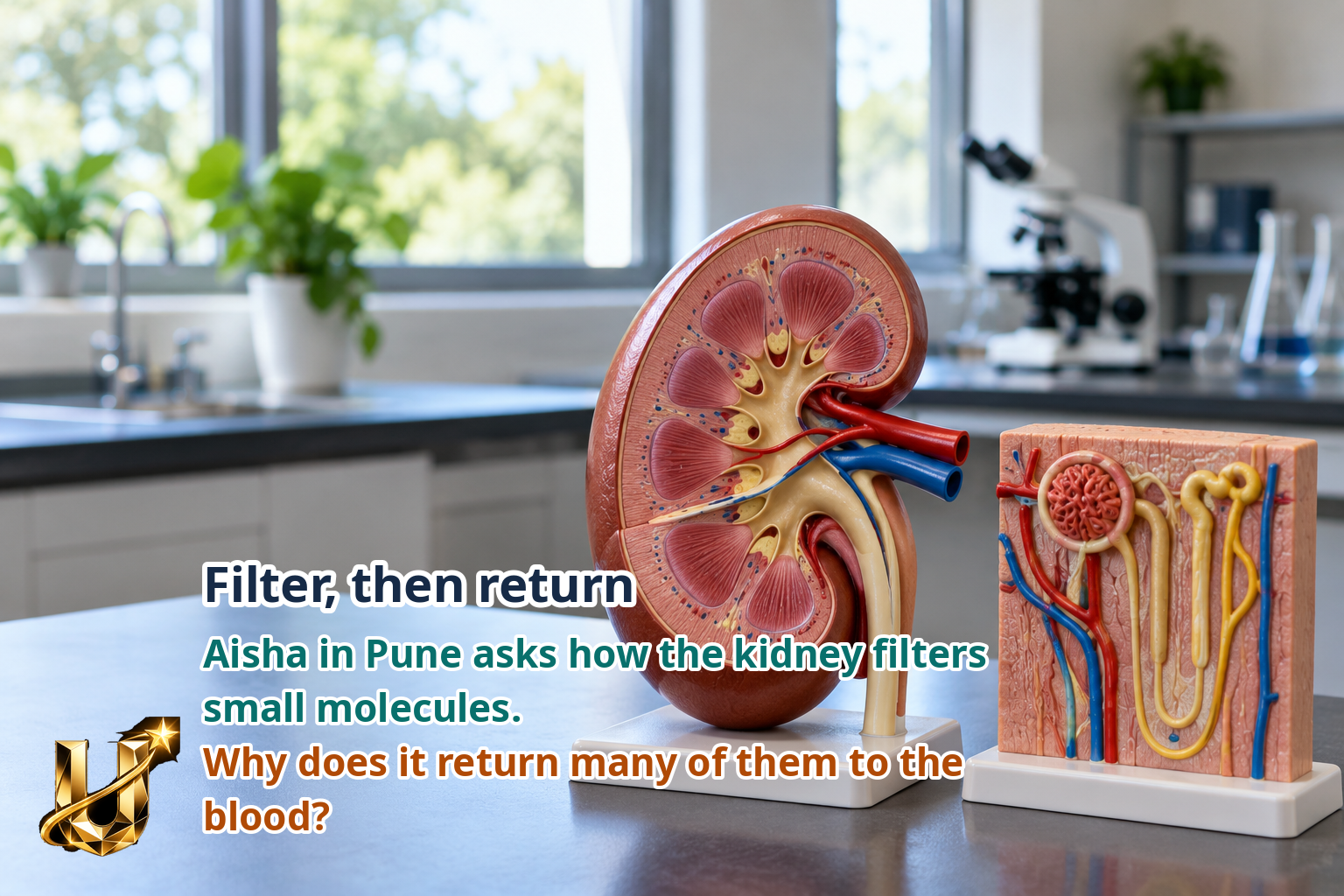
Aisha in Pune asks why the kidney filters useful small molecules and then returns many of them instead of simply removing everything that passes the first barrier.
Working review group 8; official unit label pending
Aisha in Pune asks why the kidney filters useful small molecules and then returns many of them instead of simply removing everything that passes the first barrier.
Return of filtered substances from nephron fluid to the body’s internal fluids.
Review lesson not available yet.
Aisha in Pune asks why the kidney filters useful small molecules and then returns many of them instead of simply removing everything that passes the first barrier.
Excretion removes metabolic wastes. Ammonia, urea and uric acid are nitrogenous-waste forms associated with different water/energy strategies across animals. Egestion of undigested food is distinct. No single strategy suits every species and habitat.
One card describes urea removal and another undigested food leaving the gut.
What is excretion?
A nephron filters fluid across the glomerular barrier into the capsule, retaining cells and much large protein under usual conditions. Tubules selectively reabsorb substances and secrete others. Final urine is not simply unchanged filtered plasma.
A hypothetical model filters 100 units of water and returns 98 before the specified final output.
What is a usual initial nephron filtration site?
Processed fluid moves through collecting systems toward renal pelvis, ureter, bladder and urethra. Rates and composition depend on regulation. Finding a substance in a hypothetical sample suggests questions, not one automatic diagnosis from a class exercise.
A useful solute enters the filtrate and is later reabsorbed.
Trace a nephron and label filtration, reabsorption and secretion using prepared arrows. Compare species waste strategies without personal sample testing.
Excretion removes metabolic wastes. Nephrons filter and selectively process fluid, so final urine reflects several stages and regulation.