
A question from life
Enlarge image
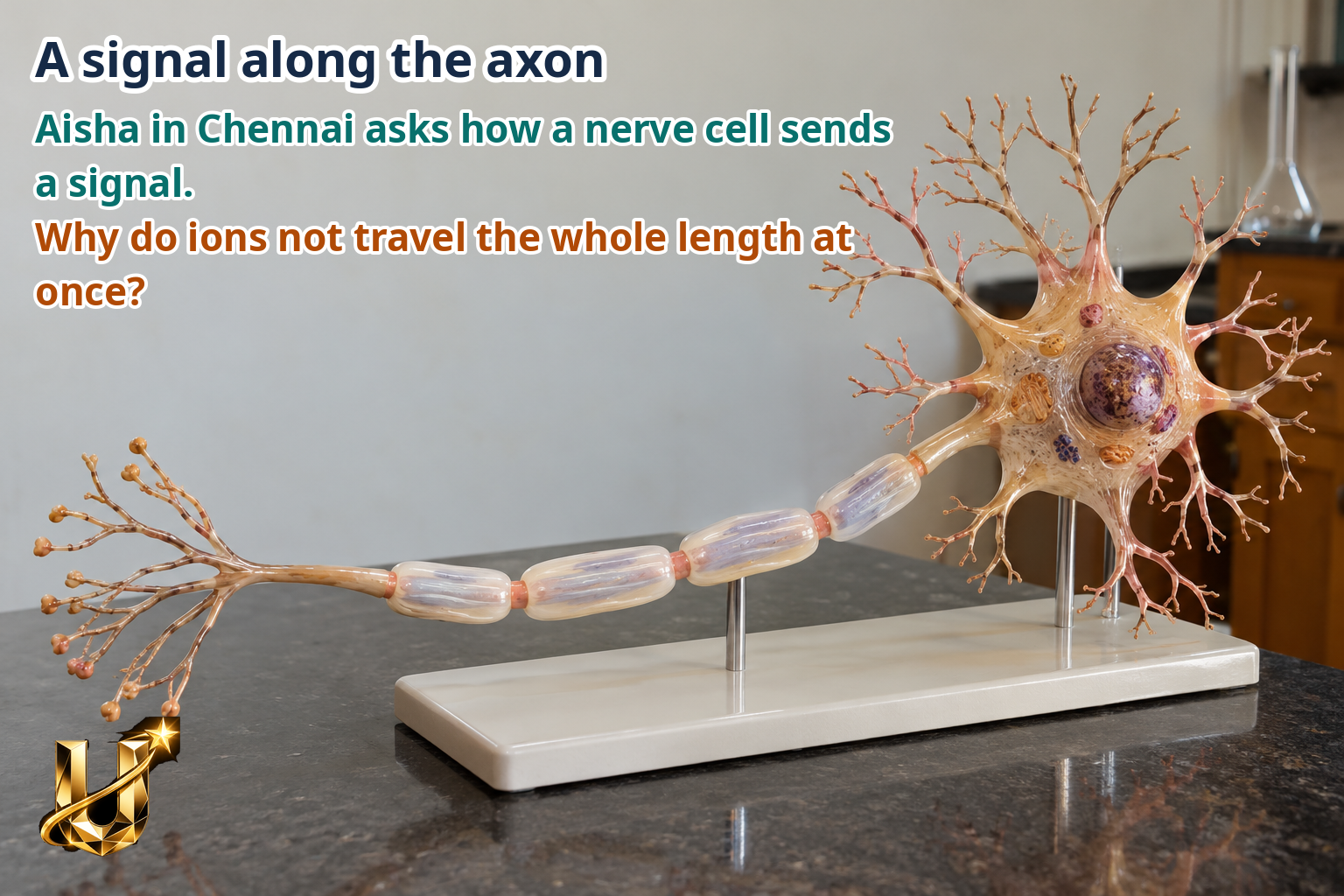
Aisha in Chennai asks how a nerve cell can send a signal along a long axon without the same group of ions travelling the entire length in one instant.
Working review group 9; official unit label pending
Aisha in Chennai asks how a nerve cell can send a signal along a long axon without the same group of ions travelling the entire length in one instant.
A rapidly regenerated change in membrane voltage that propagates along an excitable membrane.
Review lesson not available yet.
Aisha in Chennai asks how a nerve cell can send a signal along a long axon without the same group of ions travelling the entire length in one instant.
Neurons integrate inputs through specialised regions and propagate signals along axons. Dendrites, soma and axon form a useful typical model with cell-type variation. Glial cells support and regulate the signalling environment.
A model has an ion gradient but changes membrane permeability.
Across what is membrane potential defined?
Ion gradients and selective membrane permeability contribute to resting potential; pumps maintain gradients over time. A typical teaching value near −70 mV is an example, not a universal potential for every neuron. Electrical potential is measured across a membrane.
A hypothetical path is 1 m and signal speed 50 m/s.
What contributes to resting potential?
Action potentials involve voltage-dependent ion conductance changes that regenerate a signal along the membrane. Refractory behaviour helps shape propagation. Myelin enables saltatory conduction between nodes in suitable axons; the signal is not one ion racing uninterrupted from receptor to brain.
A diagram has myelin interrupted by nodes.
Interpret membrane and node diagrams, then calculate hypothetical travel times. Do not use electrical stimulation or personal reaction experiments.
Neural signalling depends on gradients, permeability and regenerative membrane events. Myelin and timing properties shape propagation without an instant whole-axon ion journey.