
A question from life
Enlarge image
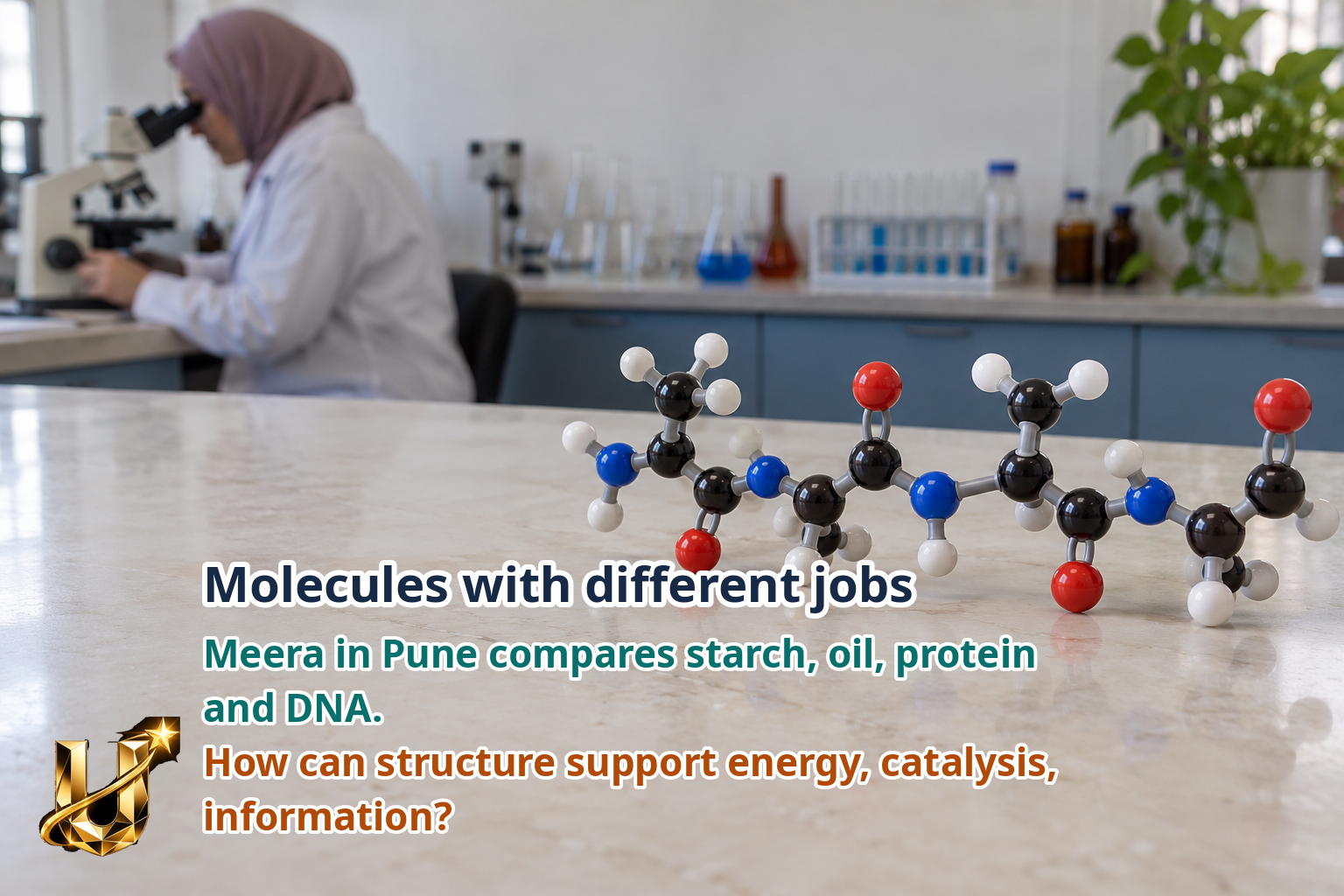
Meera in Pune compares starch, oil, a protein and DNA. How can different molecular structures support energy storage, membranes, catalysis and information?
Working review group 5; official unit label pending
Meera in Pune compares starch, oil, a protein and DNA. How can different molecular structures support energy storage, membranes, catalysis and information?
A reactant acted upon by an enzyme in the reaction being described.
Review lesson not available yet.
Meera in Pune compares starch, oil, a protein and DNA. How can different molecular structures support energy storage, membranes, catalysis and information?
Carbohydrates include monosaccharides and polymers such as starch and cellulose, with different structures and roles. Lipids are a diverse relatively hydrophobic group, not one universal repeating polymer. Membrane phospholipids have contrasting water-interacting and hydrophobic regions.
One unbranched linear chain has 20 amino acids.
What links amino acids in a usual protein chain?
Proteins contain amino-acid chains joined by peptide bonds, folded into functional structures. Sequence, interactions and environment affect folding. Some proteins have several chains or additional components. Denaturation can disrupt functional structure without necessarily breaking every peptide bond.
Starch and cellulose are both glucose-based polymers.
How many peptide bonds join 10 residues in one ordinary linear chain?
DNA and RNA are nucleotide polymers with different sugars and usual base patterns. Genetic information can guide RNA and protein production, but not every gene encodes a protein; some products are functional RNAs. RNA structures and cellular locations are diverse, so the usual single-strand model has limits.
A gene produces a functional RNA rather than a translated peptide.
Build monomer/linkage cards and compare supplied protein/nucleic-acid models. State which simplifications apply to linear chains and typical structures.
Biomolecular structure supports diverse roles. Linkage and folding matter, while genetic products and lipid structures require more nuanced descriptions than one universal rule.