
A question from life
Enlarge image
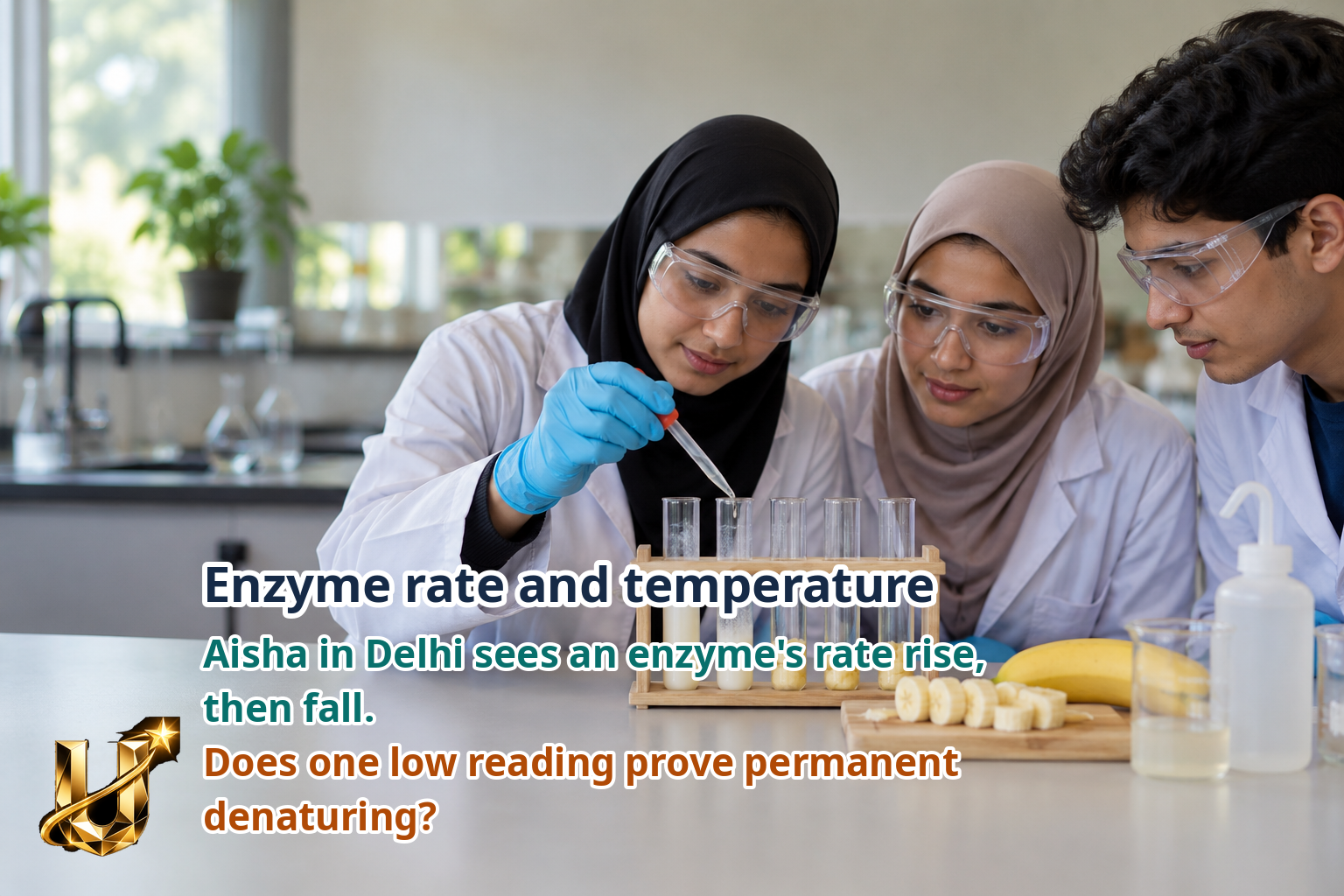
Aisha in Delhi sees an enzyme's measured rate rise with temperature and then fall. Does one low reading prove the enzyme has been permanently denatured?
Working review group 5; official unit label pending
Aisha in Delhi sees an enzyme's measured rate rise with temperature and then fall. Does one low reading prove the enzyme has been permanently denatured?
A reactant acted upon by an enzyme in the reaction being described.
Review lesson not available yet.
Aisha in Delhi sees an enzyme's measured rate rise with temperature and then fall. Does one low reading prove the enzyme has been permanently denatured?
Enzymes catalyse reactions by lowering activation barriers through molecular interactions. Most are proteins, while some catalytic RNAs exist. They are regenerated rather than consumed overall and do not change a reaction's equilibrium constant simply by catalysis.
A suitable enzyme is added to a reversible reaction at the same temperature.
What does an enzyme lower?
A substrate interacts with an active site whose properties support suitable reactions. Induced-fit models improve on a rigid lock image. At fixed enzyme amount, raising substrate concentration can increase rate toward a limit when active sites are occupied; more substrate does not guarantee unlimited rate.
Prepared rates rise from 2 to 4 to 5 units as substrate increases, then stay near 5.
Are all biological catalysts necessarily proteins?
Temperature, pH, inhibitors and concentrations affect rate. Extreme conditions can disrupt structure, but a rate decrease alone does not uniquely prove denaturation: substrate depletion, assay limits or other factors may matter. Compare controls and reversibility where the evidence permits.
A high-temperature sample has low activity but no recovery test.
Interpret prepared enzyme-rate graphs and identify controls. Separate possible explanations from proven conclusions; no biological sampling or chemical assays.
Enzymes lower activation barriers with specificity and finite capacity. Rates depend on conditions, and mechanistic claims need controls rather than one isolated result.