
A question from life
Enlarge image
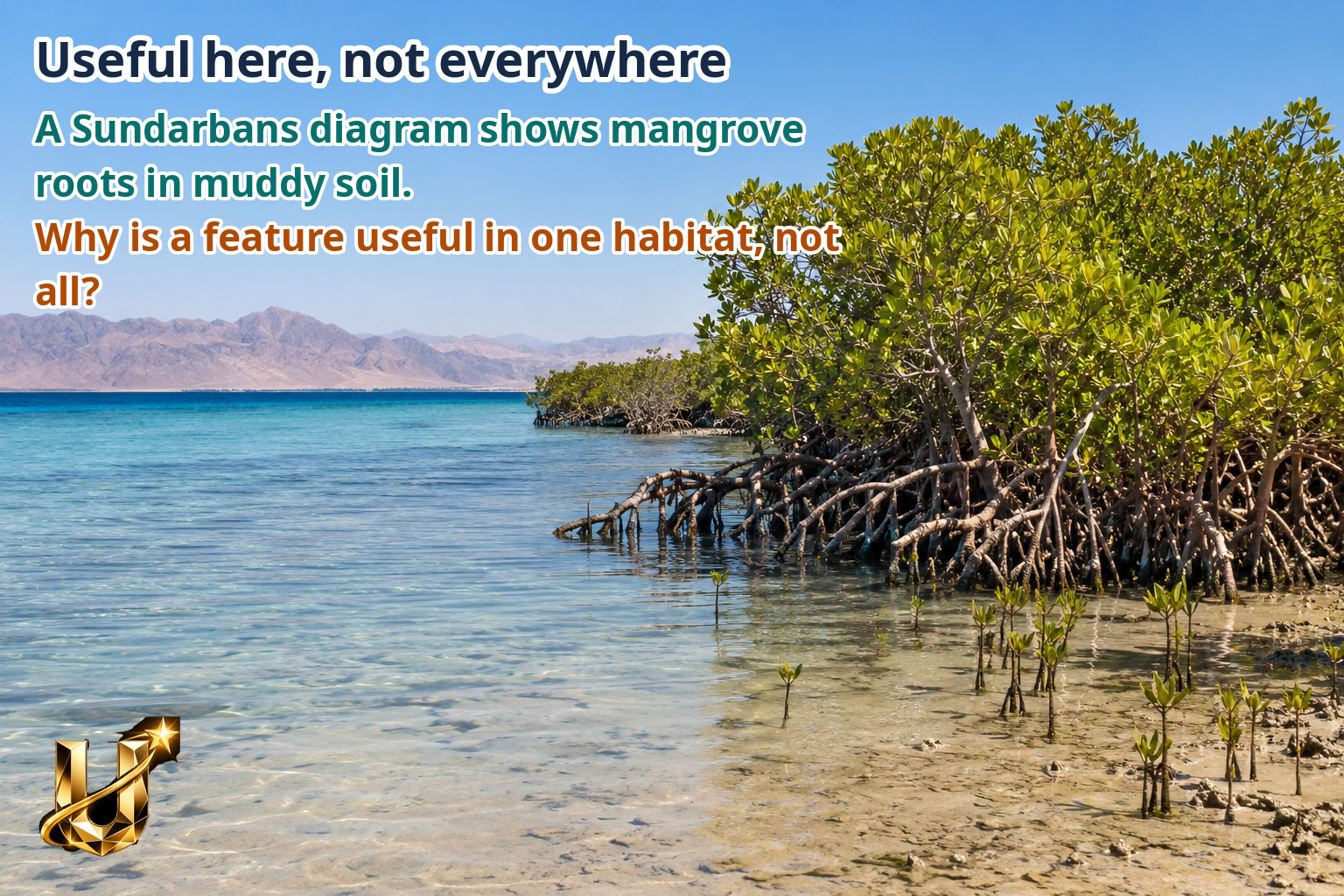
A Sundarbans classroom diagram shows mangrove roots above oxygen-poor mud. Why is a feature useful in one habitat not automatically useful everywhere?
Working review group 6; official unit label pending
A Sundarbans classroom diagram shows mangrove roots above oxygen-poor mud. Why is a feature useful in one habitat not automatically useful everywhere?
A model population-support parameter for specified environmental conditions.
Review lesson not available yet.
A Sundarbans classroom diagram shows mangrove roots above oxygen-poor mud. Why is a feature useful in one habitat not automatically useful everywhere?
An organism experiences abiotic conditions such as temperature, water, light and salinity, and biotic interactions with other organisms. Habitat is where it lives; an ecological niche describes its use of resources and relationships within conditions. A tolerance range has limits and often an optimum, but one factor's optimum does not determine the entire realised distribution.
A freshwater bony fish's body fluids are more concentrated than the surrounding model water.
Habitat mainly describes?
Organisms may regulate internal conditions, conform to external conditions, migrate or suspend activity depending on lineage and situation. Acclimatisation is a within-life response, whereas an evolutionary adaptation is an inherited feature shaped across generations. An adaptation has context and trade-offs, not a conscious purpose.
A model fish has mass1050g and non-gas volume1000cm³ in water density1g/cm³; neglect gas mass.
A tolerance optimum for one factor guarantees presence in that place?
Many fish exchange gases through gills with countercurrent flow; many bony fish use a swim bladder for buoyancy, but not all fish have one. Freshwater and marine bony fish face different osmotic challenges and use different ion/water regulation. Mangrove adaptations include gas-exchange structures in some species and salt-management mechanisms; do not assign every feature to every mangrove species.
Compare an inherited root structure with a short-term physiological response to temperature.
Match Indian habitat-condition cards to specified organism responses. Distinguish within-life response from inherited feature, and calculate the explicit buoyancy model. Use photographs/diagrams only; do not capture fish ordamagroots.
Habitat, niche and tolerance describe different ecological questions. Adaptations are context-dependent inherited features. Aquatic examples need lineage-specific qualifications.