
A question from life
Enlarge image
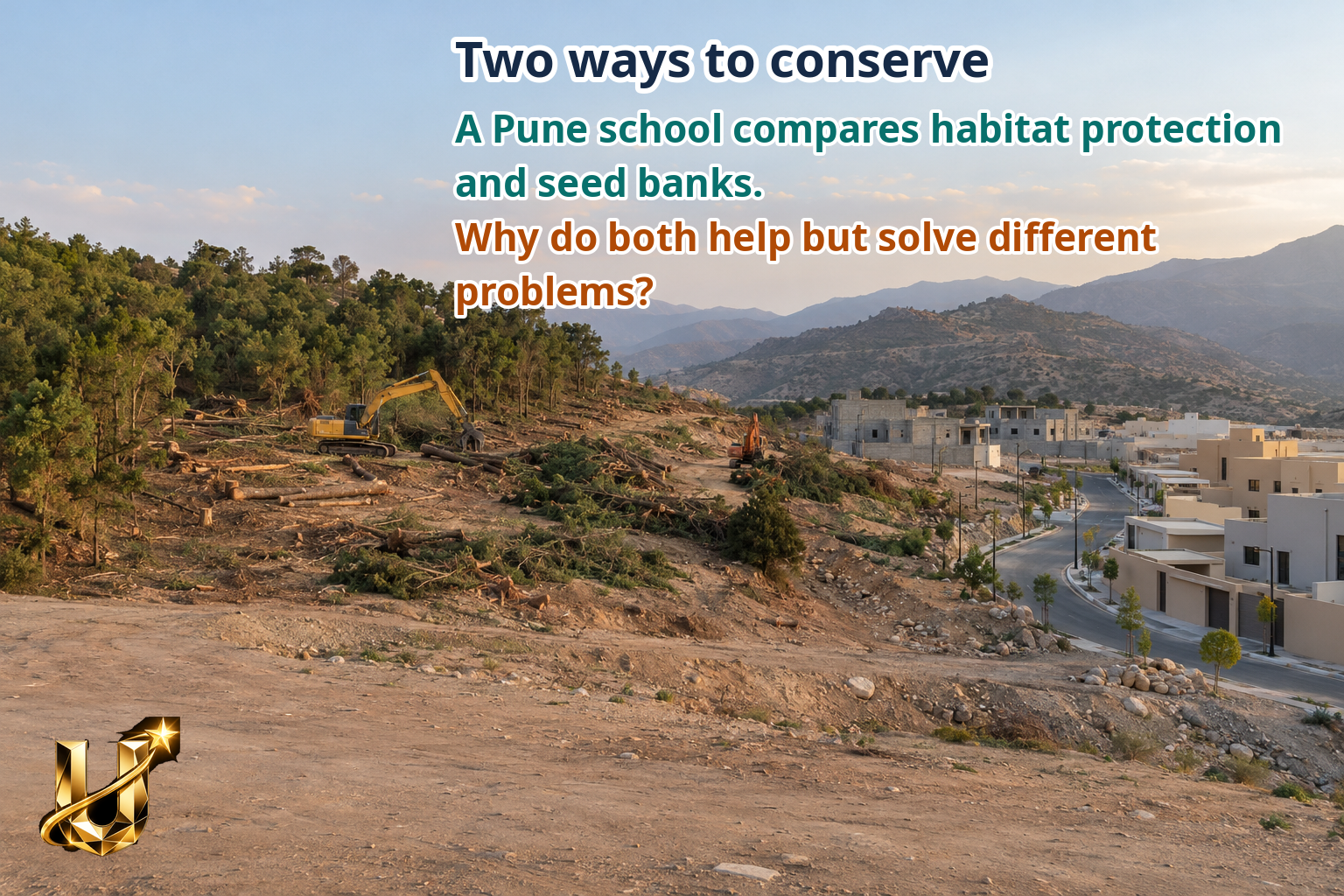
A Pune school compares protecting a habitat with storing seeds in a collection. Why can both help conservation while solving different parts of the problem?
Working review group 7; official unit label pending
A Pune school compares protecting a habitat with storing seeds in a collection. Why can both help conservation while solving different parts of the problem?
Restriction of a taxon’s natural distribution to a specified geographic region.
Review lesson not available yet.
A Pune school compares protecting a habitat with storing seeds in a collection. Why can both help conservation while solving different parts of the problem?
Habitat loss and fragmentation, overexploitation, invasive alien species and coextinctions can reduce biodiversity; pollution and climate change add context-dependent pressures. Not every non-native species becomes invasive. Fragmentation can affect connectivity and edge conditions even when some habitat area remains. Threats often interact rather than acting alone.
A fictional forest declines from500km²to350km².
In situ conservation means?
In situ conservation protects organisms within their ecosystems, including appropriately managed protected areas and habitat connections. Ex situ conservation maintains selected material or organisms outside natural habitats, such as seed banks and specialist breeding collections. Ex situ methods do not preserve every interaction or replace habitat protection. Reintroduction requires case-specific ecological, genetic and welfare assessment.
A fictional Indian school plants40local native plants and36survive one year.
A seed bank is usually which approach?
Biodiversity hotspots combine high endemism and substantial habitat loss in a defined prioritisation framework; high species count alone does not define one. Conservation also addresses ecological function, equity and local community knowledge. A project'shectares, trees planted or captive numbers are indicators, not complete proof of long-term success. Outcomes need monitoring and appropriate comparisons.
Compare a protected wetland with a seed bank.
Compare fictional habitat maps and calculate area loss/survival. Sort in situ/ex situ strategies and identify what each evidence indicator can and cannot establish. Do not release organisms or collect protected material.
Biodiversity loss has interacting causes. In situ and ex situ strategies address different needs. Conservation claims require monitoring, context and more than one count.
Ramsar sites are wetlands designated as internationally important under the Convention on Wetlands. Designation recognises criteria and supports conservation and wise use; it does not mean every ecological problem has been solved. Wetland condition still depends on water regimes,habitats,species and management. A Ramsar site,a biodiversity hotspot and a seed bank describe different conservation frameworks; their labels are not interchangeable.
A designated wetland loses water inflow after upstream change. Does its designation prove that no ecological damage can occur?
A Ramsar site is primarily a designated: