
A question from life
Enlarge image
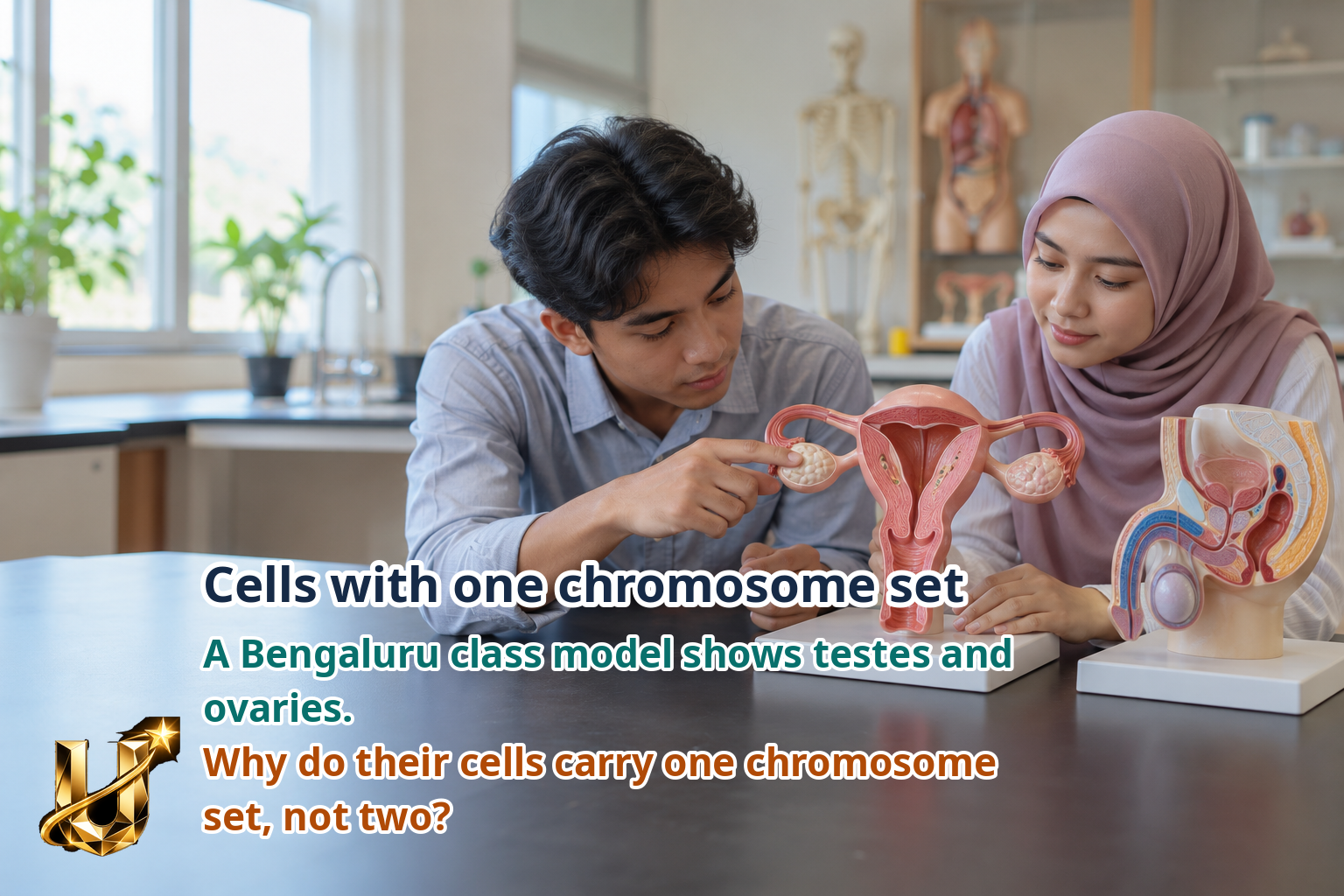
A Bengaluru classroom model shows testes and ovaries producing specialised cells. Why do those cells carry one chromosome set rather than the usual two?
Working review group 1; official unit label pending
A Bengaluru classroom model shows testes and ovaries producing specialised cells. Why do those cells carry one chromosome set rather than the usual two?
Embedding of the developing conceptus in the uterine lining.
Review lesson not available yet.
A Bengaluru classroom model shows testes and ovaries producing specialised cells. Why do those cells carry one chromosome set rather than the usual two?
Testes contain seminiferous tubules where spermatogenesis occurs with support from Sertoli cells. Leydig cells secrete testosterone. Sperm mature in the epididymis and travel through the vas deferens and other ducts; accessory glands add components of seminal fluid. Sperm cells are not the whole semen. Their head contains the nucleus/acrosomal region, midpiece supports energy supply and tail supports movement.
A typical primary spermatocyte has46chromosomes before meiotic division.
Where does spermatogenesis chiefly occur?
Ovaries contain follicles and developing oocytes and secrete reproductive hormones. Oviducts connect the region near the ovaries to the uterus, with the ampullary-isthmic region a usual site of fertilisation. The uterine endometrium supports implantation; the cervix leads to the vagina. Anatomy diagrams show general organisation, not a diagnosis of an individual's structure or function.
Three primary spermatocytes complete normal meiosis in a simplified count.
Leydig cells chiefly secrete?
In humans, meiosis reduces chromosome sets from2n=46ton=23. One primary spermatocyte can yield four haploid spermatids that differentiate into sperm. Oogenesis has unequal cytoplasmic divisions and developmental arrests; the cell released at ovulation is typically a secondary oocyte arrested in meiosis II, which completes after fertilisation triggers. It is not four equal functional ova from one primary oocyte.
Compare a sperm cell with semen.
Use non-graphic labelled anatomical schematics and cell-division cards. Match organ, function and gamete stage, then count chromosomes without applying classroom ratios to an individual's fertility.
Reproductive organs support cell production, transport and hormonal functions. Human meiosis makes haploid gametes; spermatogenesis and oogenesis differ in timing and cytoplasmic division.