
A question from life
Enlarge image
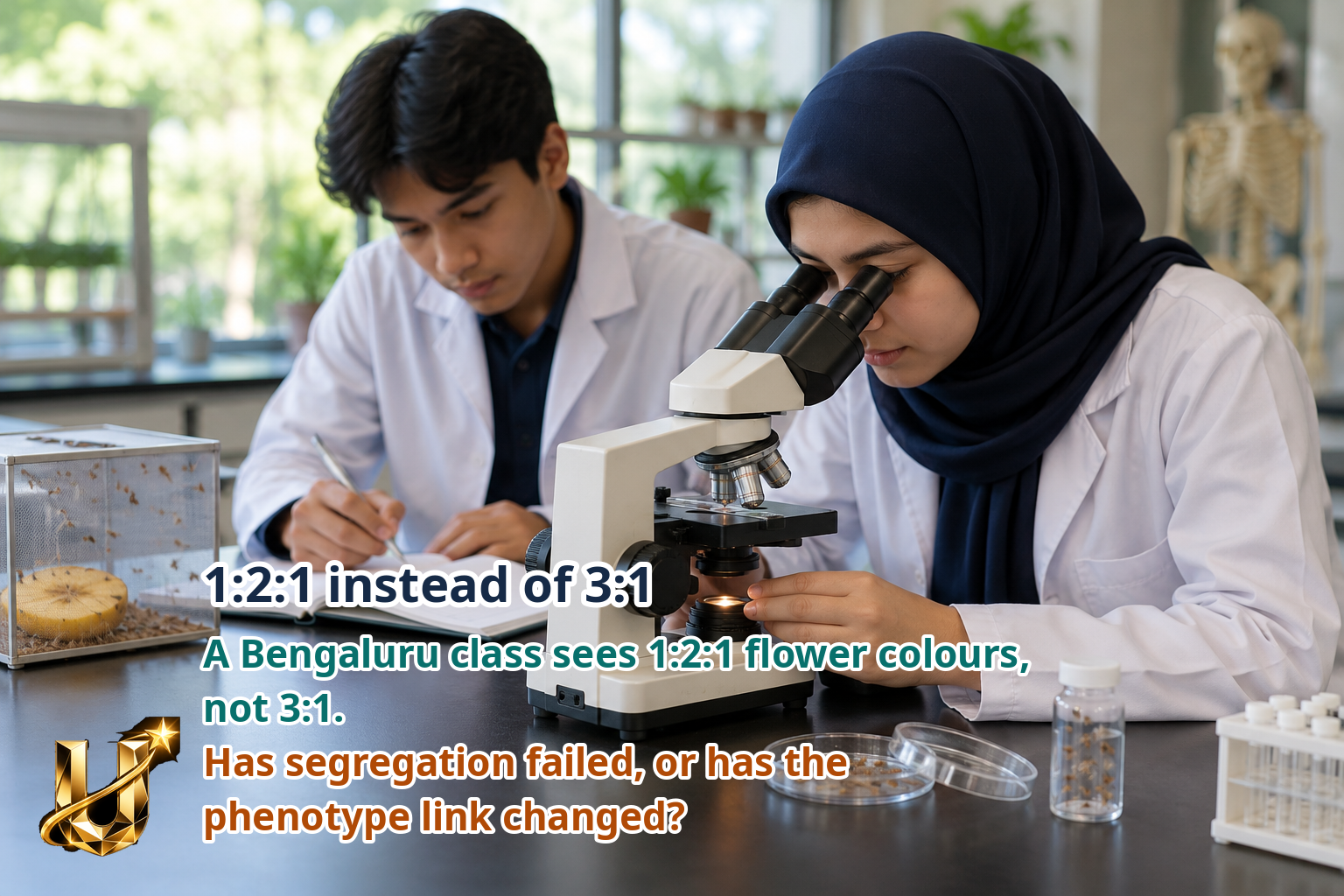
A Bengaluru class sees1:2:1flower colours instead of3:1. Has segregation failed, or has the phenotype relationship changed?
Working review group 2; official unit label pending
A Bengaluru class sees1:2:1flower colours instead of3:1. Has segregation failed, or has the phenotype relationship changed?
Association of loci on the same chromosome that can reduce independent assortment.
Review lesson not available yet.
A Bengaluru class sees1:2:1flower colours instead of3:1. Has segregation failed, or has the phenotype relationship changed?
Incomplete dominance gives a heterozygote phenotype intermediate between the defined homozygotes; codominance allows both specified allelic products to be expressed. The ABO locus has multiple alleles in the population, although a typical diploid individual carries two. Many traits are polygenic and environment-influenced. One gene can also affect several features: pleiotropy.
Cross two heterozygous pink flowers, RW×RW, where RR is red and WW white.
A heterozygote showing both specified allelic products illustrates?
Genes on the same chromosome can be linked. Crossing over can produce recombinant gametes; closer loci often show lower recombination fractions. Recombination frequency isnot a universal physical distance ruler and does not exceed50%in the usual two-locus gamete comparison. Independent assortment can be approximated for unlinked or far-apart loci.
At the ABO locus, consider IA IB.
An intermediate heterozygote phenotype can illustrate?
In the common XX/XY human model, eggs contribute X and sperm contributeXorY; chromosomal variation and developmental complexity exist. X-linked recessive models differ from autosomal ones because chromosome copy counts differ. Nondisjunction can change chromosome number; Down syndrome commonly involves trisomy21. These are biological models, not judgements about identity, ability or human worth, and no parent should be blamed for a chance chromosomal outcome.
A defined testcross data set contains80recombinant offspring among1000informative offspring.
Compare incomplete/codominant flower or molecule cards, andcountrecombinants in fictional data. Use anonymous chromosome models without drawing classmates'pedigrees or inferring personal health.
Expression patterns can vary while alleles still segregate. Linkage and crossing over affect joint inheritance. Chromosome models explain variation with limits and must not be used to stigmatise people.
Thalassemias involve reduced production of particular globin chains of haemoglobin; beta-thalassemia concerns beta-globin production and commonly follows an autosomal recessive inheritance pattern. This differs from a whole-chromosome number change. Turner syndrome involves a missing or altered X-chromosome contribution,sometimes in a mosaic pattern; the simple school example is forty-five,X. Klinefelter syndrome commonly involves an additional X chromosome in an XXY pattern,with mosaic forms possible. Biological effects vary; neither chromosome labels nor appearance define a person’s worth or provide a classroom diagnosis. Birds commonly use ZZ/ZW sex chromosomes,and honey-bee haplodiploidy differs from the human XX/XY model.
Compare a beta-globin gene variant with an extra X chromosome. Are both changes at the same organisational scale?
The common school Klinefelter chromosome pattern is: