
A question from life
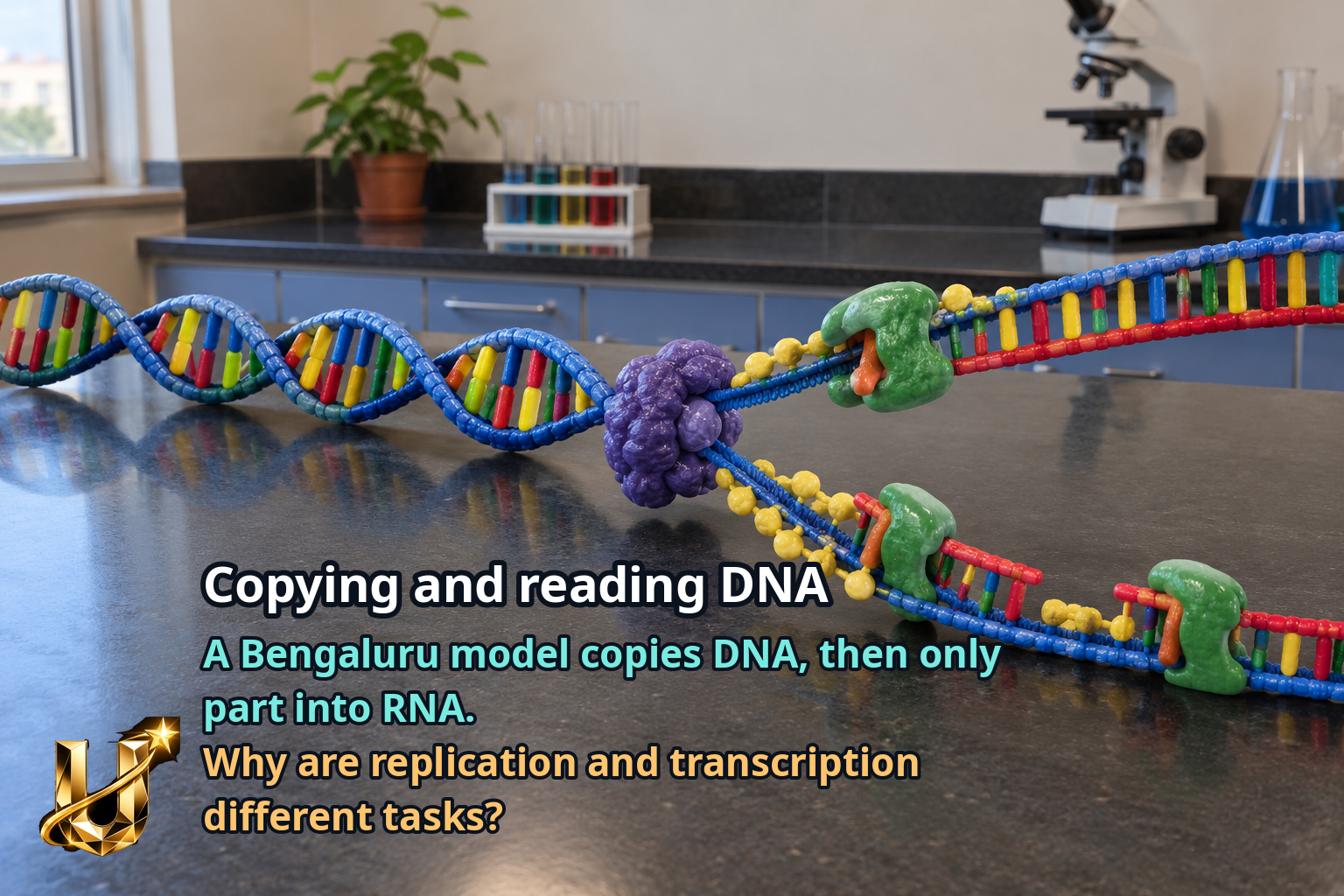
Enlarge image
A Bengaluru model copies DNA before cell division, but later copies only a selected region into RNA. Why are replication and transcription different tasks?
Working review group 3; official unit label pending
A Bengaluru model copies DNA before cell division, but later copies only a selected region into RNA. Why are replication and transcription different tasks?
A nucleic-acid strand used to guide complementary synthesis.
Review lesson not available yet.
A Bengaluru model copies DNA before cell division, but later copies only a selected region into RNA. Why are replication and transcription different tasks?
Semiconservative replication gives each daughter duplex one parental strand and one new strand. Helicase opens the duplex; DNA polymerase extends a suitable primer by adding nucleotides5′→3′. Antiparallel templates lead to continuous leading-strand and discontinuous lagging-strand synthesis with Okazaki fragments. Primer removal, replacement and ligase action complete the backbone; proofreading and repair reduce errors but do not make mutation impossible.
One1000-base-pair duplex replicates once completely.
Semiconservative replication means each daughter DNA has?
RNA polymerase uses a DNA template to synthesise complementary RNA5′→3′. RNA generally contains ribose and U instead ofT. In a eukaryotic protein-coding example, the primary transcript can be processed by capping, splicing and polyadenylation before mature mRNA is used. Not every transcript is mRNA, and prokaryotes do not use a nucleus.
The DNA template is3′-TACGGA-5′.
DNA polymerase extends a new strand in which direction?
Ribosomes read mRNA codons in the5′→3′direction. tRNAs deliver amino acids with suitable anticodon pairing; ribosomal RNA participates in the translation machinery. The standard code has64codons, including61amino-acid coding and3stop codons. AUG commonly initiates and codes methionine. A stop codon recruits termination machinery rather than contributing an amino acid.
mRNA reading frame is5′-AUGCCUUAA-3′under the standard code.
Use labelled strand cards to distinguish copying a genome from transcribing a region. Build a short template/mRNA/codon sequence with direction arrows and stop handling. Use paper models only, no biological samples.
Replication copies DNA semiconservatively. Transcription makes RNA from a template, and translation decodes a reading frame into a peptide. Direction and RNA type matter at every stage.