
A question from life
Enlarge image
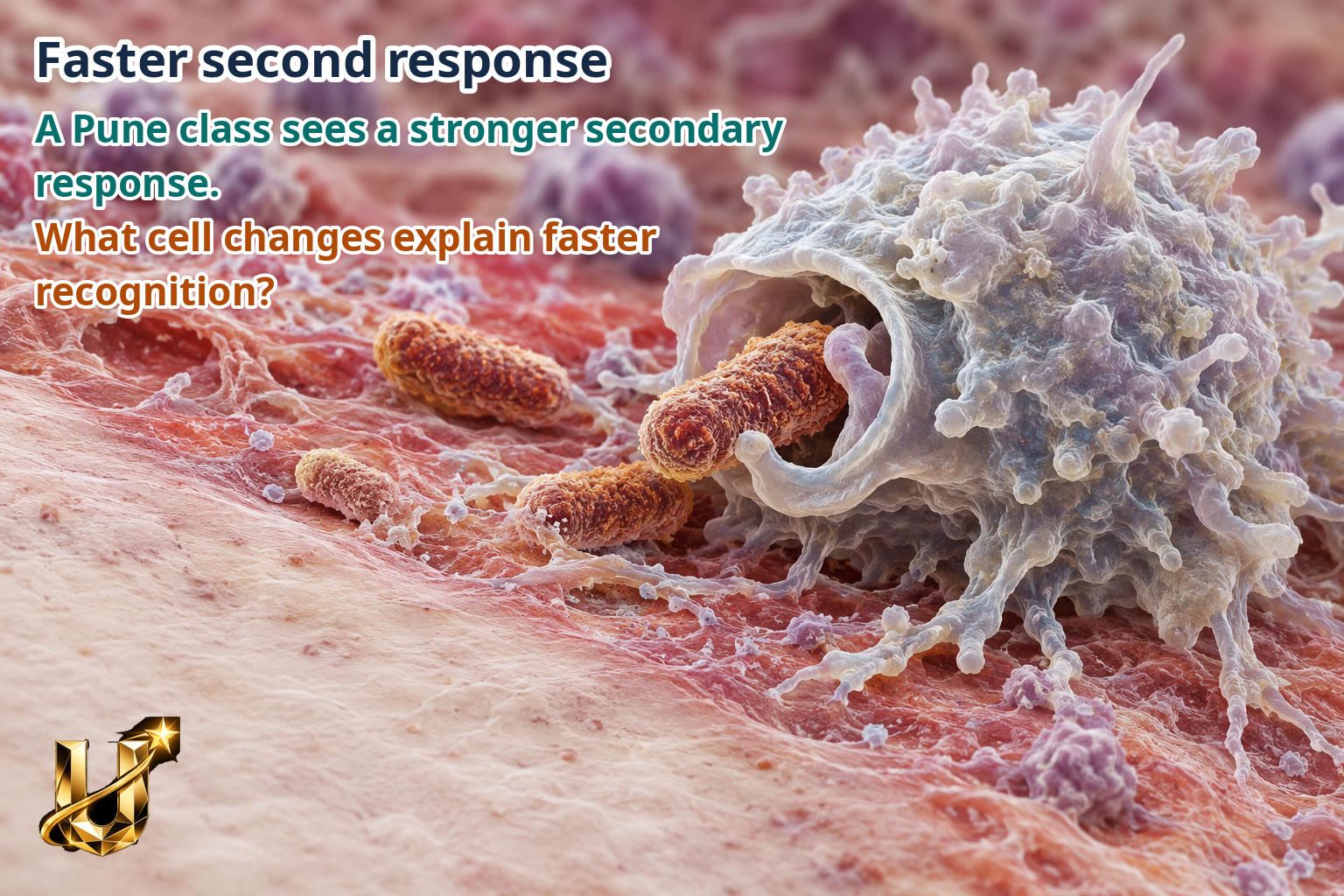
A Pune class sees a stronger secondary response in a prepared antibody graph. What cellular changes can explain faster recognition without claiming reinfection is impossible?
Working review group 4; official unit label pending
A Pune class sees a stronger secondary response in a prepared antibody graph. What cellular changes can explain faster recognition without claiming reinfection is impossible?
A molecular feature recognised specifically by an adaptive immune receptor or antibody.
Review lesson not available yet.
A Pune class sees a stronger secondary response in a prepared antibody graph. What cellular changes can explain faster recognition without claiming reinfection is impossible?
Skin, mucus and other barriers reduce entry. Innate immune cells recognise patterns of infection or damage and can trigger inflammation, phagocytosis and other responses. These responses are rapid and broad but not literally identical against every agent. Lymphatic vessels return fluid and support immune traffic; lymph nodes sample lymph andthe spleen samples blood.
Match bone marrow, thymus and lymph node.
B cells mature chiefly in?
B cells mature in bone marrow and T cells in the thymus in the standard human model. Antigen recognition can select and expand appropriate clones. Plasma cells secrete antibodies; helper T cells coordinate many responses and cytotoxic T cells can target infected cells presenting relevant antigen. Antibodies can neutralise, opsonise and engage other systems; they do not independently destroy every pathogen in the same way.
One model cell divides ten times with no loss in a simplified calculation.
Plasma cells chiefly secrete?
Adaptive memory can make a later response faster or stronger, but protection varies with pathogen, host and time. Active immunity follows the host's response to antigen; passive immunity transfers ready-made antibodies and is generally temporary. Vaccines can use several platforms, including antigen components or genetic instructions as well as attenuated/inactivated agents. Not every vaccine guarantees complete or lifelong prevention of infection.
A prepared secondary-exposure graph rises faster than the primary curve.
Match immune cells and organs to functions, then compare supplied primary/secondary curves. Classify active versus passive mechanisms without choosing treatments or sharing vaccination histories.
Innate barriers and cells interact with adaptive B/T responses. Antibodies and memory have specialised functions and limits. Active and passive protection arise through different mechanisms.