
A question from life
Enlarge image
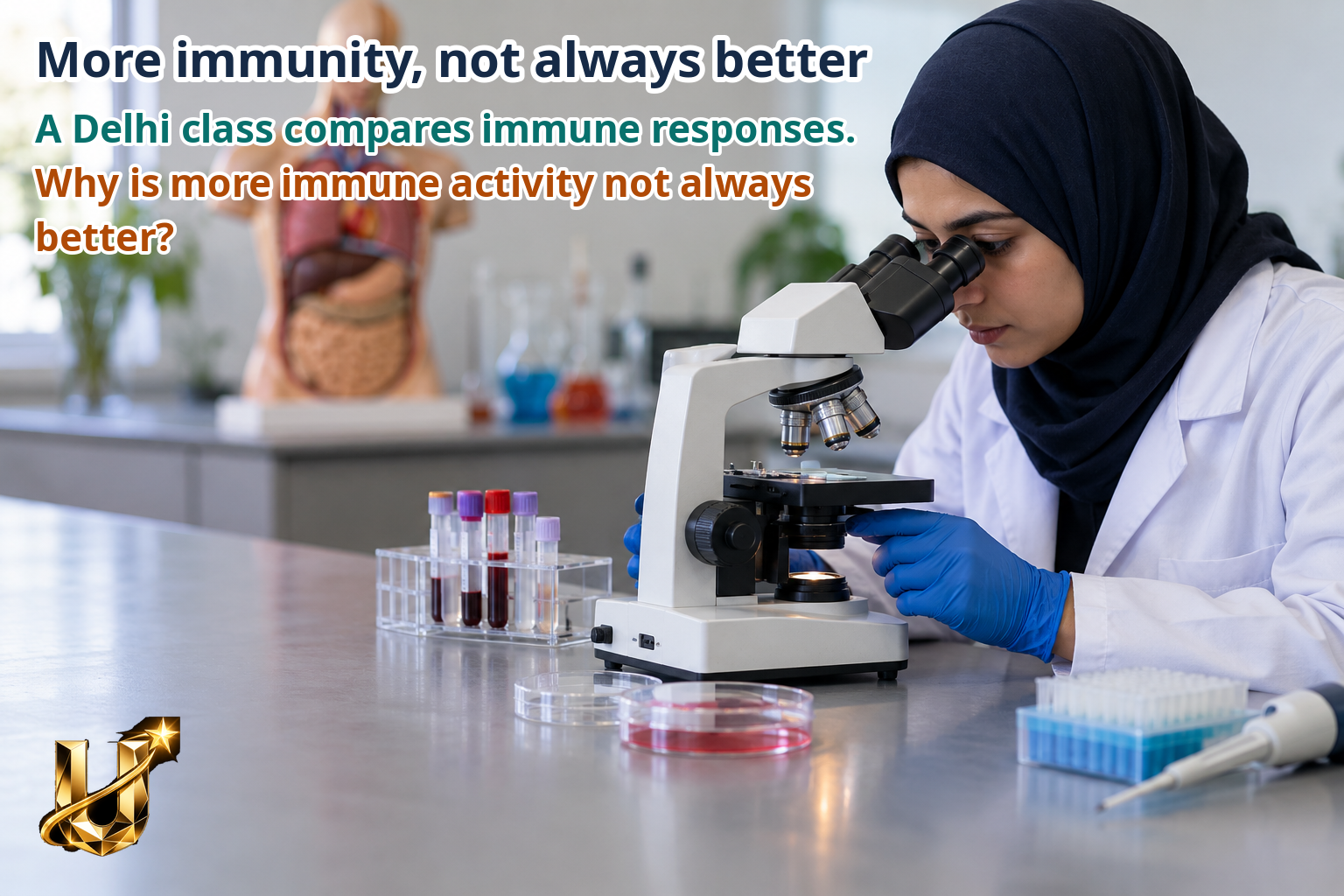
A Delhi classroom compares an immune response against a pathogen with one against a harmless trigger or self tissue. Why is more immune activity not always better?
Working review group 4; official unit label pending
A Delhi classroom compares an immune response against a pathogen with one against a harmless trigger or self tissue. Why is more immune activity not always better?
A molecular feature recognised specifically by an adaptive immune receptor or antibody.
Review lesson not available yet.
A Delhi classroom compares an immune response against a pathogen with one against a harmless trigger or self tissue. Why is more immune activity not always better?
Allergy is an inappropriate immune response to a trigger in a sensitised context; autoimmunity involves responses against self components. Immunodeficiency reduces selected defence functions. These are different mechanisms, not interchangeable labels for any illness. HIV infects important immune-cell populations; AIDS describes an advanced syndrome associated with HIV infection, not the name of the virus.
A fictional model targets a harmless pollen protein rather than a pathogen.
An immune response against self components is termed?
Cancer involves dysregulated cell proliferation and other changes that may permit invasion and spread. Mutations affecting growth-control pathways, including proto-oncogene and tumour-suppressor functions, can contribute. Benign and malignant growths differ in invasion/spread behaviour. Cancer is not one single disease, and one risk factor or mutation does not guarantee a particular outcome.
A model mutation reduces a protein that normally restrains cell-cycle progression.
HIV is?
Some psychoactive substances affect nervous-system signalling and can alter reward, judgement and physiology. Tolerance, dependence and withdrawal are related but distinct concepts; their presence and severity vary. Substance-use disorders are health conditions, not evidence of low human worth. Supportive evidence-based care and trusted help can matter; this lesson gives no instructions for use, doses or self-treatment.
A fictional description says the same exposure later produces less effect.
Sort fictional mechanism cards into allergy, autoimmunity, immunodeficiency and growth-control categories. Separate an observation from a diagnosis, and compare tolerance/dependence definitions without personal disclosure.
Immune overreaction, self-targeting and deficiency differ. Cancer involves altered growth-control biology. Substance-related adaptation needs careful, non-stigmatising interpretation rather than self-diagnosis.