
A question from life
Enlarge image
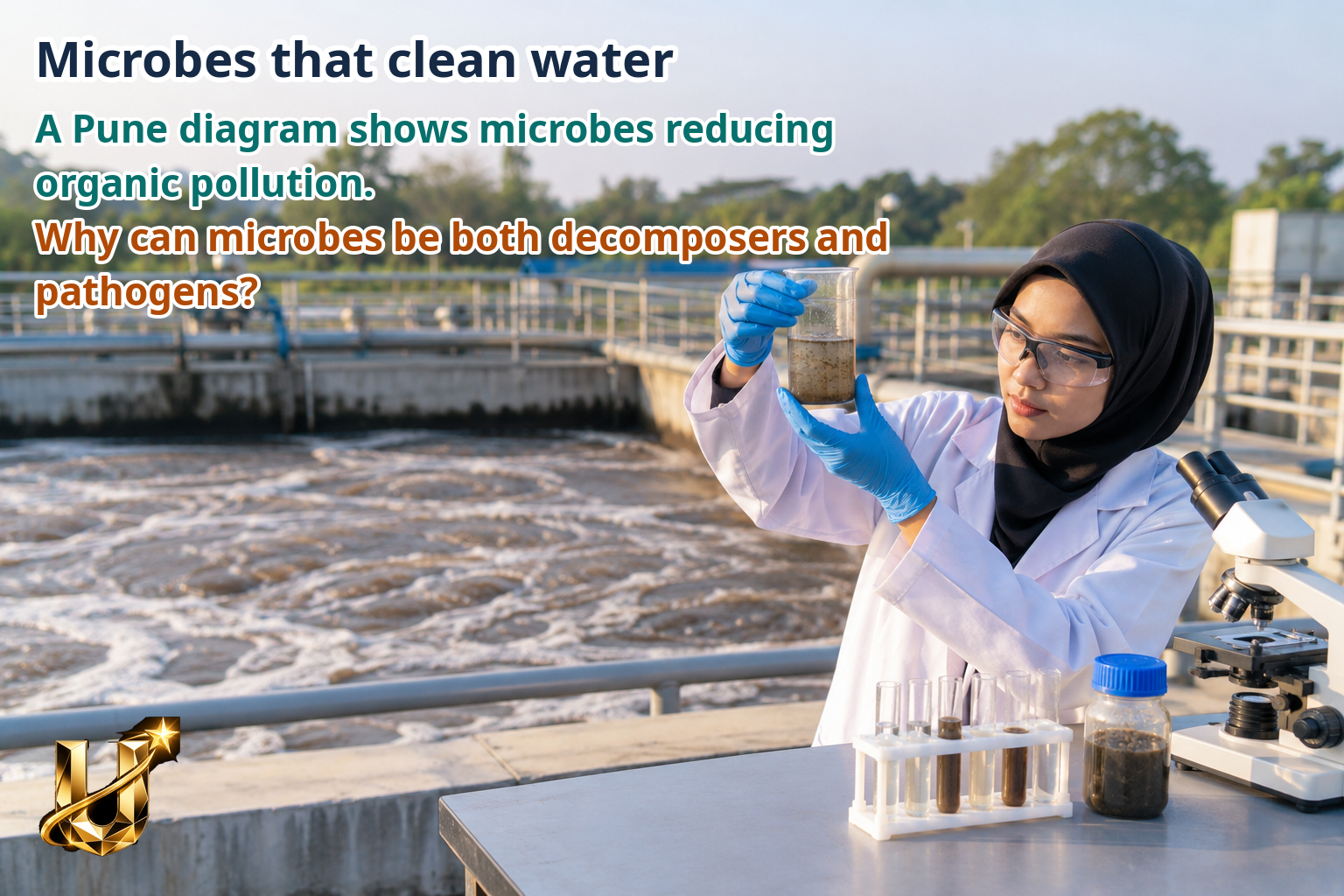
A Pune treatment-plant diagram shows microbes helping reduce organic pollution. Why can the same broad category microbes include both useful decomposers and pathogens?
Working review group 4; official unit label pending
A Pune treatment-plant diagram shows microbes helping reduce organic pollution. Why can the same broad category microbes include both useful decomposers and pathogens?
Biochemical oxygen demand: oxygen used under a defined assay by biological decomposition of organic material.
Review lesson not available yet.
A Pune treatment-plant diagram shows microbes helping reduce organic pollution. Why can the same broad category microbes include both useful decomposers and pathogens?
Primary treatment chiefly removes physical solids by processes such as settling. Secondary biological treatment uses microbial activity to reduce biodegradable organic material; activated-sludge flocs include microbes and associated material. Aeration supports appropriate aerobic activity. Lower organic load often reduces biochemical oxygen demand(BOD), but a BOD drop alone does not prove water is pathogen-free or potable.
A diagram first settles solids, then uses an aerated biological stage.
Primary wastewater treatment is chiefly?
Anaerobic communities break down suitable organic material in staged interactions. Methanogenic archaea contribute to methane formation in biogas systems. Biogas contains methane and other gases; composition and hazards depend on process conditions. Digesters and gas handling require engineered controls; the lesson uses process maps, not construction instructions.
Fictional influent BOD is200units and effluent BOD40under comparable measurement conditions.
Activated-sludge secondary treatment uses what?
Rhizobium can form nitrogen-fixing symbioses with suitable legumes; selected cyanobacteria and other microbes contribute in relevant settings. Mycorrhizal fungi can support nutrient acquisition in plant partnerships. Biocontrol uses specific biological interactions to manage pests/pathogens; it does not mean every introduced organism is safe or effective. Host compatibility, ecological effects and quality control matter.
A legume-root diagram contains compatible Rhizobium nodules.
Arrange wastewater-stage cards and calculate fictional BOD changes. Match legume/mycorrhizal relationships and identify limits ofa biocontrol claim. Do not handle wastewater, gas systems or microbial inocula.
Microbes help process organic material and support selected agricultural partnerships. BOD, reaction products and safety are different questions. Useful biological applications still require specific context and control.