
A question from life
Enlarge image
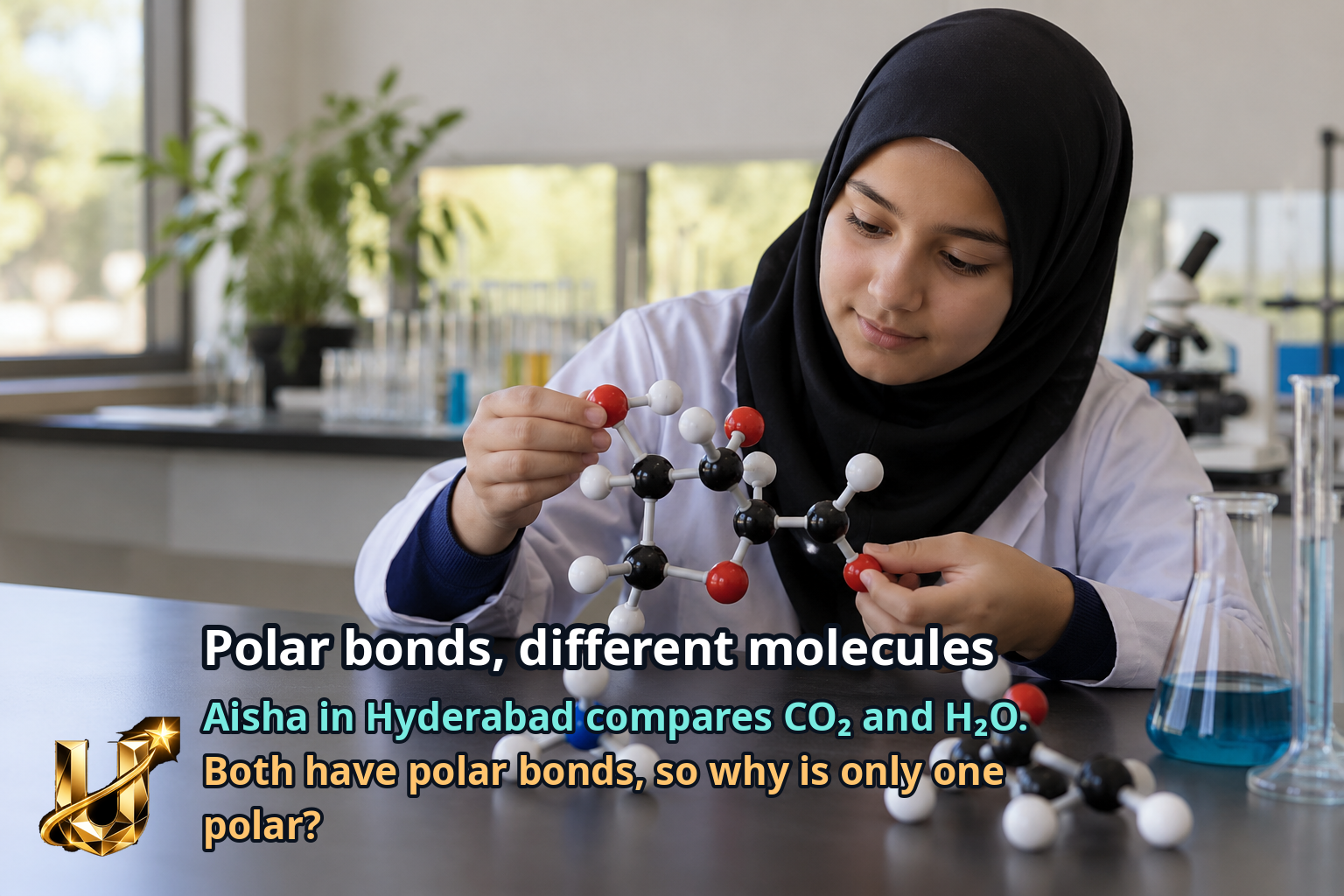
Aisha in Hyderabad compares CO₂ and H₂O. Both have polar bonds, so why is one molecule nonpolar while the other is polar?
Working review group 2; official unit label pending
Aisha in Hyderabad compares CO₂ and H₂O. Both have polar bonds, so why is one molecule nonpolar while the other is polar?
A region of bonding or lone-pair electron density counted as one unit in a VSEPR geometry model.
Review lesson not available yet.
Aisha in Hyderabad compares CO₂ and H₂O. Both have polar bonds, so why is one molecule nonpolar while the other is polar?
VSEPR uses electron-domain repulsion as a shape model. A multiple bond counts as one domain for this geometry step. Four domains give tetrahedral electron geometry; lone pairs change molecular shape, as in pyramidal NH₃ and bent H₂O.
The oxygen Lewis model has two bond pairs and two lone pairs.
How many VSEPR domains does one double bond count as?
Hybridisation is a useful localised bonding model: usual carbon in methane is sp³, ethene sp² and ethyne sp. Molecular polarity depends on both bond dipoles and geometry. Symmetric CO₂ has cancelling dipoles, while bent water does not.
CH₄, H₂C=CH₂ and HC≡CH are supplied.
What is water's molecular shape?
Molecular orbital theory distributes electrons over the molecule; bond order in the simple model is ½(bonding−antibonding electrons). Unpaired electrons can explain O₂ paramagnetism. Intermolecular forces differ from intramolecular bonds; hydrogen bonding needs suitable partners and is not the same as any H-containing molecule.
A simple MO filling has 8 bonding and 4 antibonding electrons.
Compare prepared Lewis, shape and orbital diagrams. State which model answers which question; avoid treating hybridisation as a directly photographed mixing process.
Shape models, local hybridisation and molecular orbitals serve different purposes. Geometry controls polarity, while orbital occupancy helps explain bond order and magnetism.