
A question from life
Enlarge image
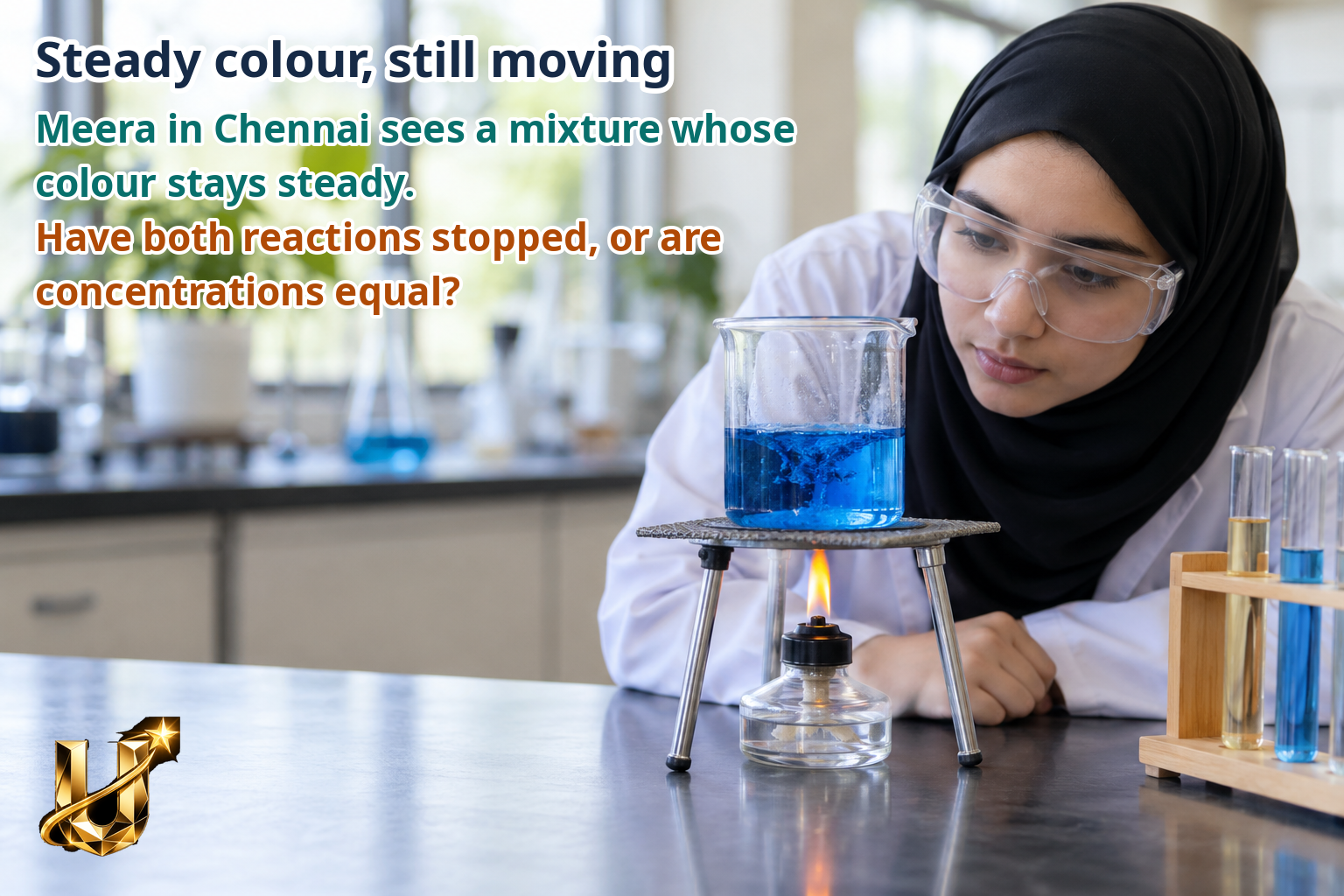
Meera in Chennai sees an equilibrium mixture whose colour stays steady. Does this mean both reactions have stopped or both concentrations must be equal?
Working review group 3; official unit label pending
Meera in Chennai sees an equilibrium mixture whose colour stays steady. Does this mean both reactions have stopped or both concentrations must be equal?
An effective concentration relative to a standard state used in thermodynamic expressions.
Review lesson not available yet.
Meera in Chennai sees an equilibrium mixture whose colour stays steady. Does this mean both reactions have stopped or both concentrations must be equal?
At equilibrium forward and reverse rates are equal while microscopic transformations continue. Concentrations remain constant under fixed conditions but need not be equal. A reversible arrow alone does not establish that equilibrium has already been reached.
A+B⇌C has equilibrium A = 0.2 M, B = 0.5 M and C = 0.4 M.
What equalises at equilibrium?
For aA+bB⇌cC+dD, a dilute-solution school expression is Kc = [C]^c[D]^d/([A]^a[B]^b) at equilibrium. Omit pure solids and pure liquids appropriately. Q has the same expression with current values; Q<K favours net forward change and Q>K reverse. Thermodynamic constants use standard-state activities.
The same equation has K = 4 and current Q = 1.
For A⇌2B, what is the concentration expression?
At fixed temperature, concentration or volume changes can shift composition without changing K for the same reaction. Temperature can change K. A catalyst speeds approach without changing equilibrium K. For ideal gases in consistent conventional forms Kp = Kc(RT)^Δn, with Δn counting gaseous product minus reactant coefficients.
N₂+3H₂⇌2NH₃ is compressed at constant T in the ideal model.
Write K and Q from phase-labelled cards and predict the direction after one specified disturbance. State temperature and ideal/dilute assumptions.
Equilibrium is dynamic. K describes a fixed-temperature equilibrium relation; Q indicates net direction, and kinetic changes must be kept separate.
Formative extension: for a fixed dilute ideal-gas sample,pressure times volume is proportional to absolute temperature. At constant temperature,pressure varies inversely with volume; at constant pressure,volume varies directly with temperature. Real gases deviate because molecules occupy space and interact. High pressure and low temperature often make these deviations important; condensation is outside a simple ideal-gas model.
An ideal gas at constant temperature changes from two litres to one litre with amount fixed. Compare its absolute pressure.
Halving volume at fixed amount and temperature in the ideal model makes pressure: