
A question from life
Enlarge image
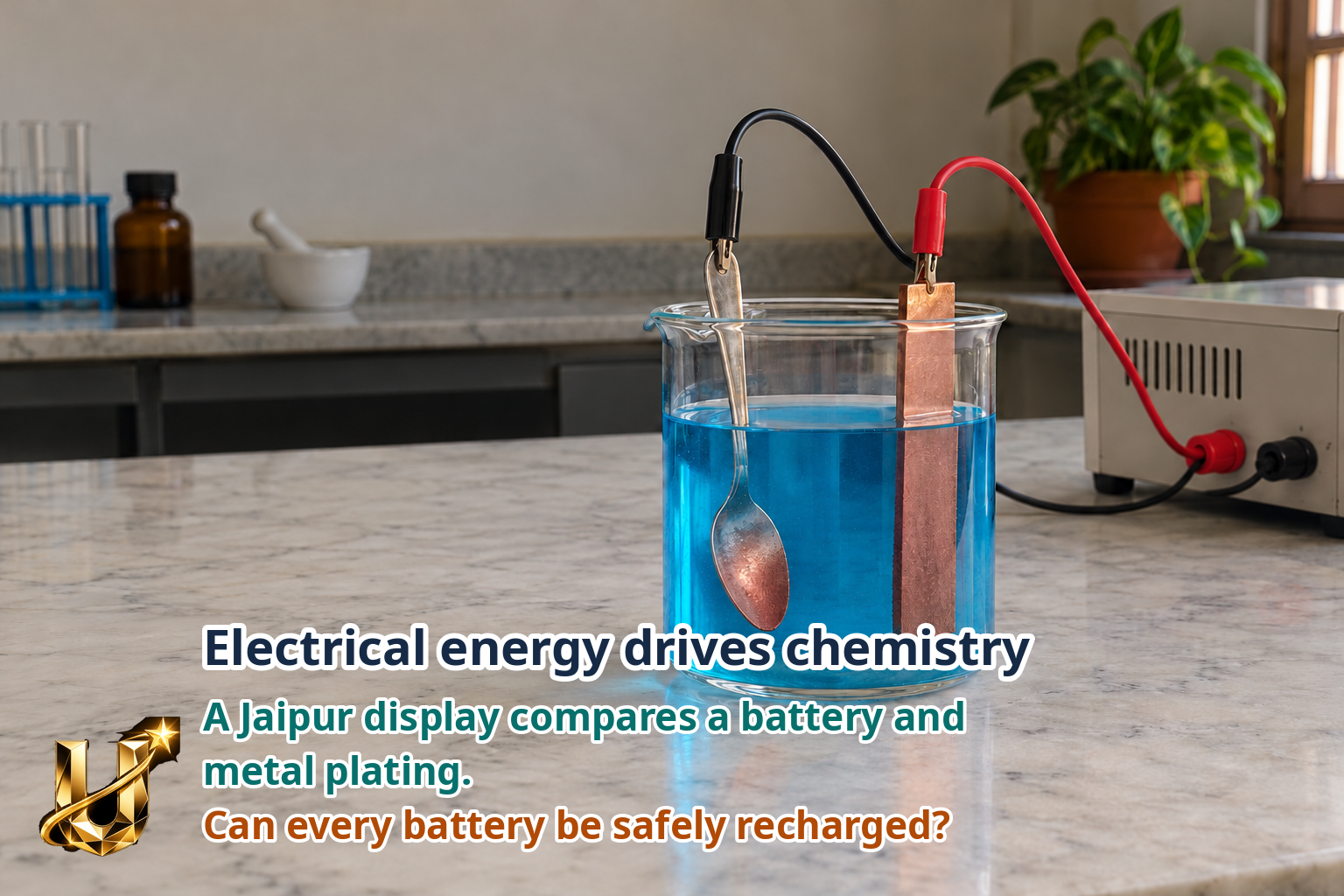
A Jaipur display compares a rechargeable battery with a metal-plating model. In both, electrical energy can drive chemistry, but can every battery safely be recharged?
Working review group 1; official unit label pending
A Jaipur display compares a rechargeable battery with a metal-plating model. In both, electrical energy can drive chemistry, but can every battery safely be recharged?
A potential measured relative to a reference that describes an electrode’s redox tendency under stated conditions.
Review lesson not available yet.
A Jaipur display compares a rechargeable battery with a metal-plating model. In both, electrical energy can drive chemistry, but can every battery safely be recharged?
An electrolytic cell uses external energy to drive a nonspontaneous net reaction. Oxidation remains at the anode and reduction at the cathode; in the basic externally driven cell the anode is positive, cathode negative. Product selection depends on species, concentration, electrode material and overpotential. Molten NaCl and aqueous NaCl need not give the same cathode product.
I=2.0A, t=965s, M(Cu)=63.5g/mol, Cu²⁺+2e⁻→Cu; assume100% efficiency.
In a basic electrolytic cell, cathode reaction is?
Passed chargeQ=It. One mole of electrons carriesF≈96500C/mol. Ifn electrons deposit one formula unit and current efficiency is100%, deposited massm=MIt/(nF). Balance the electrode half-reaction to find n. Competing reactions reduce the fraction of current producing the desired substance.
A model battery requires12V nominal from2V nominal cells in aiding series.
Charge carried by one mole of electrons is approximately?
Primary cells are not designed for recharging; secondary cells are designed for controlled reversible operation. Lead-acid discharge converts Pb and PbO2 to PbSO4 while consuming sulfuric acid. A hydrogen–oxygen fuel cell yields water in its net reaction, but environmental impact also depends on hydrogen production and the wider system. Iron corrosion is an electrochemical oxidation promoted by suitable moisture/oxygen conditions; coatings, galvanisation and cathodic protection interrupt different parts of the process.
A plating calculation predicts1.00g at100% current efficiency, but only80% of charge produces that deposit.
Balance electrode equations and calculate deposits from prepared current-time records. Compare labelled primary/secondary/fuel-cell diagrams and corrosion-prevention cards. Do not open, recharge unknown cells or electrolyse salts at home.
Electrolysis obeys charge accounting and electrode definitions. Faraday mass calculations require a balanced electron count and efficiency assumption. Batteries, fuel cells and corrosion have distinct mechanisms and limits.