
A question from life
Enlarge image
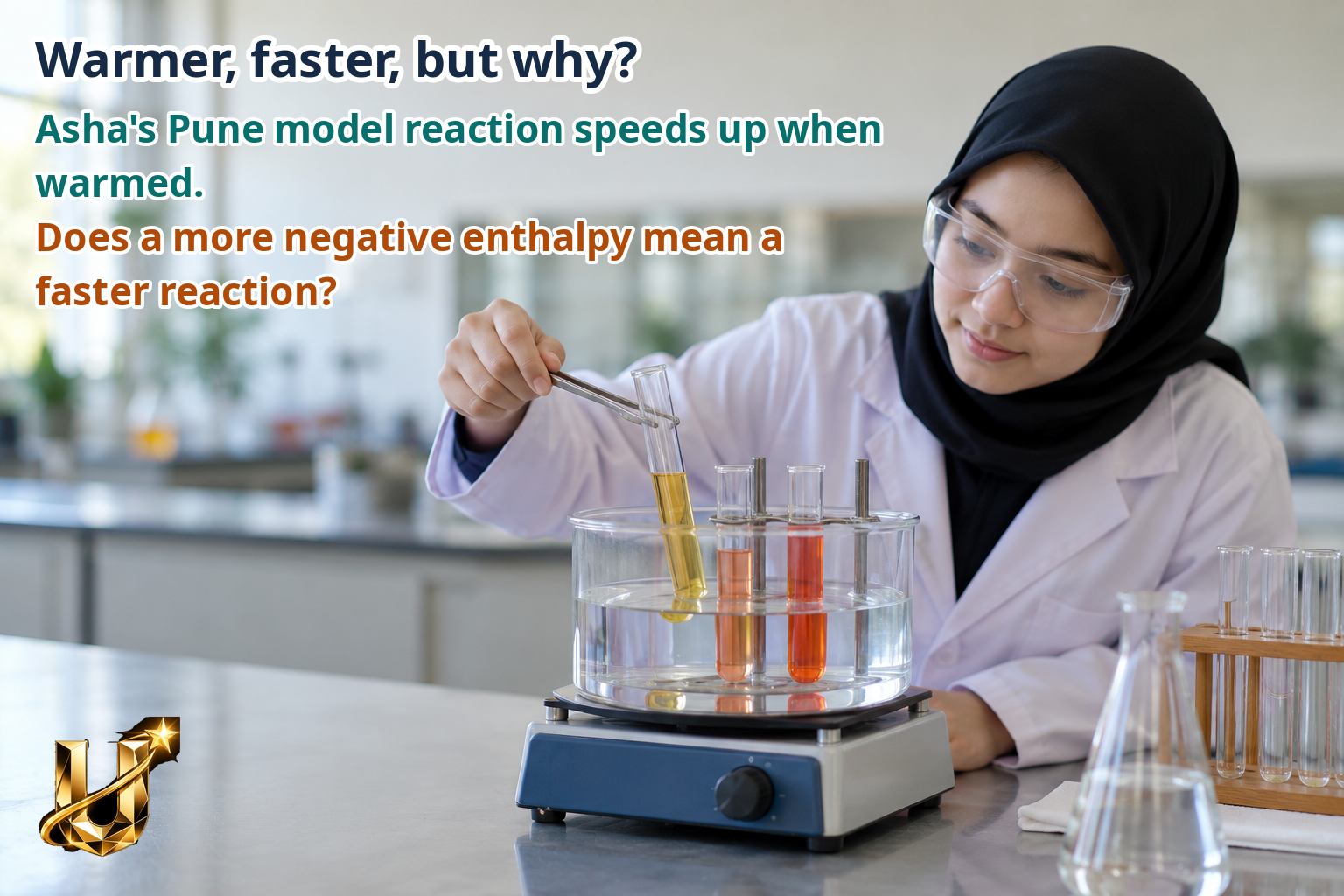
Asha's Pune model reaction speeds up when warmed. Does a more negative reaction enthalpy automatically mean a faster reaction?
Working review group 2; official unit label pending
Asha's Pune model reaction speeds up when warmed. Does a more negative reaction enthalpy automatically mean a faster reaction?
An experimentally determined exponent or sum of exponents in a rate law.
Review lesson not available yet.
Asha's Pune model reaction speeds up when warmed. Does a more negative reaction enthalpy automatically mean a faster reaction?
Collision theory requires sufficient energy and suitable orientation for productive encounters in an elementary model. Activation energy Ea is the barrier from reactants towards a transition state; reaction enthalpyΔH compares products and reactants. An exothermic reaction may still be very slow if its pathway has a large barrier.
Reactants are20kJ/mol, transition-state peak70 and products−10.
A catalyst changes which quantity in its alternative pathway?
A common temperature model isk=Ae^(−Ea/RT), where A is a pre-exponential factor and T is Kelvin. A plotlnk versus1/T has slope−Ea/R when Ea andA are approximately constant. Two-temperature form: ln(k2/k1)=(Ea/R)(1/T1−1/T2). The rule that rate doubles every10K is not universal.
A model ln k-versus1/T line has slope−6000K. UseR=8.314Jmol^-1K^-1.
The T in Arrhenius's equation is?
A catalyst supplies an alternative pathway with a lower effective barrier and is regenerated overall; it can participate in intermediate steps. At a fixed temperature it does not changeΔH,ΔG° or the equilibrium constant; it accelerates approach to equilibrium in both directions. Surface area matters for heterogeneous reactions, and concentration effects follow the measured law rather than a universal doubling rule.
Take Ea/R=6000K, T1=300K and T2=330K, with A and Ea assumed constant.
Read a prepared energy profile and identify Ea, reverse Ea andΔH. Compare ln k-versus1/T data and state which assumptions justify a straight line. Discuss catalyst and controlled-variable cards without performing heating experiments.
Rate depends on barriers and effective encounters. Arrhenius analysis needs Kelvin and consistent energy units. Catalysts change pathways and approach times, not equilibrium thermodynamics.