
A question from life
Enlarge image
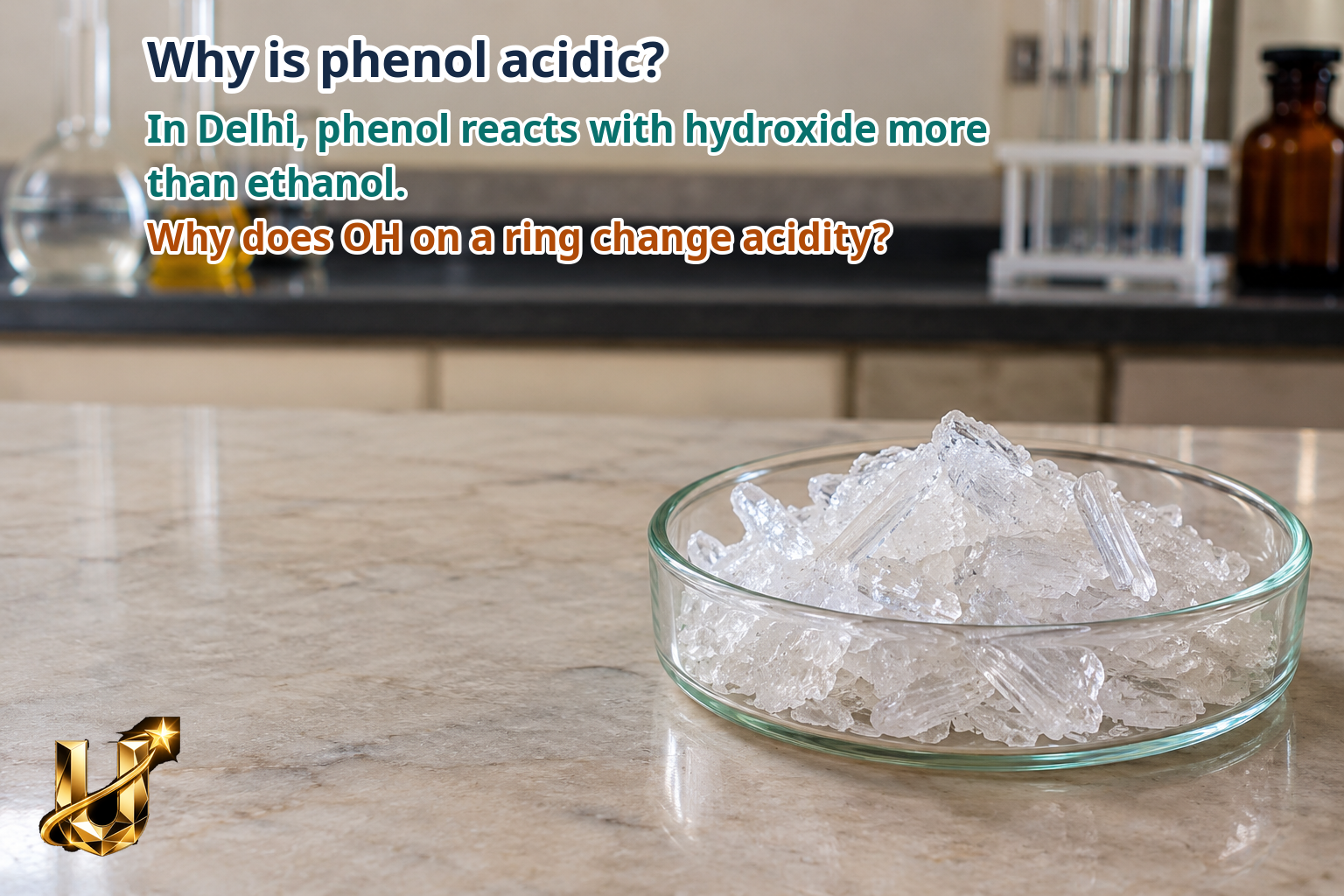
In a Delhi model comparison, phenol reacts with aqueous hydroxide more readily than ethanol. Why does attaching OH directly to an aromatic ring change acidity?
Working review group 4; official unit label pending
In a Delhi model comparison, phenol reacts with aqueous hydroxide more readily than ethanol. Why does attaching OH directly to an aromatic ring change acidity?
The species formed when an acid loses a proton.
Review lesson not available yet.
In a Delhi model comparison, phenol reacts with aqueous hydroxide more readily than ethanol. Why does attaching OH directly to an aromatic ring change acidity?
Phenol has OH directly attached to an aromatic carbon. Its conjugate base, phenoxide, has charge delocalisation involving the oxygen and ring, so phenol is more acidic than typical aliphatic alcohols. Phenol remains a weak acid in water; strength is not judged by tasting or touching.
Compare C6H5OH with C6H5CH2OH.
Which is a phenol?
C6H5OH+OH⁻⇌C6H5O⁻+H2O favours phenoxide formation under suitable basic conditions. Phenol is generally too weak to liberate appreciable CO2from bicarbonate under the usual school comparison, whereas many carboxylic acids do. Substituents affect acidity: electron-withdrawing groups can stabilise the conjugate base; position and other effects matter.
9.4gphenol, molar mass94g/mol, reacts with NaOH in a1:1model.
Phenol's conjugate base is?
The OH group generally activates electrophilic substitution at ortho/para positions. Bromine-water records may show2,4,6-tribromophenol under the specified conditions; different media change selectivity. Kolbe–Schmitt chemistry maps phenoxide plus CO2towards an ortho-hydroxycarboxylic product after work-up; Reimer–Tiemann chemistry maps phenol towards an ortho-hydroxyaldehyde under suitable conditions. These are conceptual reaction maps, not practical instructions.
Explain typical phenol-versus-ethanol acidity.
Compare phenol and benzyl-alcohol cards, then draw resonance contributors of phenoxide using valid electron bookkeeping. Discuss supplied reaction records rather than handling phenol, bromine or concentrated base.
Direct ring attachment distinguishes phenol. Phenoxide stabilisation explains its weak acidity relative to common alcohols. Ring substitution is activated with condition-dependent selectivity.