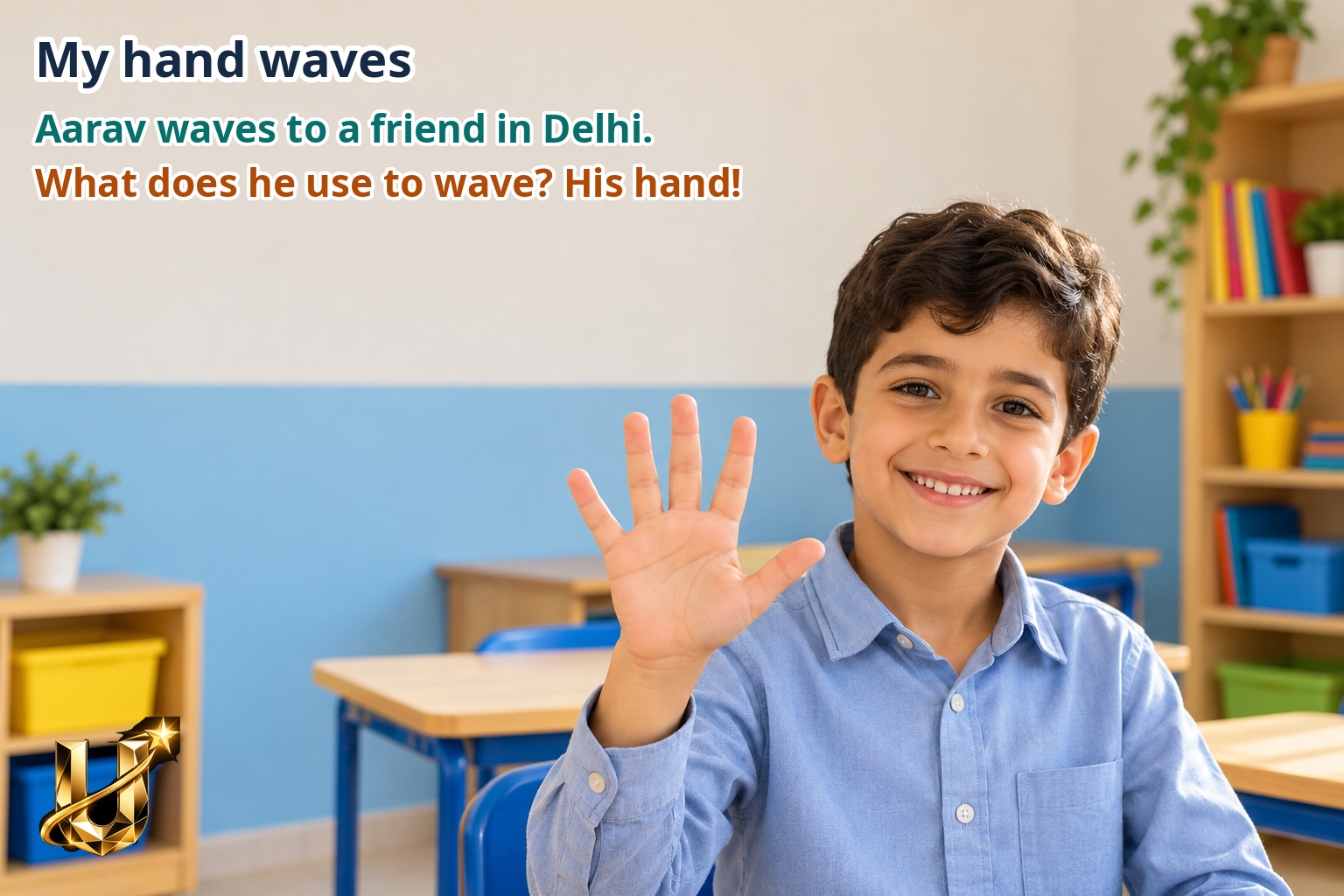
What helps you wave?
Open Two Little Hands in your student book with an adult. First use this reading explanation and application. The later original examples practise language separately. Separate original practice context: Aarav meets a friend in Delhi. He waves. What does he use to wave?
Read the book: Two Little Hands
The book’s action song links parts of the body with clapping, tapping, looking, listening, smelling and speaking. Repeated action sounds give it a beat. Follow the words in your book. You may name, imagine or choose a comfortable action instead of copying every movement.
Practise with the book
Connect the action words to the song.
- Clap names the action linked with hands.
- Tap names a repeated beat; listen to the word’s sound.
- An adult can help you point to a word while saying it.
Name body parts
Hand. Foot. Eye. Ear. Mouth. Listen, point to your own body, and say each word. You may watch or name the parts without moving them. Listen to this new chant: Clap and tap. Clap and tap. Tap and clap. The words clap and tap rhyme because their ending sounds match. Say the chant or mark its beat comfortably.
Example 1: One body part
Aisha points to one hand. What does she say?
- Point to one hand.
- Say: hand.
- A hand can wave.
Name an action
We can clap with our hands. We can hear with our ears. We can see with our eyes. People do things in different ways; choose a comfortable action.
Example 2: A word with an action
Aarav hears a bell. Which body word matches hearing?
- Listen to the word hear.
- Choose ear.
- Say: I hear with my ears.
Listen and choose
Which body part can wave?