Read an original practice text
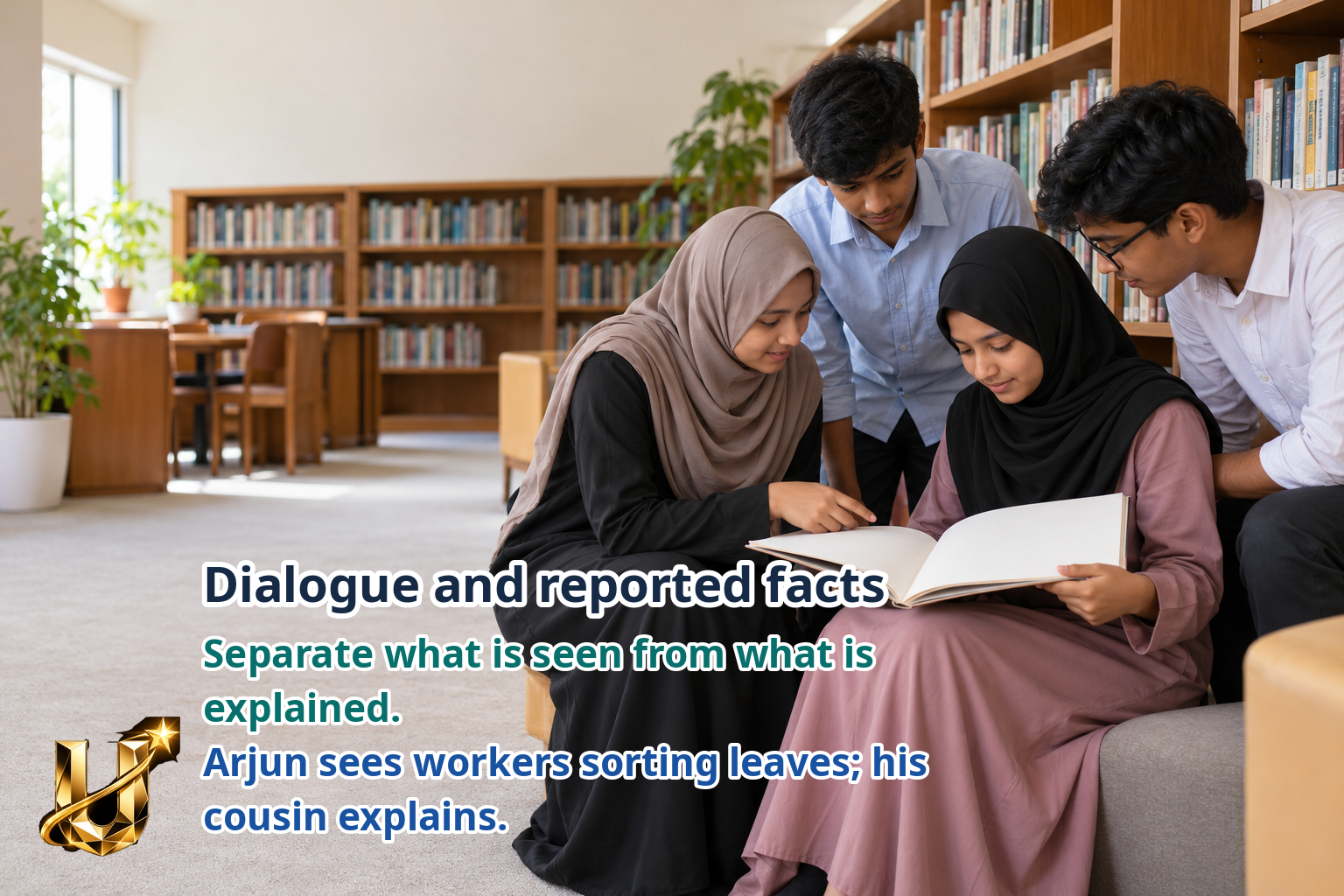
In an original Guwahati practice dialogue, Arjun points to workers sorting leaves. His cousin explains a process she has studied. Arjun notices that sorting and packing happen at different tables, but he has not watched the earlier stages.
The reading skill
A travel conversation can combine direct observation with information supplied by another speaker. Identify the source of each claim and avoid presenting second-hand information as something the narrator witnessed.
Example 1: Locate evidence
First identify a detail stated in the practice text.
- Read the practice passage again.
- Select the explicit detail: Arjun sees sorting and packing at different tables.
- Keep this observation separate from an explanation of its significance.
Control the scope of a claim
Track who knows each detail and how they know it. Arjun has not witnessed the earlier stages. A claim about the actual named textbook piece requires reading that piece; this practice scene is not its plot.
Example 2: Make a supported inference
Explain what the detail suggests, then show why your wording is appropriately limited.
- Locate the words supporting the interpretation in the original passage: In an original Guwahati practice dialogue, Arjun points to workers sorting leaves. His cousin explains a process she has studied. Arjun notices that sorting and packing happen at different tables, but he has not watched the earlier stages.
- Explain what they suggest: The scene separates observed work from his cousin's explanation.
- Keep the conclusion within what these words establish.
Check 1
Which is a directly stated action or textual detail, rather than an interpretation?
Example 3: Evaluate a response
A reader writes: Arjun personally witnessed everything his cousin describes. Evaluate and improve this response using the practice passage.