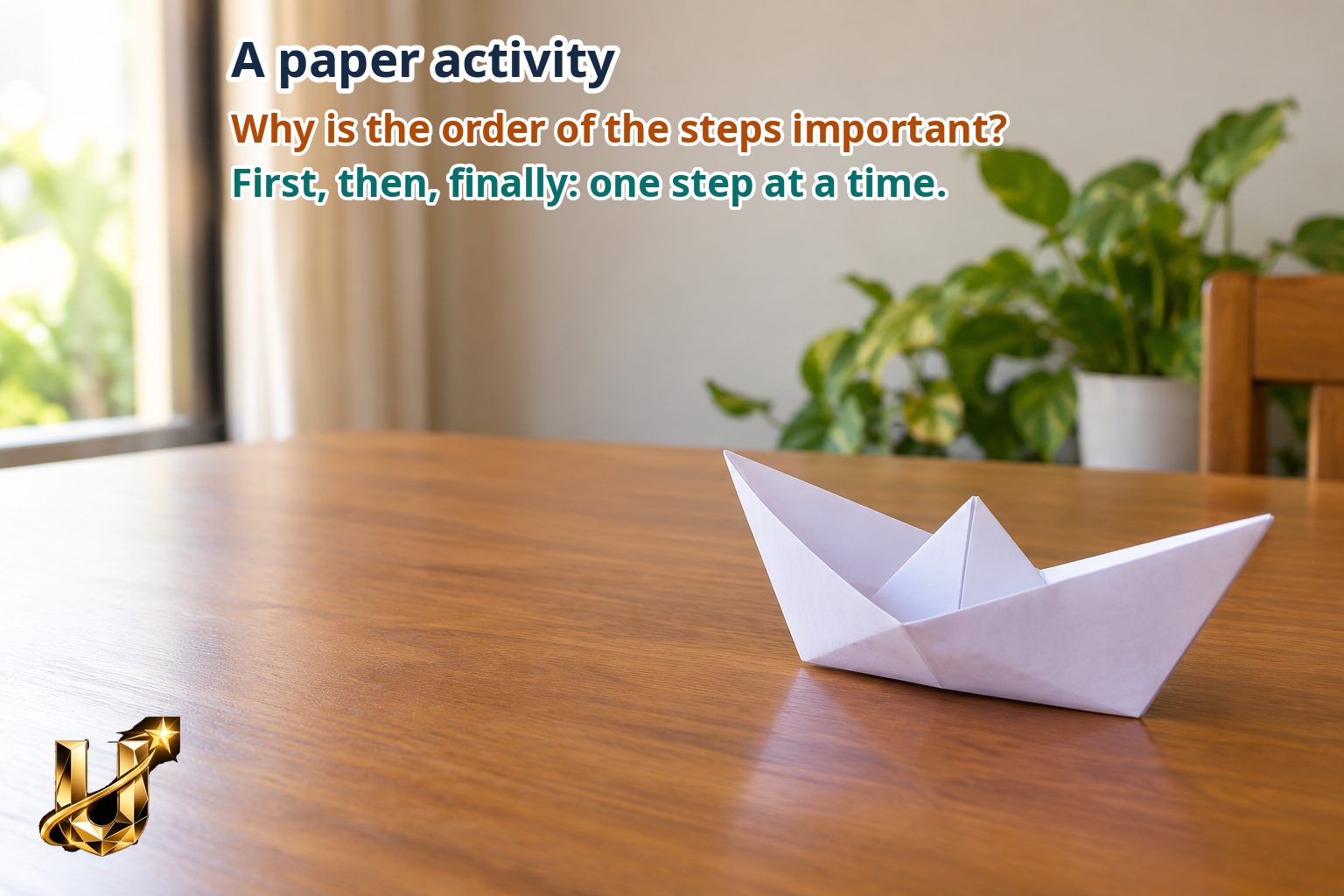
A paper activity
Open Paper Boats in your student book with an adult. First use this reading explanation and application. The later original examples practise language separately. Separate original practice context: Aisha and an adult make a simple paper shape at a Chennai table. The adult gives one instruction at a time. Why is the order of the steps important?
Read the book: Paper Boats
Meena enjoys floating paper boats, but a boy overturns them. She tells him to stop. When he says he wants to join but cannot make a boat, she teaches him. Both then enjoy their own boats. Overturn means turn over; delighted means very pleased. Cooperation follows a boundary and a request, not acceptance of destroying someone else’s play.
Practise with the book
What makes the change from conflict to shared play possible?
- Meena explains that the boy’s fun damages her boats.
- He agrees to stop and asks for help.
- Her teaching gives him a way to participate without spoiling her activity.
Instruction words
Take a sheet. Fold it. Press the fold. These sentences start with action words and tell someone what to do. An instruction can be short without naming you.
Example 1: Find the action
Take a sheet.
- The first word is Take.
- It tells the action.
- A sheet names what to take.
Order the steps
First, take a sheet. Then, fold it in half. Finally, press the fold. This is a three-step folding-language activity, not a complete boat-making method. These three steps make one fold, not a whole boat. It can replace one clear thing: The boat is on the table. It is small. They can replace more than one: The boats are in a box. They are dry. In, on and under tell positions.
Example 2: Put steps in order
You cannot press a fold before you make it.
- Take the paper first.
- Fold it next.