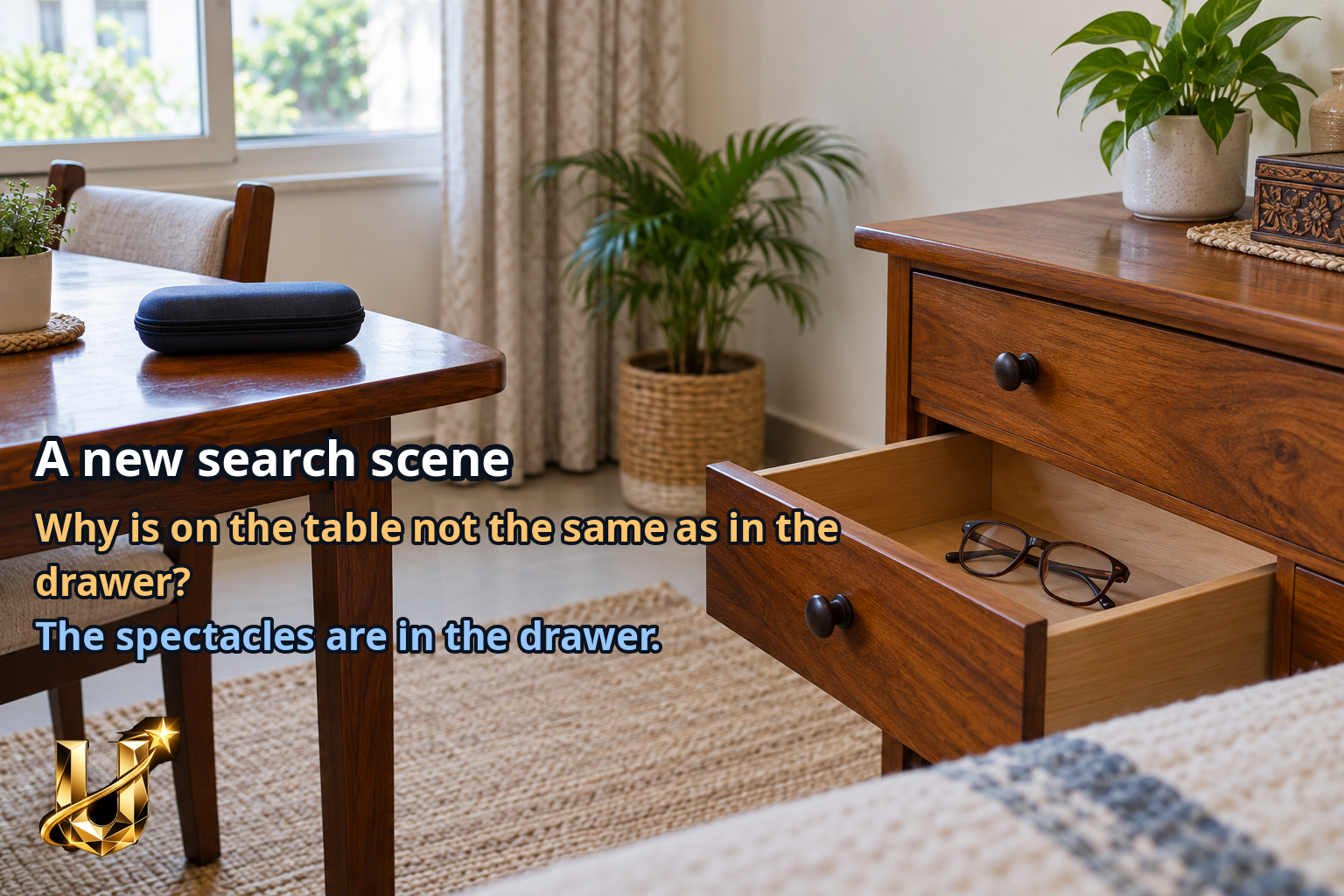
A new search scene
Open Papa’s Spectacles in your student book with an adult. First use this reading explanation and application. The later original examples practise language separately. Separate original practice context: At a Delhi home, Meera helps an adult look for spectacles. A case lies on the table, but the spectacles are inside a drawer. Why is on the table not the same as in the drawer? This is a new scene, not a retelling of the textbook poem.
Read the book: Papa’s Spectacles
The poem follows Papa searching for the spectacles he needs for everyday activities. He checks pockets, beneath a chair and near a window, while the child notices they are on his head. Spectacles means glasses worn to help vision; glanced means looked briefly. The ending is funny because the sought object is close to the searcher but outside his attention.
Practise with the book
How does the ending change our understanding of the search?
- Papa has looked in several possible places.
- The child finds the glasses on Papa himself.
- The surprise concerns an overlooked location, not proof that the spectacles were stolen or moved by someone else.
Match a place word to a relation
In means inside an area or container. On commonly shows contact with a surface. Under shows a lower position. Behind shows a position at the back of something from the stated viewpoint. Say both the object and its reference.
Example 1: Inside a container
The spectacles lie inside a closed drawer in our scene.
- Name the object: spectacles.
- Name the container: drawer.
- Say: The spectacles are in the drawer.
Use between and check the evidence
Between names a relation to two stated things in our simple arrangement: The case is between a book and a cup. Do not guess an object's place from a title or from where it is usually kept. Use the actual scene. Homophones sound alike but have different meanings: see and sea. Spell each word and use its meaning in a sentence; listening alone cannot distinguish the spellings.