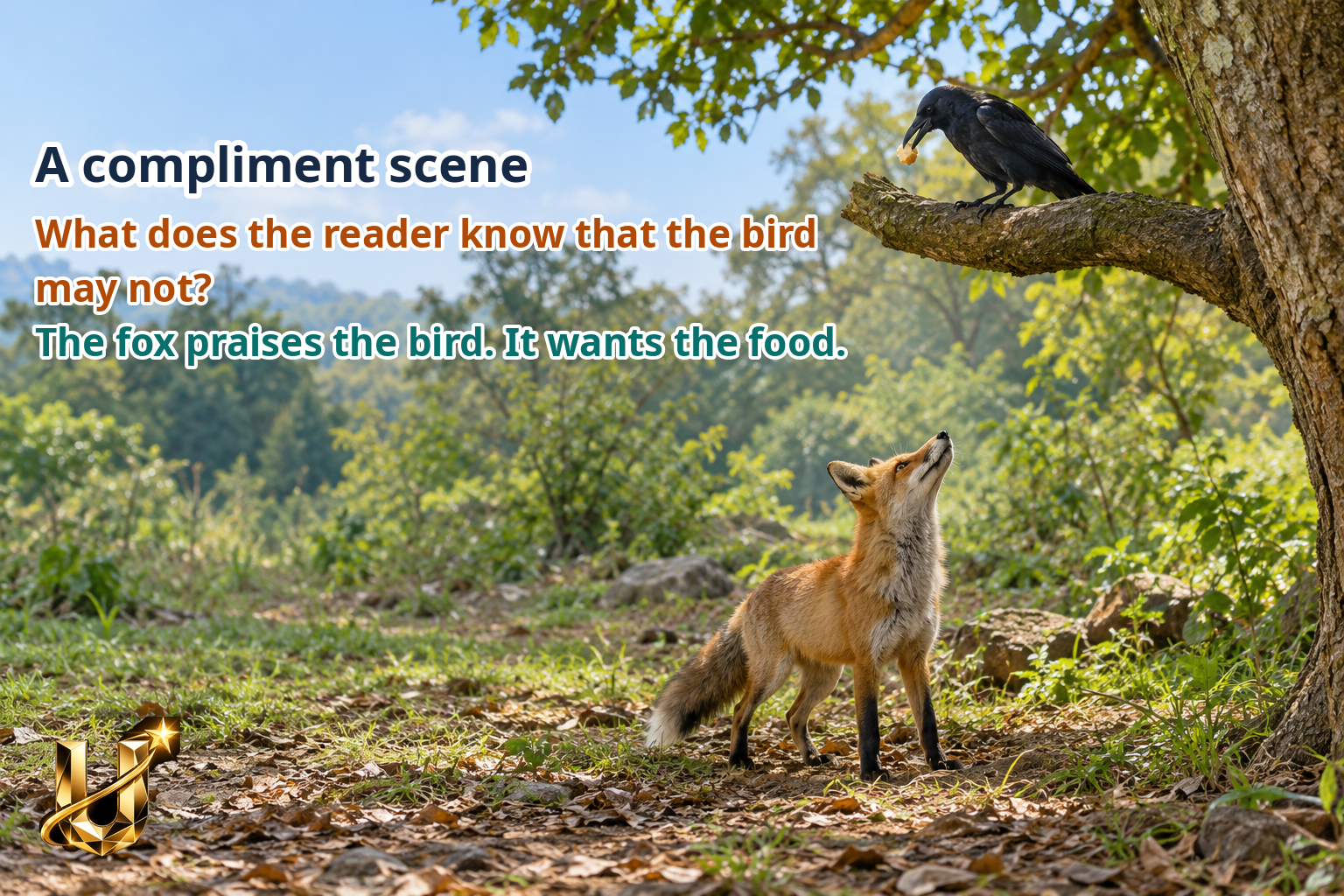
An original compliment scene
Open The Raven and the Fox in your student book with an adult. First use this reading explanation and application. The later original examples practise language separately. Separate original practice context: In a new animal fable, a fox praises a bird's singing while looking at the food held in its beak. The narrator tells us the fox wants the food. What does the reader know that the bird may not realise?
Read the book: The Raven and the Fox
Reynard praises a raven holding food. The flattered bird opens its beak to sing and loses the morsel. The verse exposes praise used for selfish gain. Perched means resting above ground; a morsel is a small piece of food.
Practise with the book
How does the fox's plan work?
- Praise encourages the bird to sing.
- Opening its beak releases the food.
Infer motive from more than speech
A compliment can be sincere or strategic. Here, the narrator states the fox's desire. The praise and its attention to the food show a gap between polite words and the stated aim.
Example 1: Identify the stated motive
The narrator says the fox wants the food.
- This motive is directly stated.
- Do not treat it as merely a guess.
- Use it to interpret the praise.
Reader and character knowledge
Dramatic irony occurs when the audience knows something important that a character does not. In this scene, the reader is told the fox's aim while the bird hears flattering praise. Giving an animal human speech is personification. Fox and box rhyme; kind and unkind contrast in meaning. A rhyme scheme labels matching line-ending sounds with the same letter. Alliteration repeats initial sounds, as in bright blue.
Example 2: Compare knowledge
The bird hears a compliment.
- The reader also knows the fox's aim.
- The knowledge differs.
- This difference can create dramatic irony.