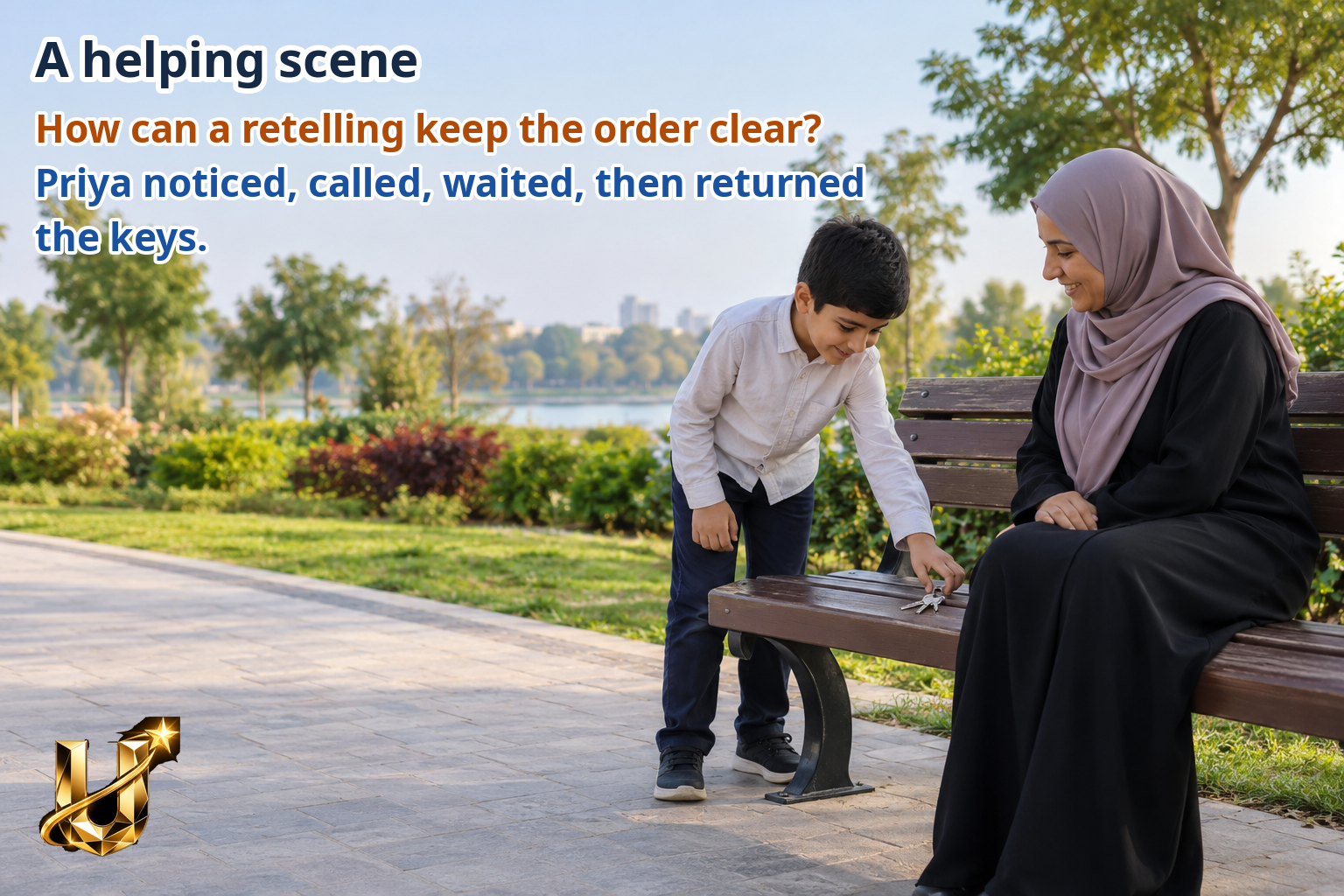
An original helping scene
Open Rama to the Rescue in your student book with an adult. First use this reading explanation and application. The later original examples practise language separately. Separate original practice context: In a new Lucknow practice story, Priya noticed a neighbour's keys beside a bench. She called the neighbour, waited, and returned the keys. How can a retelling keep this order clear?
Read the book: Rama to the Rescue
In this Tamil Nadu comic folktale, a couple notice a thief. Their pretended conversation about naming a future child lets them call Rama increasingly loudly. Rama, the village kotwal, hears and arrests the intruder. Kotwal names the local guard.
Practise with the book
Why does the conversation have two audiences?
- The thief hears an apparently ordinary discussion.
- The guard hears his own name and responds.
Use the simple past for finished events
Noticed, called, waited and returned describe completed actions. Time links show sequence: first, then, afterwards and finally. A retelling should preserve the actual order.
Example 1: Summarise in order
Retell the practice scene.
- First, Priya noticed the keys.
- Then she called and waited.
- Finally, she returned them.
Use before and after carefully
Priya called the neighbour before returning the keys. She returned them after the neighbour arrived. The word order of a sentence is not always the event order; read the time relationship. She is waiting uses is plus an ing form for an action in progress now. Quickly describes manner. A contraction shortens words: I will becomes I'll; we are becomes we're. An apostrophe marks the omitted letters here. Where are the keys? is a question; What a surprise! is an exclamation.
Example 2: Interpret before
She called before she returned the keys.
- The call comes earlier.
- The return comes later.