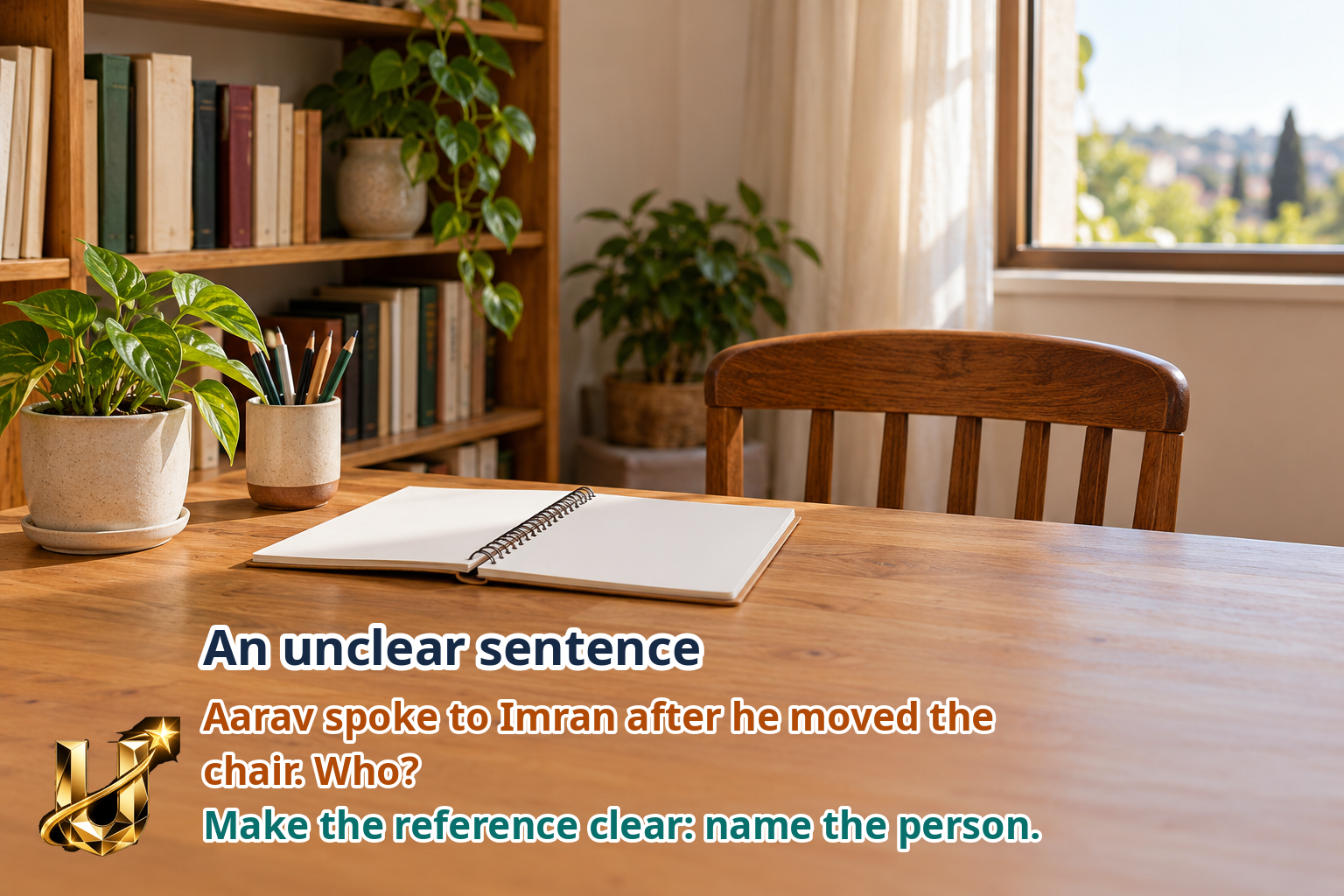
An unclear sentence
Open The Chair in your student book with an adult. First use this reading explanation and application. The later original examples practise language separately. Separate original practice context: In a new Pune note, Aarav spoke to Imran after he moved the chair. Who moved it? The sentence alone may not tell us. How can the writer make the reference clear?
Read the book: The Chair
Mario boasts of many friends. His grandfather's invisible-chair challenge reveals Guneet, Asma and Deepa holding him up while others laugh. The supposed magic is practical support. Invisible means unseen; companions share company but may not offer dependable care.
Practise with the book
What supports Mario at the end?
- Three children physically hold him.
- Their action, rather than a visible chair, demonstrates care.
Find the antecedent
An antecedent is the earlier word or phrase a pronoun refers to. Aisha brought a chair. She placed it by the table. She refers to Aisha; it refers to a chair. Check meaning as well as grammatical number.
Example 1: Track she
Aisha brought a chair. She smiled.
- The person named is Aisha.
- She refers back to Aisha.
- The reference is clear in this short example.
Repair ambiguity
If two people could fit he, repeat the intended name: Aarav spoke to Imran after Imran moved the chair. Repeating a name can be clearer than forcing a pronoun. They can refer to a clearly named group. A suffix follows a base: care plus ful makes careful. A careful friend pairs an adjective with a noun. A suffix can change meaning or word class; not every word can take every suffix. An acrostic arranges selected letters, often line initials, to spell a word.
Example 2: Track it
Aisha placed it by the table.
- Use the previous sentence's chair.
- It refers to the chair.