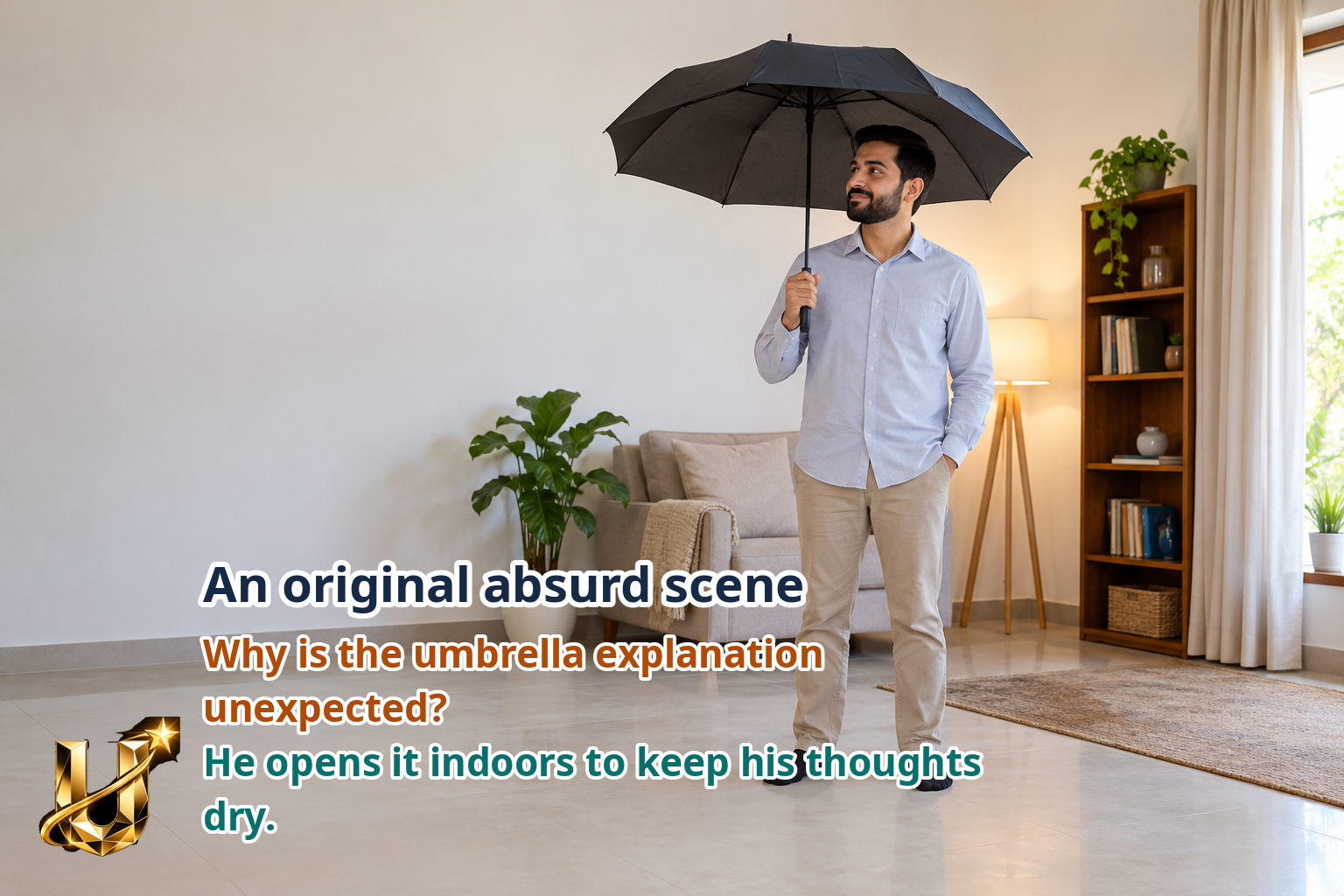
An original absurd scene
Open A Funny Man in your student book with an adult. First use this reading explanation and application. The later original examples practise language separately. Separate original practice context: A fictional man opens an umbrella inside a quiet room and says he wants to keep his thoughts dry. Why is the explanation unexpected rather than ordinary weather information?
Read the book: A Funny Man
Natalie Joan's man reverses hats and shoes, offers a bun as a rose, and hops on his head. Polite manners contrast with absurd actions; mixed sensory descriptions heighten the nonsense. A currant is a small dried grape; staggered means moved unsteadily.
Practise with the book
Why is the offering surprising?
- He names a flower.
- He presents food instead.
Notice the usual expectation
An umbrella ordinarily protects a person from rain. Thoughts are not physical objects that get wet like clothing. The invented scene mixes an everyday object with an impossible purpose.
Example 1: State the expectation
What is an umbrella usually for?
- Protection from rain is the relevant expectation.
- Name that ordinary use.
- Do not invent a different scene.
Explain incongruity
Incongruity is a mismatch between what is expected and what happens. Here, the unexpected purpose may create humour. A response should identify the exact mismatch, not merely say it is funny. A phrasal verb combines a verb with a particle: take up drawing means begin it; take off a coat means remove it; take after someone means resemble them. Context chooses the meaning. Inversion changes usual word order for an effect. A conventional limerick has five lines with matching ending sounds in lines one, two and five, and in lines three and four.
Example 2: Find the surprise
The man wants to keep thoughts dry.
- Thoughts are not wet clothing.
- The purpose breaks the ordinary expectation.