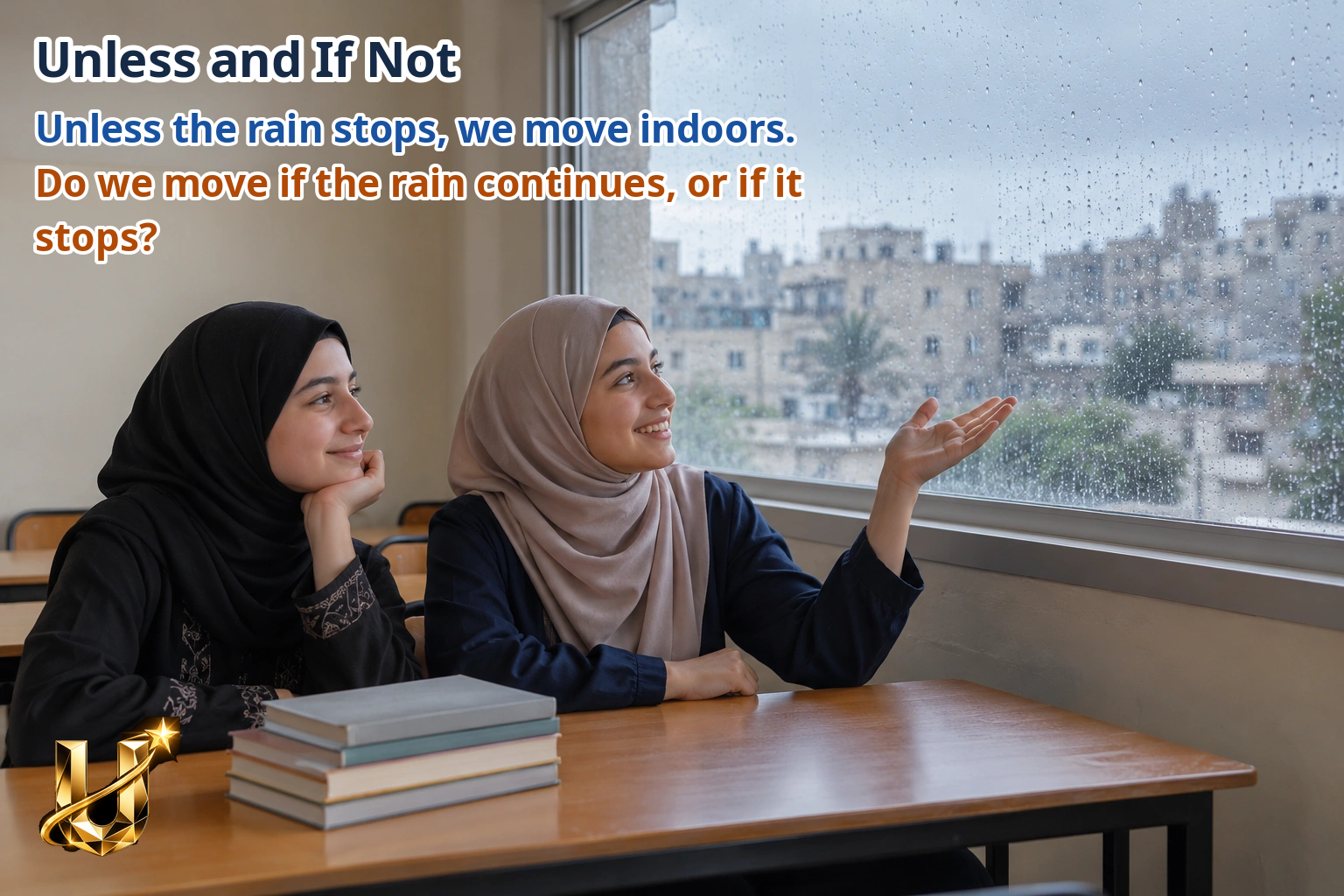
An original event plan
Open Waiting for the Rain in your student book with an adult. First use this reading explanation and application. The later original examples practise language separately. Separate original practice context: A fictional Kochi class note says, Unless the rain stops, we will move the drawing activity indoors. Does this mean the class moves indoors if the rain continues, or if it stops?
Read the book: Waiting for the Rain
Farmer Velu fears drought. An older woman's image of land resting changes his attitude; gathering rain ends the story hopefully. Nature becomes a caring mother in her speech. Dejected means discouraged. The metaphor is not a scientific explanation of drought.
Practise with the book
What changes before the weather?
- Velu begins reconsidering his relationship with the land.
- The conversation reshapes his emotional viewpoint.
Unless sets a negative condition
In this example, unless the rain stops means if the rain does not stop. The stated result, moving indoors, follows if rain continues. Do not reverse the condition by ignoring the negative meaning.
Example 1: Rewrite the condition
Unless the rain stops.
- Use if ... not in this example.
- If the rain does not stop.
- Keep the same result clause.
A conditional plan is not a forecast
The note explains what the class will do under a condition. It does not predict with certainty whether rain will stop. Distinguish the decision rule from information about what weather will actually occur. It rains states a general pattern; It is raining describes a current event; It has rained connects a past event with the present. Determiners specify a noun: this cloud, my notebook, two drops, some water, each learner. See and sea are homophones, distinguished by meaning and spelling.
Example 2: Apply the stated plan
The rain continues in the imagined case.
- The stopping condition has not occurred.