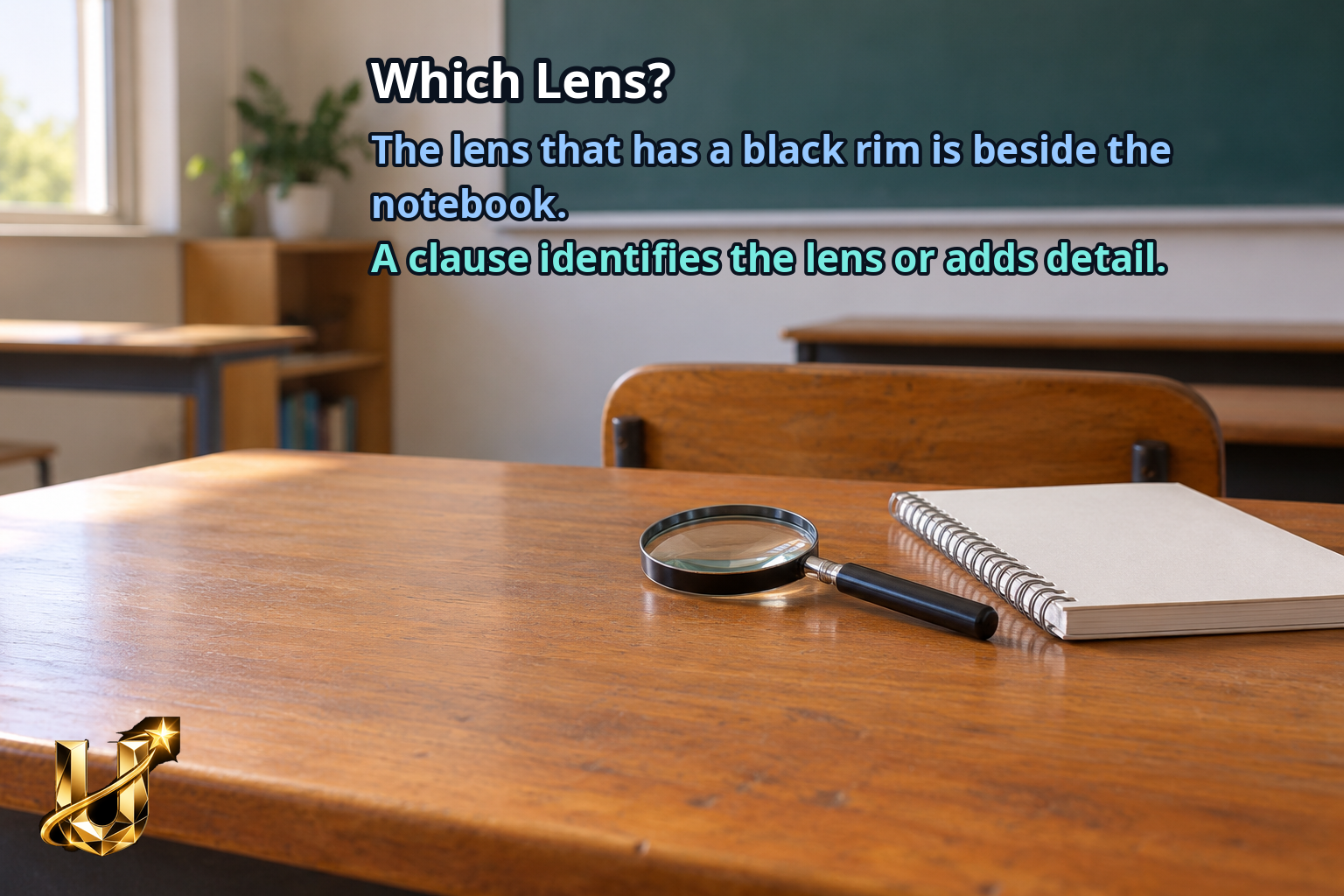
Which lens?
Open Magnifying Glass in your student book with an adult. First use this reading explanation and application. The later original examples practise language separately. Separate original practice context: An original table description says, The lens that has a black rim is beside the notebook. Another says, This lens, which has a black rim, is beside the notebook. How does a clause help identify an object or add information about one already indicated?
Read the book: Magnifying Glass
Walter de la Mare's speaker finds astonishing detail in chalk, moss, water and a spider, then imagines the moon seeming nearer. Comparisons enlarge familiar scenes. Myriad means very many; deft means skilful. Apparent nearness does not shorten physical travel.
Practise with the book
How does magnification affect the voice?
- Small objects inspire expanding comparisons.
- The tone communicates curiosity and wonder.
A defining clause helps identify
The lens that has a black rim identifies which lens is meant. Removing the clause can remove information needed to distinguish it from other lenses. Who can introduce a clause about a person: the learner who wrote the note.
Example 1: Identify an object
The lens that has a black rim.
- The clause narrows the reference.
- It helps choose the intended lens.
- Treat it as defining in this example.
An additional clause can add information
This lens, which has a black rim, is beside the notebook uses commas for additional information about this indicated lens. Interpret the whole sentence and punctuation; do not assume which always has only one use in English. A flock of birds uses a collective noun. Keep an eye on means watch or monitor in a suitable context. The suffix ish can form adjectives such as childish. Fine and vine begin with different sounds: an adult can model the airflow and voice contrast. A simile compares with like or as; alliteration repeats initial sounds.
Example 2: Add a detail
This lens, which has a black rim, ... .