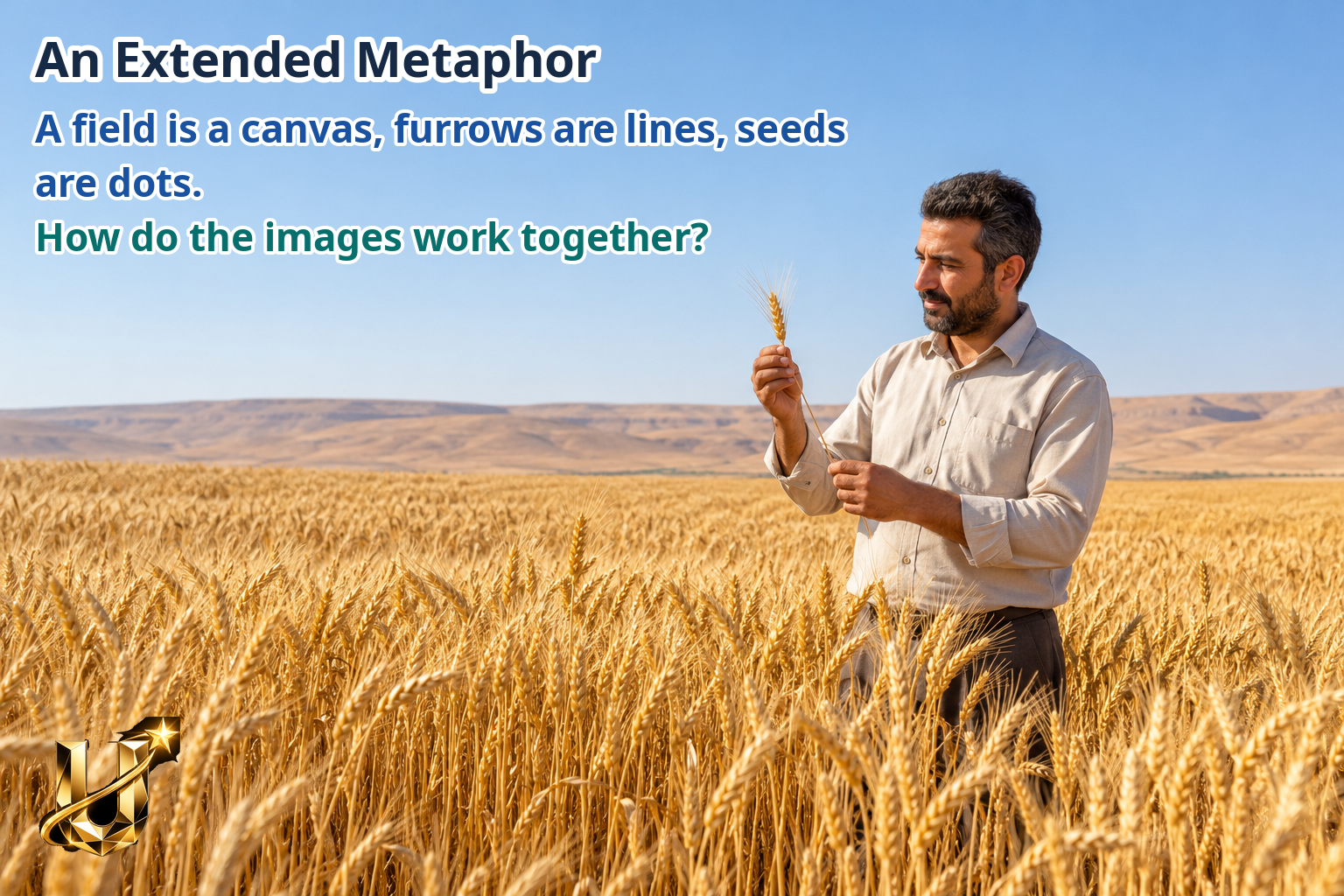
An original image sequence
Open Canvas of Soil in your student book with an adult. First use this reading explanation and application. The later original examples practise language separately. Separate original practice context: A new practice description calls a field a canvas, furrows lines, and scattered seeds dots in a design. How do the images work together rather than as three unrelated comparisons?
Read the book: Canvas of Soil
Maya Anthony compares a garden with a painting: seeds become brushstrokes, plots become canvases and blossoms provide colour. Gardeners connect art with living growth. Tilling means working soil. The extended metaphor celebrates cultivation without making plants literal paint.
Practise with the book
How does the central comparison develop?
- Seeds introduce imagined brushstrokes.
- Coloured flowers complete the garden-as-art image.
An extended metaphor develops one mapping
A metaphor presents one thing through another. An extended metaphor carries that comparison across several related details. Here, field-to-canvas, furrows-to-lines and seeds-to-dots connect farming imagery with an artistic design.
Example 1: Find the main mapping
The field is called a canvas.
- Field is the described thing.
- Canvas is the comparison image.
- This sets up an art-related frame.
Explain links and limits
Name each mapping and what it highlights, such as arrangement or creative care. Do not treat the metaphor as a literal claim that soil is painted cloth, or assume every element in the scene has a stated artistic counterpart. An article uses a title, byline, focused opening, linked points with relevant support and a closing. A literal statistic and a metaphor play different roles: a metaphor may illuminate experience without measuring a yield.
Example 2: Trace a related detail
Furrows are described as lines.
- The detail continues the art frame.