Similar people, different grammar
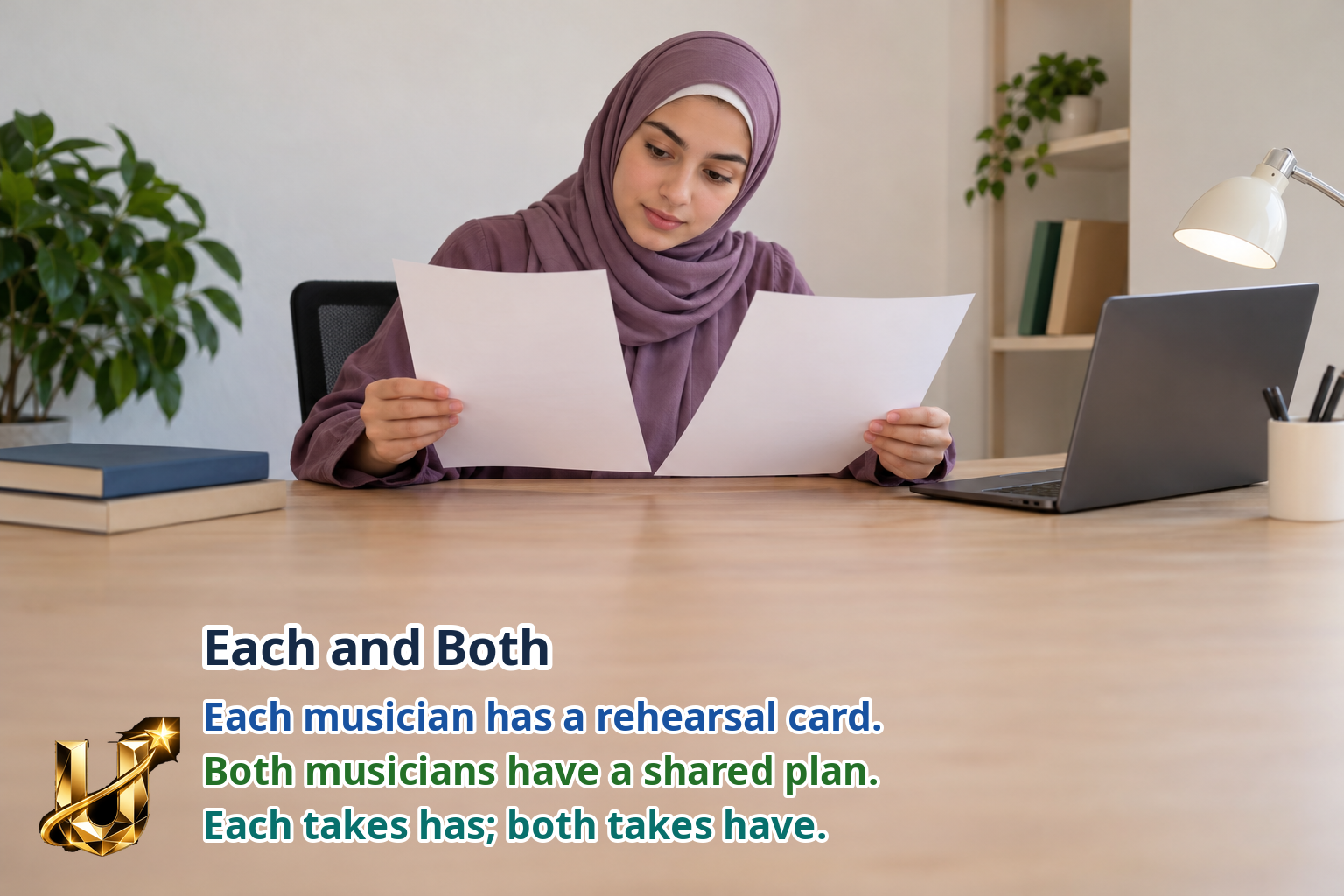
Open A Friend Found in Music in your student book with an adult. First use this reading explanation and application. The later original examples practise language separately. Separate original practice context: An original club note says, Each musician has a rehearsal card. Both musicians have a shared plan. Why does the verb change from has to have?
Read the book: A Friend Found in Music
Bryanna T. Perkins presents music as ocean, rhythm, comfort and a dependable friend. Repeated openings link bodily feeling with emotional support. Feeling blue means feeling sad. The therapy metaphor describes the speaker's experience, not a clinical treatment guarantee.
Practise with the book
Why call music a friend?
- It accompanies both happiness and difficulty.
- Personification makes emotional support seem companionable.
Find the grammatical subject
Each musician is treated as singular in the taught pattern, so use has. Both musicians is plural, so use have. Do not choose the verb solely from the general idea that a club contains many people.
Example 1: Agreement with each
Each musician has a card.
- Each points to members individually.
- The subject pattern is singular.
- Use has.
Do not let an inserted phrase distract
Each musician in the two groups has a card. The phrase in the two groups does not change each musician into a plural subject. Find the subject's head rather than the nearest plural word. Determiners specify a noun: a musician, the named musician, this card, my plan, two cards, some music, each learner. Each musician has a card; both musicians have cards. A nearby plural modifier does not change the singular head in each musician in the groups.
Example 2: Agreement with both
Both musicians have a plan.
- Both includes two members together.
- The subject is plural.