
A question from life
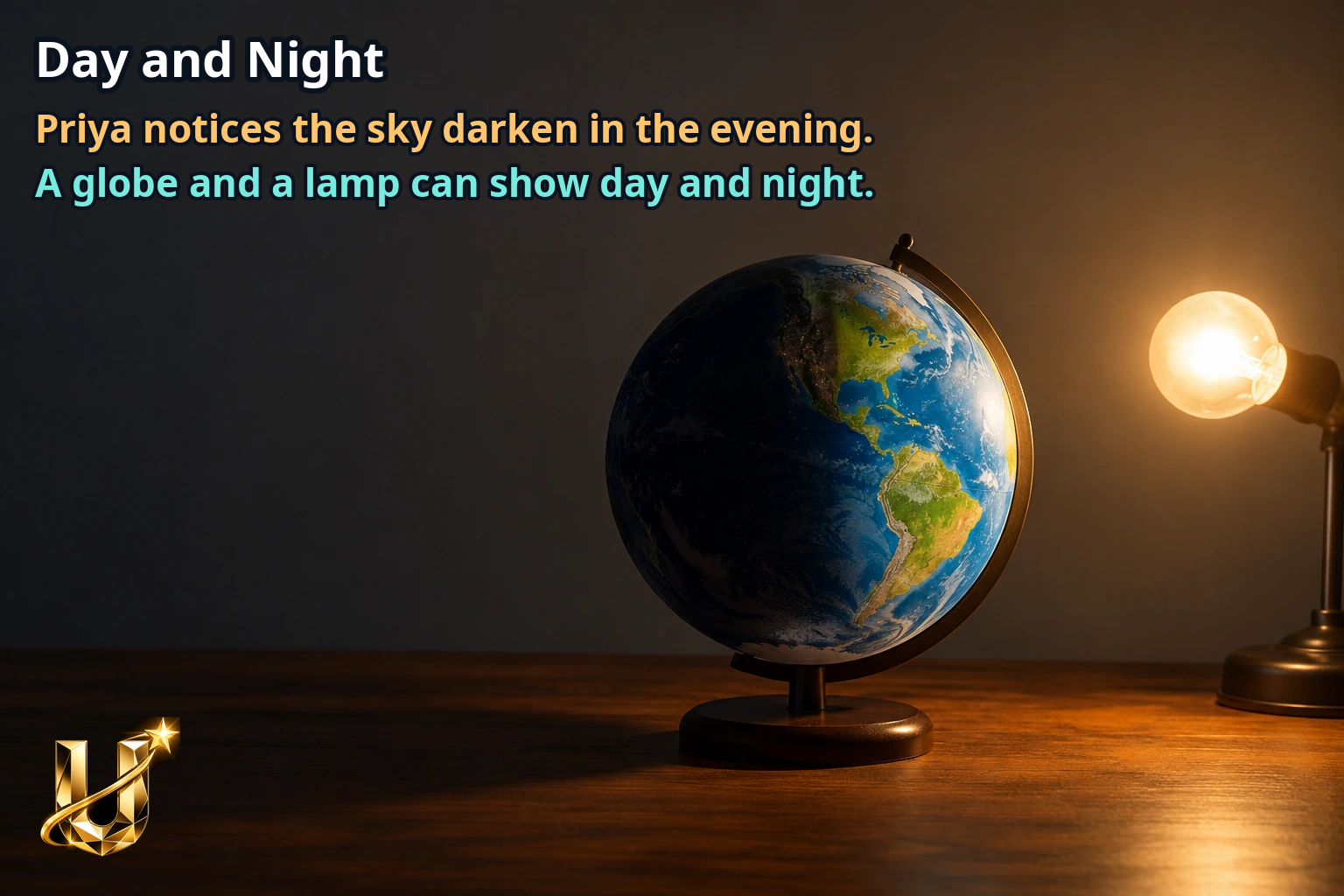
Enlarge image
In Delhi, Priya notices the sky darken in the evening and the Moon look different on different nights. Did the Sun switch off, or is something moving?
Unit 5: Things Around Us
In Delhi, Priya notices the sky darken in the evening and the Moon look different on different nights. Did the Sun switch off, or is something moving?
A region where an object blocks light from reaching a surface.
Review lesson not available yet.
In Delhi, Priya notices the sky darken in the evening and the Moon look different on different nights. Did the Sun switch off, or is something moving?
Earth rotates about its axis. The side facing the Sun has daylight, while the side turned away has night. A full rotation takes about a day. The Sun does not switch off each evening.
An adult shows a globe beside a safe room light and turns it. A marked place moves from light into shade. What does it represent?
Day and night are mainly explained by:
The Moon reflects sunlight rather than making its own light. As it travels around Earth, the part of its sunlit half visible to us changes. These are phases. Ordinary phases are not caused by Earth's shadow.
Aarav sees a crescent and later a fuller Moon. Has the solid Moon changed into a different shape?
The Moon is visible because it:
Record dates, times and what the sky looks like from an adult-approved safe place. The Moon may be visible in daytime too. Never look directly at the Sun through eyes, binoculars, a telescope or an improvised device; use approved indirect educational images or models.
Meera sees the Moon in a pale afternoon sky. Must her record be wrong?
With an adult, view an approved Moon image or a safe globe model indoors. Describe the visible lit portion or day/night position. No direct Sun viewing or rooftop observation.
Earth's rotation explains day and night. The Moon reflects sunlight, and its phases change what we see of the lit half. Use safe images and careful records.
Chandrayaan is India's series of missions to study the Moon. A lander reaches and operates on the surface; a rover can move across a small part of it. Chandrayaan-three's Vikram lander reached the lunar surface on the twenty-third of August, two thousand and twenty-three, and its Pragyan rover was deployed. Their instruments collected measurements; these are spacecraft, not living explorers.
Distinguish Vikram and Pragyan in the Chandrayaan-three mission.
What distinguishes a rover from a lander in this example?