
A question from life
Enlarge image
Priya in Pune draws her seedling on three dates. One day it has three visible leaves and later it has five. What does her diary show, and what does it not show?
Unit 2: Life Around Us
Priya in Pune draws her seedling on three dates. One day it has three visible leaves and later it has five. What does her diary show, and what does it not show?
A plant organ that commonly anchors the plant and takes in water and minerals.
Review lesson not available yet.
Priya in Pune draws her seedling on three dates. One day it has three visible leaves and later it has five. What does her diary show, and what does it not show?
Observe the same plant or clearly identify different plants. Use dates and the same feature, such as visible leaf count. A drawing or spoken note can record change without uprooting or measuring delicate roots.
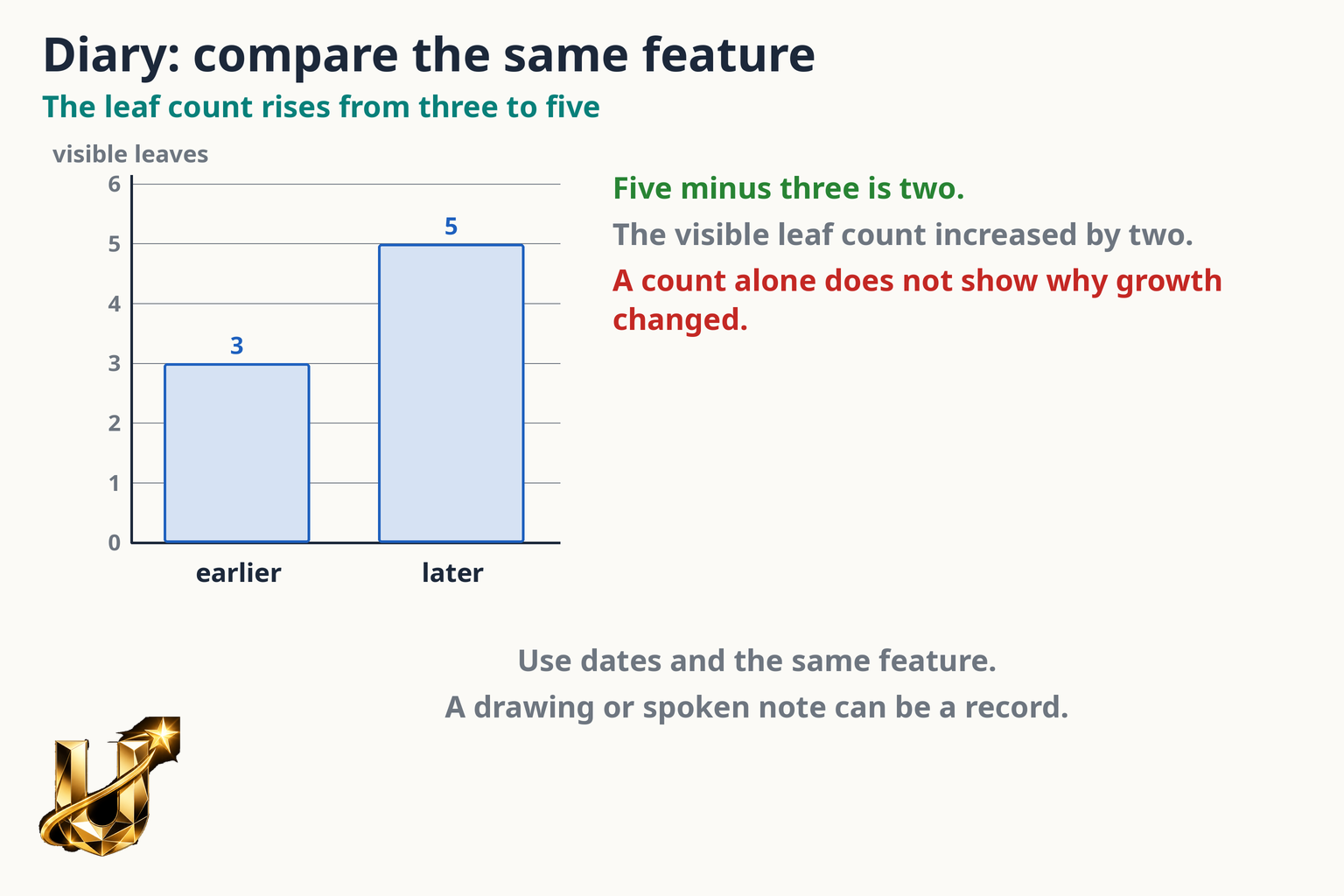
A visible leaf count rises from three to five. What is the increase?
Three visible leaves changing to five is an increase of:
A change in leaf count is evidence of a visible difference. It does not alone establish why growth changed or whether a new leaf replaced an old one. More observations and suitable comparisons help investigate causes.
A plant is moved, put in a larger pot and watered more. It grows differently. Was water the only possible cause?
A diary should identify:
Light, water, air and suitable warmth affect growth. Plants vary in needs. In a comparison, keep other important conditions similar while changing one factor. Adults choose safe amounts and avoid experiments that harm plants unnecessarily.
Aarav wants daily root pictures. Should he pull up the seedling each morning?
Use a fictional diary with three, four and five leaves on dated drawings. Explain the pattern and one question the record cannot answer.
Diaries show observed changes. Counts do not automatically prove causes. Use fair comparisons and gentle care.