
A question from everyday life
Enlarge image
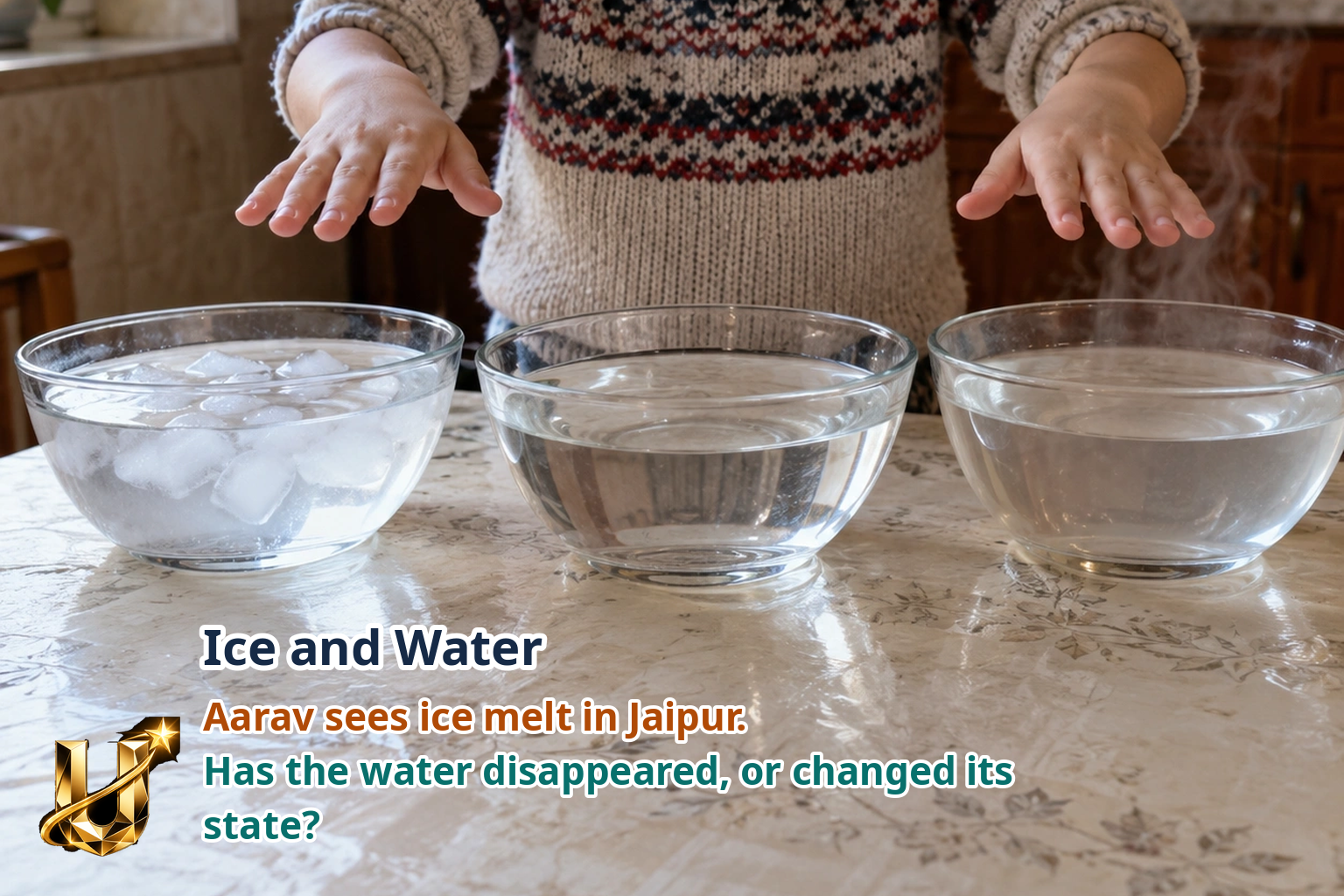
Aarav in Jaipur sees ice melt and a wet cloth dry. Has the water disappeared, or changed its state?
Unit 1: Life Around Us
Aarav in Jaipur sees ice melt and a wet cloth dry. Has the water disappeared, or changed its state?
A change from liquid water to water vapour.
Review lesson not available yet.
Aarav in Jaipur sees ice melt and a wet cloth dry. Has the water disappeared, or changed its state?
Ice is solid water. Liquid water flows and takes a container's shape. Water vapour is water as an invisible gas. The white mist near steam is made of tiny droplets, not the invisible vapour itself.
Priya leaves a small ice piece in a safe dish indoors. Liquid appears. What changed?
Water vapour is:
Melting changes solid water to liquid; freezing is the reverse. Evaporation changes liquid to gas, even below boiling. Cooling water vapour can form liquid droplets by condensation. Adults handle heating and freezing equipment.
A damp cloth dries in Pune. Where can water go?
Liquid changing to solid is:
Sunlight supplies energy for evaporation. Water can condense into droplets, fall as precipitation and move by runoff or infiltration. Water cycles, but clean usable water can still be limited or polluted. A cycle does not guarantee enough safe water everywhere.
Rain falls on a garden and some soaks into the ground. Which process is this?
Use pictures of ice, liquid and a drying cloth. With an adult, name the state or change. No heating or tasting unknown water.
Water changes among solid, liquid and gas. It moves through a cycle, while safe local supplies still require protection.