
A question from everyday life
Enlarge image
Aarav plans a pretend journey from Jaipur to Delhi on a classroom map. What can the map tell him, and what information is still needed for real travel?
Unit 3: Incredible India
Aarav plans a pretend journey from Jaipur to Delhi on a classroom map. What can the map tell him, and what information is still needed for real travel?
An ordered way from one place to another.
Review lesson not available yet.
Aarav plans a pretend journey from Jaipur to Delhi on a classroom map. What can the map tell him, and what information is still needed for real travel?
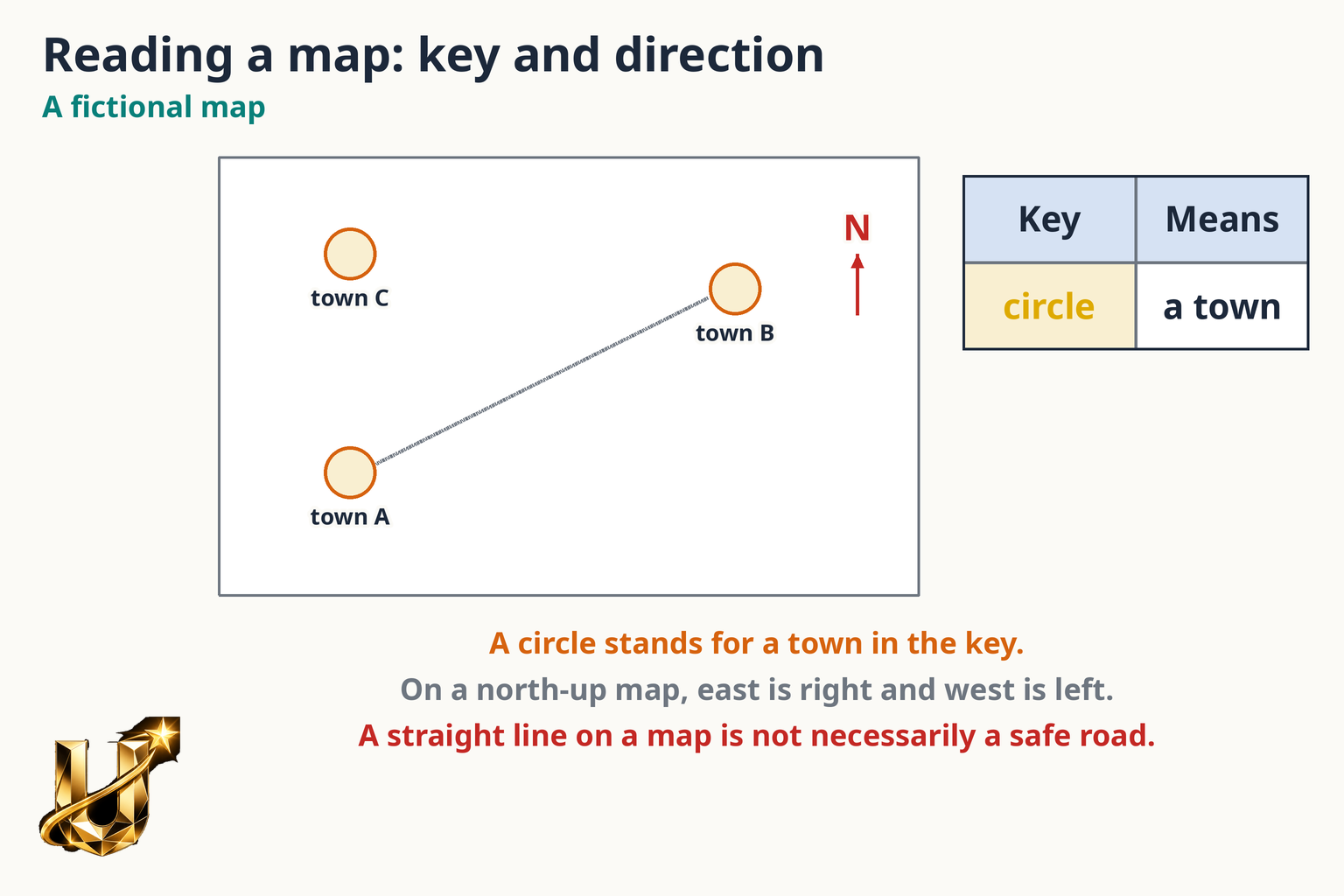
A key explains symbols and a direction arrow gives orientation. On a north-up map, east is right and west is left. A map is a representation; it does not automatically show every safe road or current condition.
A circle stands for a town in the key. What does a circle on the map mean?
A map key tells us:
A route describes an ordered way between places. Distance, accessibility and available transport can affect a real choice. A straight line on paper is not necessarily a usable road. Adults arrange actual journeys using appropriate information.
A pretend craft costs ₹35 and a notebook ₹25. Aarav has ₹100. How much remains?
₹35 plus ₹25 equals:
Rupees, written ₹, are used in India. A simple budget compares money available with stated costs. Classroom costs are invented examples, not current prices. Children do not share payment details or make real bookings.
A straight line joins two towns on a map. Can pupils assume it is a safe road?
Use a fictional map and ₹100 budget card. Interpret one symbol, trace a pretend route and calculate a stated purchase remainder.
Maps use conventions and have limits. Ordered routes and invented rupee budgets can support classroom reasoning without becoming live travel instructions.