
A question from everyday life
Enlarge image
Aarav feels tired holding a bag still in Pune. Does everyday tiredness mean the bag has moved or that mechanical work on it is the same as the effort he feels?
Unit 4: Things Around Us
Aarav feels tired holding a bag still in Pune. Does everyday tiredness mean the bag has moved or that mechanical work on it is the same as the effort he feels?
A quantity used to explain transfers and changes, including stored and moving forms.
Review lesson not available yet.
Aarav feels tired holding a bag still in Pune. Does everyday tiredness mean the bag has moved or that mechanical work on it is the same as the effort he feels?
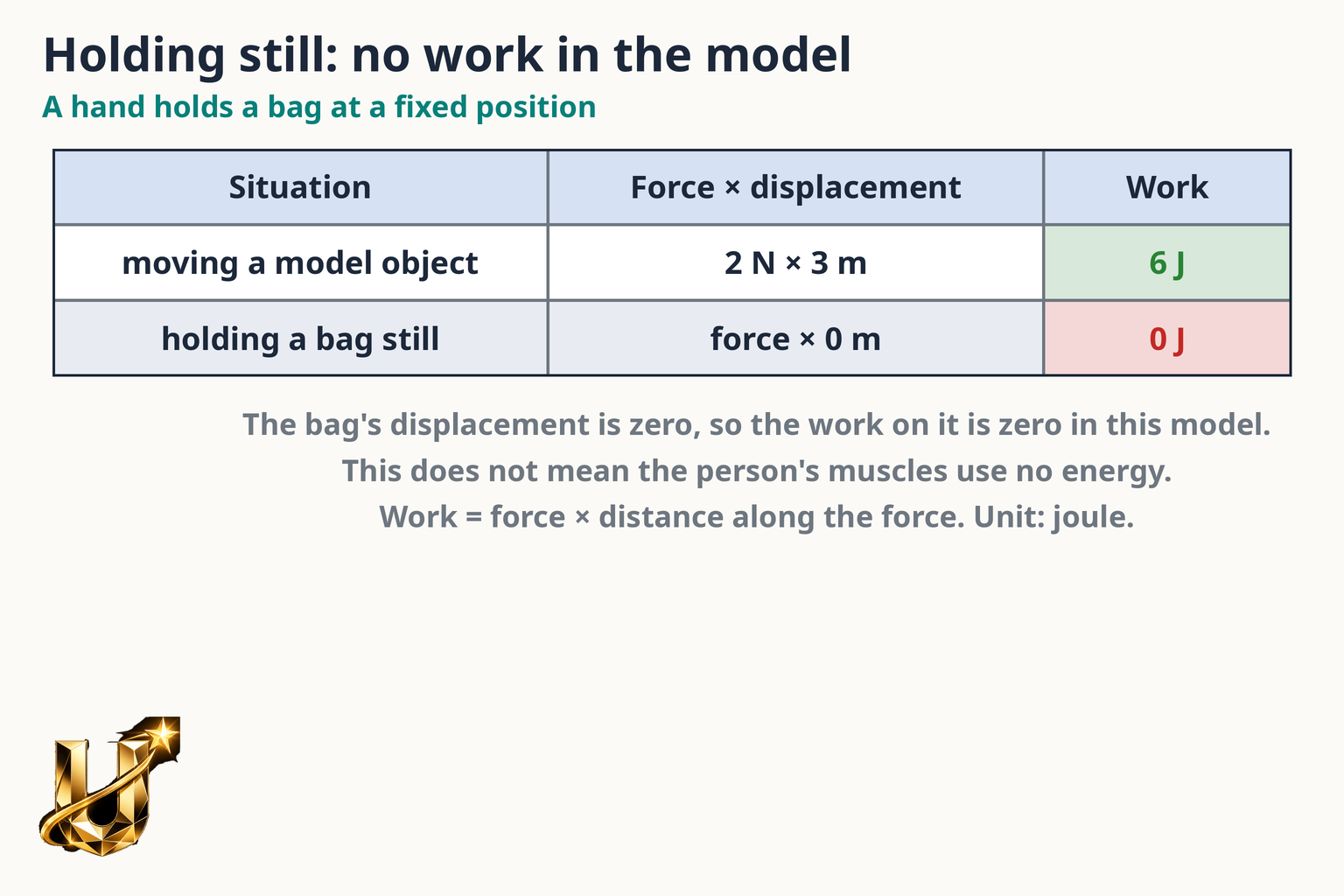
In a simple model, a constant force acting along a displacement does work equal to force multiplied by distance. The unit is the joule. Holding a stationary bag involves no displacement of the bag, so mechanical work on it is zero in this model, although muscles still use energy.
A stated constant force of 2 newtons moves a model object 3 metres in the force's direction. What work does this force do?
In the stated along-motion model, work equals:
To compare a toy's travel, keep the object, slope and release conditions similar while changing one selected factor. Repeated trials reveal variation. Travel distance alone is not an exact direct measurement of every energy transfer.
A hand holds a bag at a fixed position. What is the work on the stationary bag in the stated model?
2 newtons × 3 metres gives:
A model simplifies conditions. Friction and other effects can transfer energy to the surroundings. Report actual results rather than changing them to match a prediction. Use safe small-scale examples, not heavy lifting or powered machinery.
Two toy trials change both slope and surface. Can surface alone be blamed?
Solve the invented 2-newton, 3-metre example on a picture card. Discuss why a stationary bag and tired muscles describe different things. No lifting experiment.
Mechanical work has a defined model. Fair comparisons and honest limits matter, and tiredness is not a direct measure of work on an object.