
Start with a real question
Enlarge image
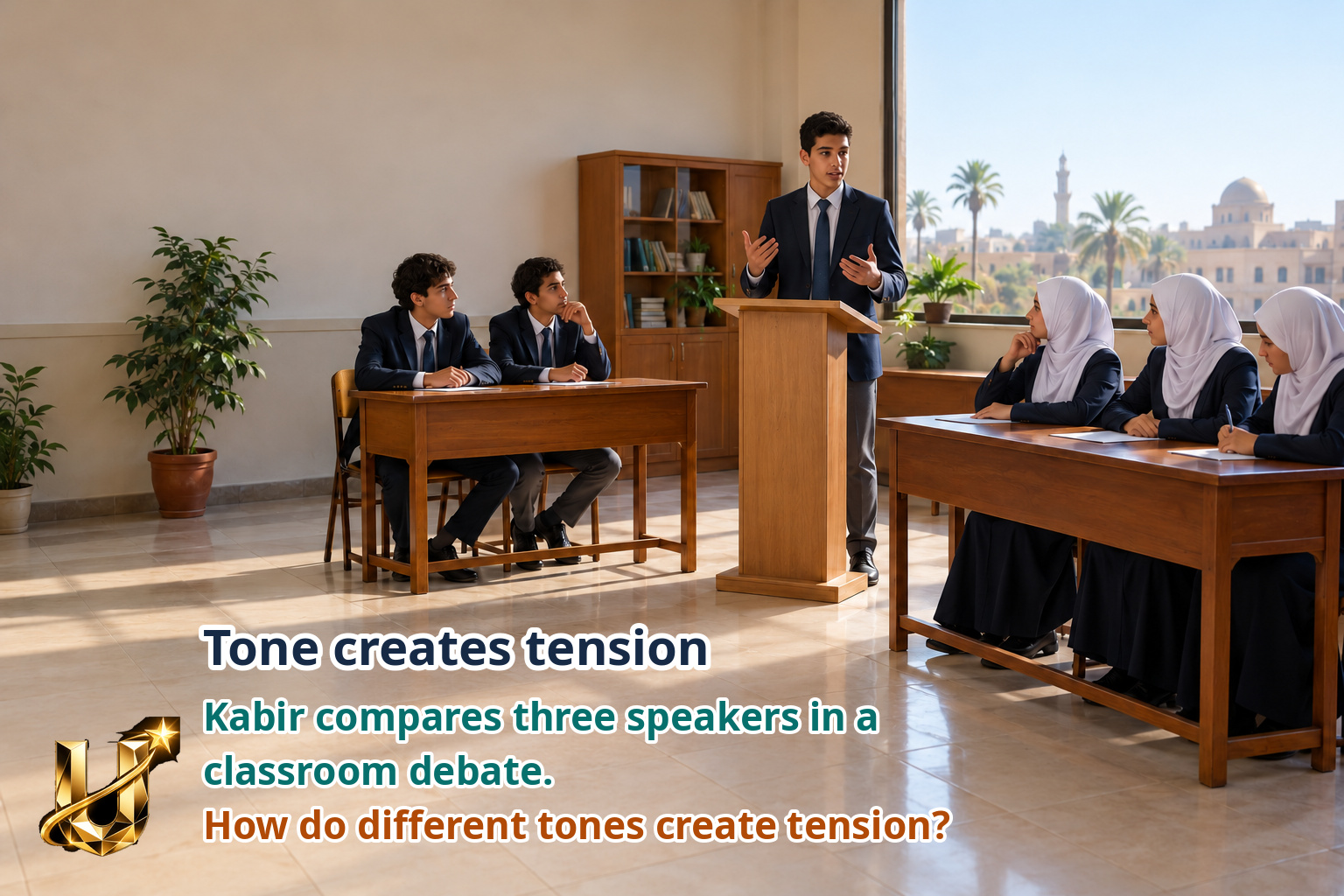
Kabir compares three fictional speakers in a classroom debate. How do different tones create tension?
Authoring unit 9: राम-लक्ष्मण-परशुराम संवाद
Kabir compares three fictional speakers in a classroom debate. How do different tones create tension?
Sarcasm conveys pointed criticism or mockery through wording whose apparent praise or politeness contrasts with its contextual meaning.
Review lesson not available yet.
Kabir compares three fictional speakers in a classroom debate. How do different tones create tension?
Track each speaker's claim, tone and reply. Literary or mythological dialogue can be analysed without presenting its characters as verified historical witnesses. Sarcasm is a focus of this lesson.
पहले वक्ता ने कठोर प्रश्न किया।
दूसरे ने शांत उत्तर दिया।
What raises tension in the third turn?
तीसरे ने व्यंग्य किया, जिससे तनाव बढ़ा।
How should a tone claim be supported?
Track each speaker's claim, tone and reply. Literary or mythological dialogue can be analysed without presenting its characters as verified historical witnesses. पहले वक्ता ने कठोर प्रश्न किया। दूसरे ने शांत उत्तर दिया। तीसरे ने व्यंग्य किया, जिससे तनाव बढ़ा।
Read Tulsidas’s Ram-Lakshman-Parashuram Samvad in the scene after the bow breaks. Parashuram’s anger, Ram’s restrained humility and Lakshman’s sharp replies produce contrasting voices. Interpret a reply in its dramatic sequence: who speaks, to whom, about which earlier statement, and with what effect on tension.
Original tone contrast: पहला वक्ता बोला, “कृपया पहले मेरी बात सुनिए।” दूसरे ने कहा, “वाह, अब सुनने की याद आई!” The first requests a hearing politely; the second uses apparent praise to convey criticism. The punctuation helps a reader perform the contrast, but the words and context establish the interpretation.
Paraphrase a selected older expression without flattening its tone. Distinguish a speaker’s accusation from a narrator’s account and a reader’s inference. An apparently respectful form can still be sarcastic in context. Compare the roles of a calming response and a provocative response using the actual exchange rather than treating all politeness words as proof of humility.