
A question from life
Enlarge image
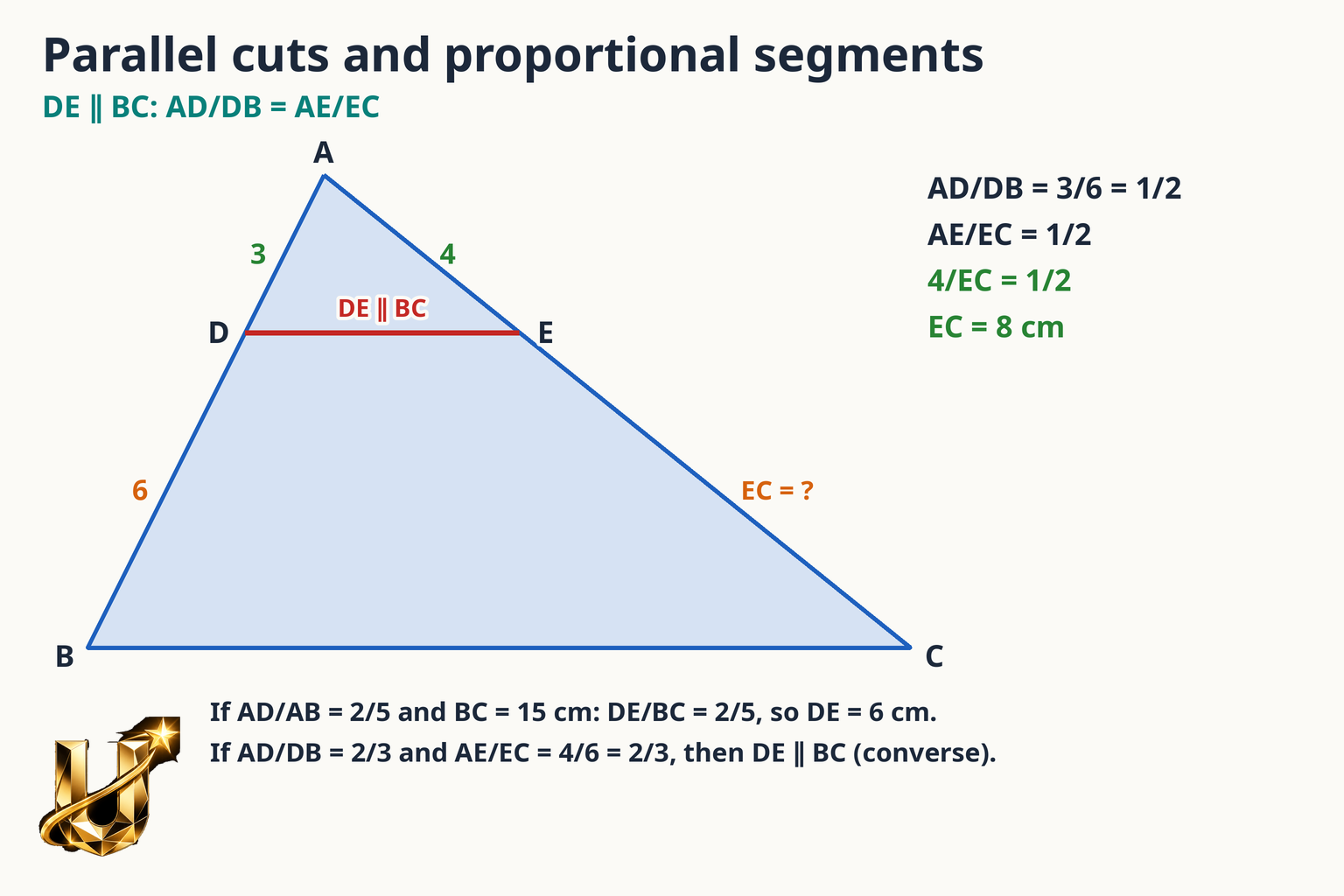
Aarav draws D on A B and E on A C, with D E parallel to B C. What can he conclude about the divided sides?
Chapter 6: Triangles
Aarav draws D on A B and E on A C, with D E parallel to B C. What can he conclude about the divided sides?
A parallel cut across two triangle sides divides those sides proportionally.
Review lesson not available yet.
Aarav draws D on A B and E on A C, with D E parallel to B C. What can he conclude about the divided sides?
A line parallel to one side of a triangle and meeting the other two sides divides them in the same ratio. Similarity gives A D/A B = A E/A C; hence A D/D B = A E/E C.
A D = 3 cm, D B = 6 cm and A E = 4 cm, with D E parallel to B C. Find E C.
The converse also holds for points on the two sides: if the divisions are in the same ratio, the joining segment is parallel to the third side. Use corresponding segment lengths consistently and state the point positions.
A D/A B = 2/5 and B C = 15 cm. Find D E.
Parallel cut with A D/D B = 1/3 gives A E/E C?
D and E divide the sides with A D/D B = 2/3 and A E/E C = 4/6.
May A D/D B be mixed with A E/A C without conversion?
Keep part-to-part and part-to-whole ratios distinct; apply direct and converse conditions carefully.
Let D lie inside side A B and E inside side A C of triangle A B C, with D E parallel to B C. Triangles A D E and D B E have a common altitude from E to A B, so their area ratio is A D divided by D B. Triangles A D E and D E C similarly give ratio A E divided by E C. Triangles D B E and D E C share base D E and lie between the same parallels, so their areas agree. Hence the two side ratios agree.
Explain why the two area ratios prove A D divided by D B equals A E divided by E C.
Does an arbitrary segment joining two sides necessarily divide them in the same ratio?