
A question from life
Enlarge image
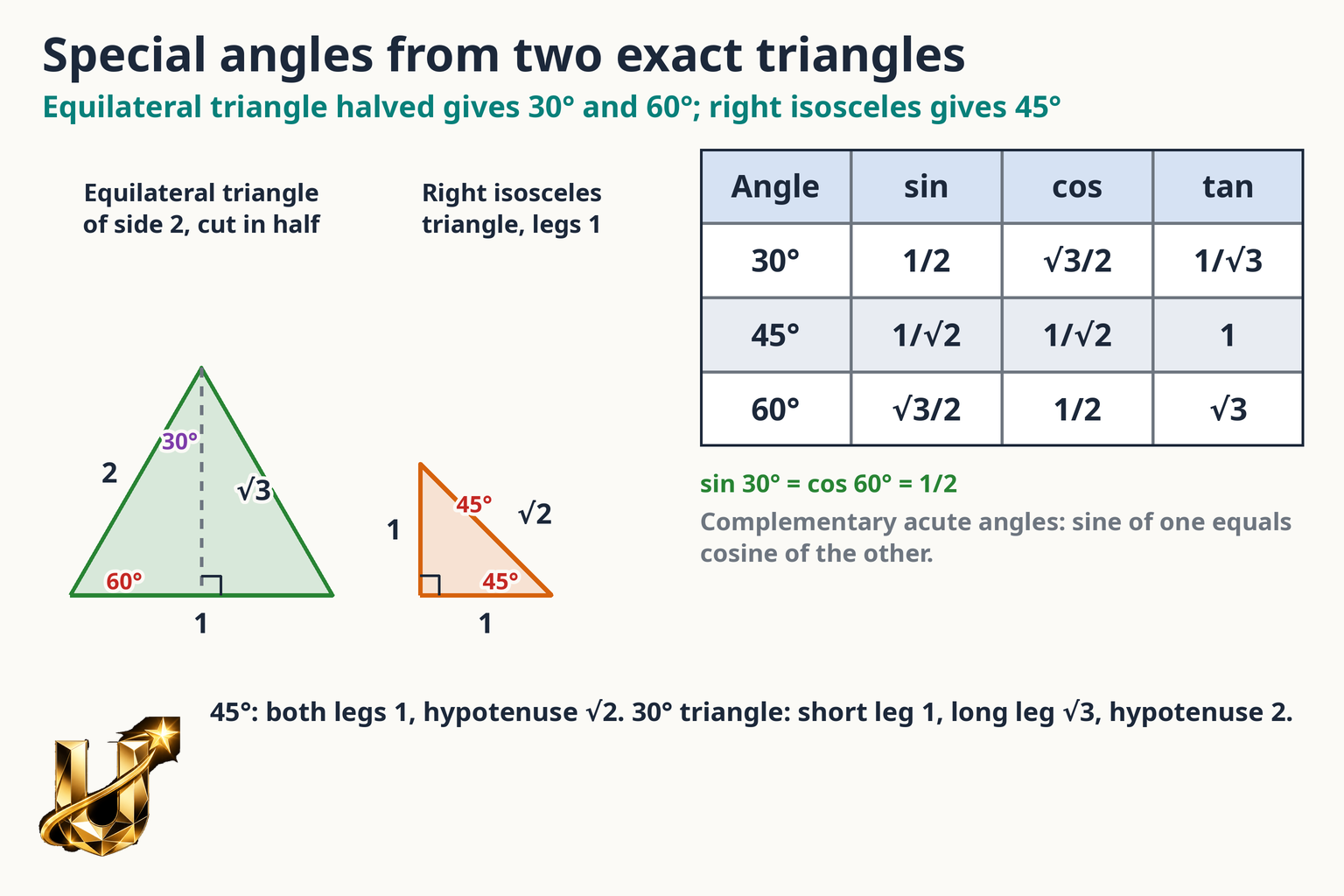
Aarav splits an equilateral triangle of side 2 into two right triangles. What exact ratios can he read?
Chapter 8: Introduction to Trigonometry
Aarav splits an equilateral triangle of side 2 into two right triangles. What exact ratios can he read?
Two angles whose measures sum to 90 degrees.
Review lesson not available yet.
Aarav splits an equilateral triangle of side 2 into two right triangles. What exact ratios can he read?
A right isosceles triangle with legs 1 has hypotenuse √2 and two 45-degree angles. Its sine and cosine ratios equal 1/√2; tangent equals 1.
Find sine, cosine and tangent of 45 degrees.
Splitting an equilateral triangle of side 2 gives a right triangle with hypotenuse 2, short leg 1 and long leg √3. Its acute angles are 30 and 60 degrees. For complementary acute angles, sine of one equals cosine of the other.
Find the ratios for 30 degrees.
Tangent of 45 degrees?
Relate a 30-degree angle to the other acute angle.
Sine of 30 degrees?
Derive exact ratios from known triangles and keep acute-angle conditions clear.
The right-triangle definitions initially use acute angles. Extending with a unit-circle point gives cosine as horizontal coordinate and sine as vertical coordinate. At zero degrees the point is one comma zero; at ninety degrees it is zero comma one. Thus sine of zero is zero and cosine of zero is one, while sine of ninety is one and cosine of ninety is zero. A reciprocal or quotient remains undefined when its denominator is zero.
Find tangent and secant at zero and ninety degrees.
Why is cosecant undefined at zero degrees?