
A question from life
Enlarge image
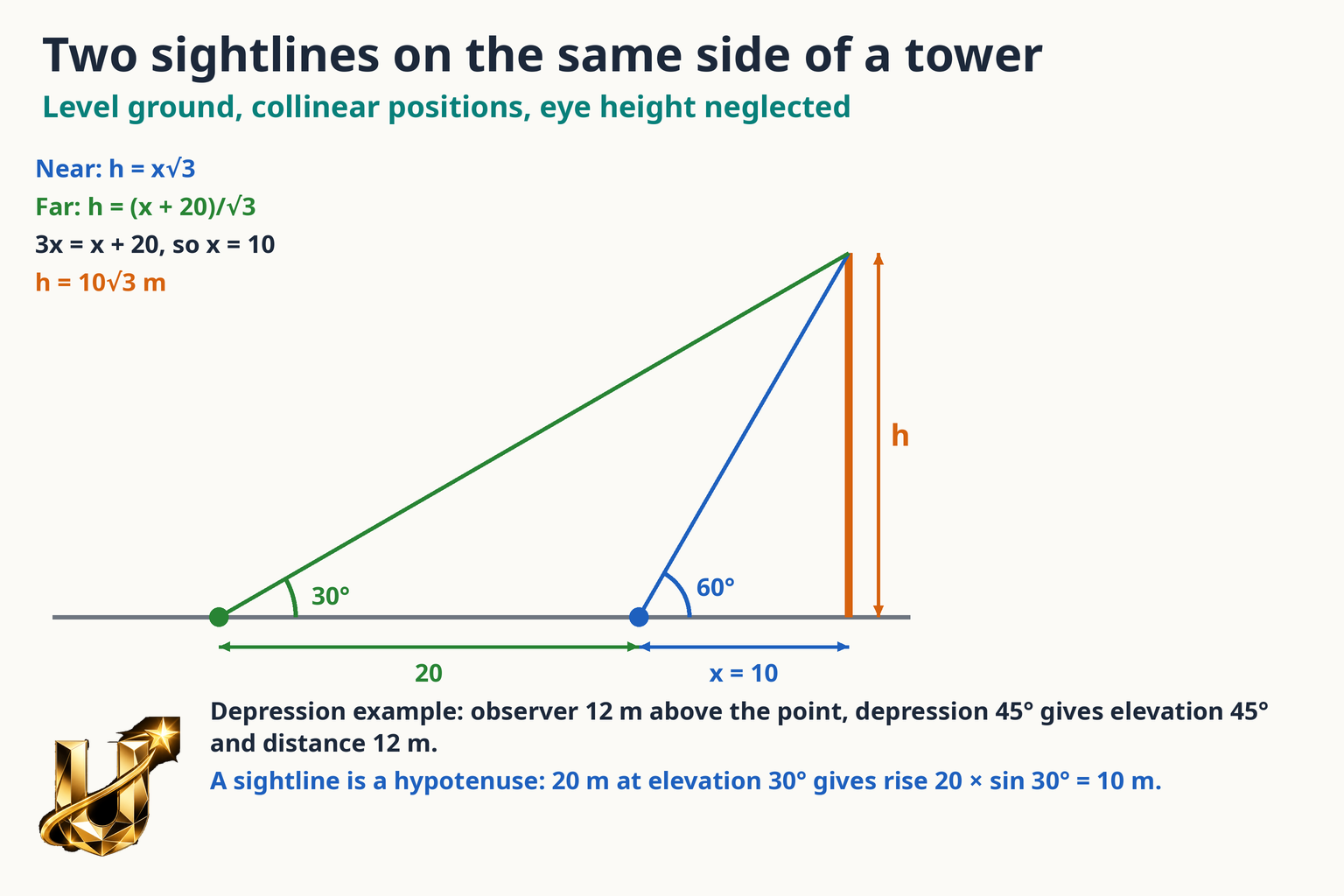
Aarav models a vertical tower from two ground-level observation points on the same straight side, 20 m apart. The elevations are 60 degrees nearer and 30 degrees farther. Can he find its height?
Chapter 9: Some Applications of Trigonometry
Aarav models a vertical tower from two ground-level observation points on the same straight side, 20 m apart. The elevations are 60 degrees nearer and 30 degrees farther. Can he find its height?
The straight segment from the observer's eye to the target.
Review lesson not available yet.
Aarav models a vertical tower from two ground-level observation points on the same straight side, 20 m apart. The elevations are 60 degrees nearer and 30 degrees farther. Can he find its height?
Introduce a horizontal distance variable and use both triangles. State same side, collinearity, level ground and whether eye height is neglected. Otherwise the distance relation may differ.
Find height h and near distance x for the stated tower model, neglecting eye height.
For two horizontal reference lines at different heights, a depression angle equals the reciprocal elevation angle because the horizontals are parallel. That does not mean every angle in the diagram is equal.
An observer is 12 m above a point's level and the depression angle is 45 degrees.
Near distance x and farther point 20 m behind on the same side gives far distance?
A right-triangle sightline is 20 m long at elevation 30 degrees. Find the vertical rise.
Sightline length belongs to which side?
Use the correct triangle sides and distance relation, with every geometric assumption stated.