
A question from life
Enlarge image
Priya compares two skew lines. Why is an arbitrary joining segment not necessarily the shortest?
Chapter 11: Three Dimensional Geometry
Priya compares two skew lines. Why is an arbitrary joining segment not necessarily the shortest?
The least nonnegative separation between points on the two specified lines.
Review lesson not available yet.
Priya compares two skew lines. Why is an arbitrary joining segment not necessarily the shortest?
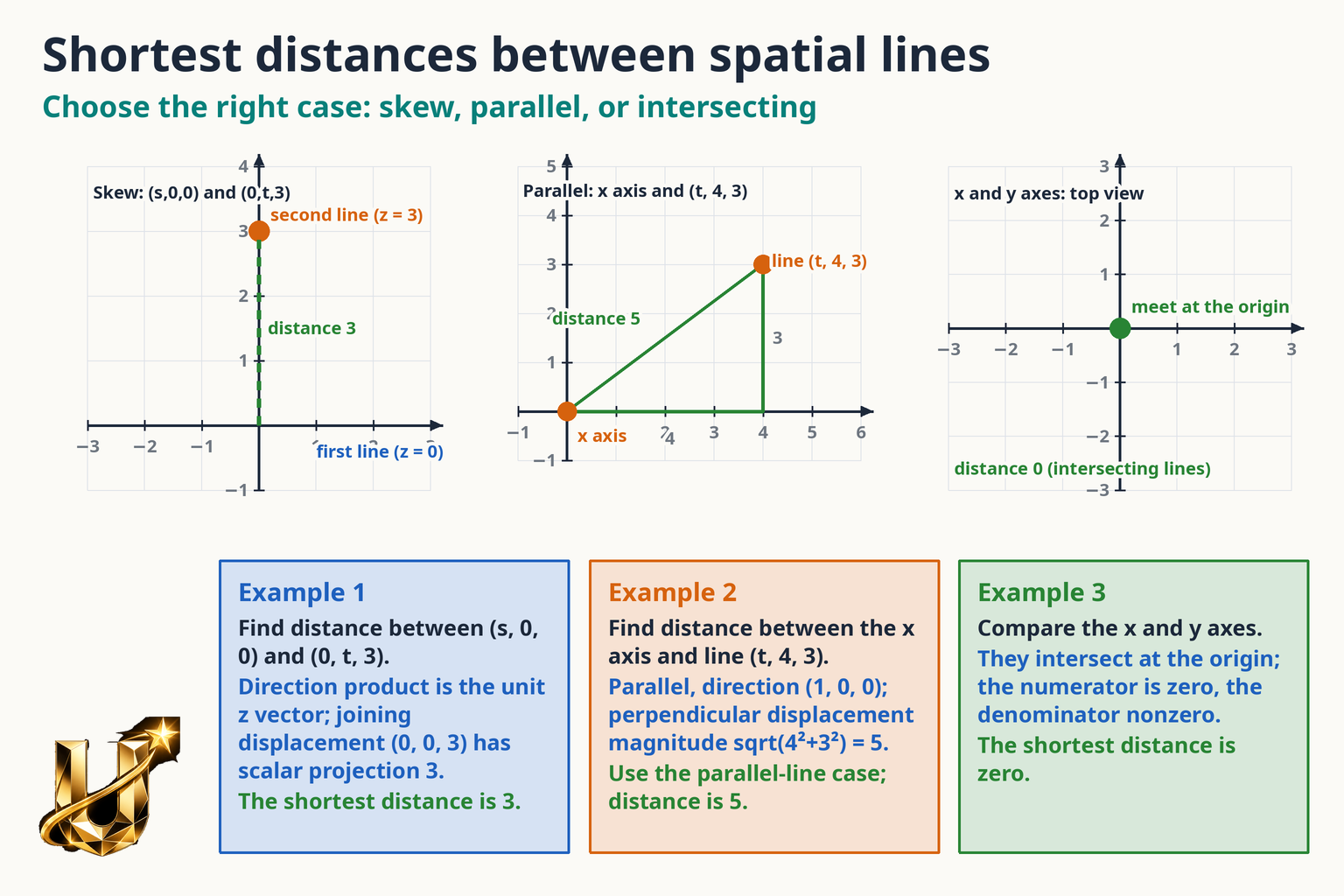
For nonparallel lines through a and c with directions b and d, shortest distance is the absolute scalar triple product of c−a with b vector-product d, divided by the magnitude of that vector product.
Find distance between (s, 0, 0) and (0, t, 3).
For parallel lines, that denominator is zero and a different formula applies: magnitude of (c−a) vector-product b divided by magnitude b. These are nonnegative perpendicular separations; intersecting lines have distance zero. The formulas require nonzero direction vectors.
Find distance between the x axis and line (t, 4, 3).
Use the skew/nonparallel formula when direction product is zero?
Compare the x and y axes.
Intersecting lines have shortest distance?
Choose the correct parallel/nonparallel case and compute a perpendicular nonnegative separation.