A question from life
Extension: this topic goes beyond the probability outline listed for CBSE 2026–27 assessment; consult your school plan. Priya records a fixed number of independent success/failure trials with the same success probability. Which distribution counts successes?
Explore
A binomial model needs fixed trial count n, two outcomes per trial, independence and constant success probability p. For integer k from 0 through n and 0<p<1, probability of k successes is n-choose-k times p^k times (1−p)^(n−k).
Worked example
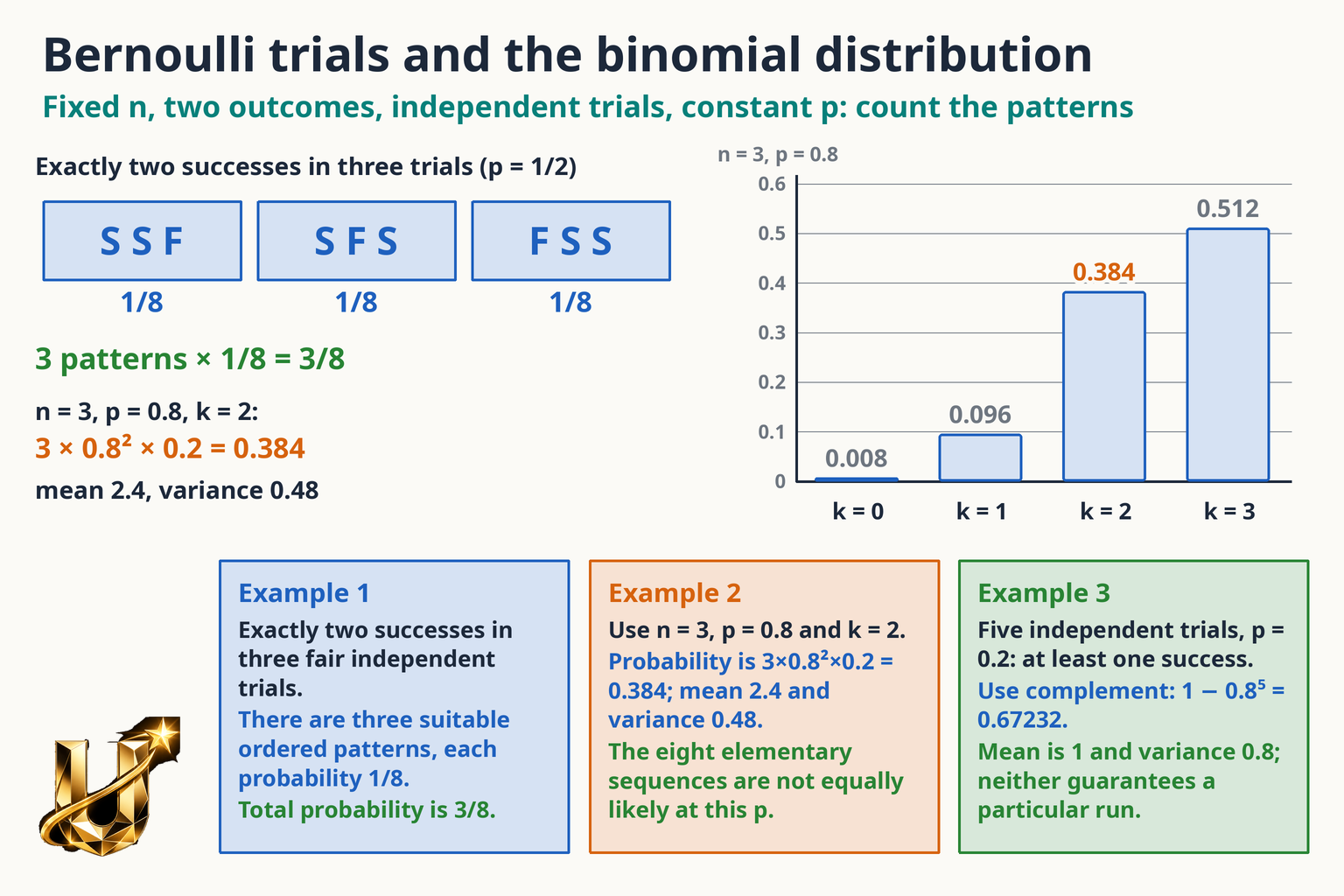
Find probability of exactly two successes in three fair independent trials.
- There are three suitable ordered patterns, each probability 1/8.
- Total probability is 3/8.
Use the idea
The binomial mean is n×p and variance n×p×(1−p). Success is just the outcome being counted. At p=0 the count is always zero; at p=1 it is always n, handled directly without ambiguous zero-power expressions. Without replacement, the assumptions usually fail.
Worked example
Use n=3,p=0.8 and k=2.
- Probability is 3×0.8^2×0.2 = 0.384.
- Mean is 2.4 and variance 0.48.
- The eight elementary sequences are not equally likely at this p.
Try it
Binomial model needs what besides two outcomes?
Worked example
For five independent trials with p=0.2, find at least one success.
- Use complement: 1−0.8^5 = 0.67232.
- Mean is 1 and variance 0.8.
- Neither mean nor event probability guarantees a particular run.
Check it
Mean for n=10,p=0.3?
Remember
Verify every Bernoulli-trial condition, count patterns and interpret moments as averages.