
A question from life
Enlarge image
Aarav recognises derivatives of sine, logarithm and arctangent. How can he use them as integration templates?
Chapter 7: Integrals
Aarav recognises derivatives of sine, logarithm and arctangent. How can he use them as integration templates?
A known antiderivative pattern matched to an integrand with proper scaling.
Review lesson not available yet.
Aarav recognises derivatives of sine, logarithm and arctangent. How can he use them as integration templates?
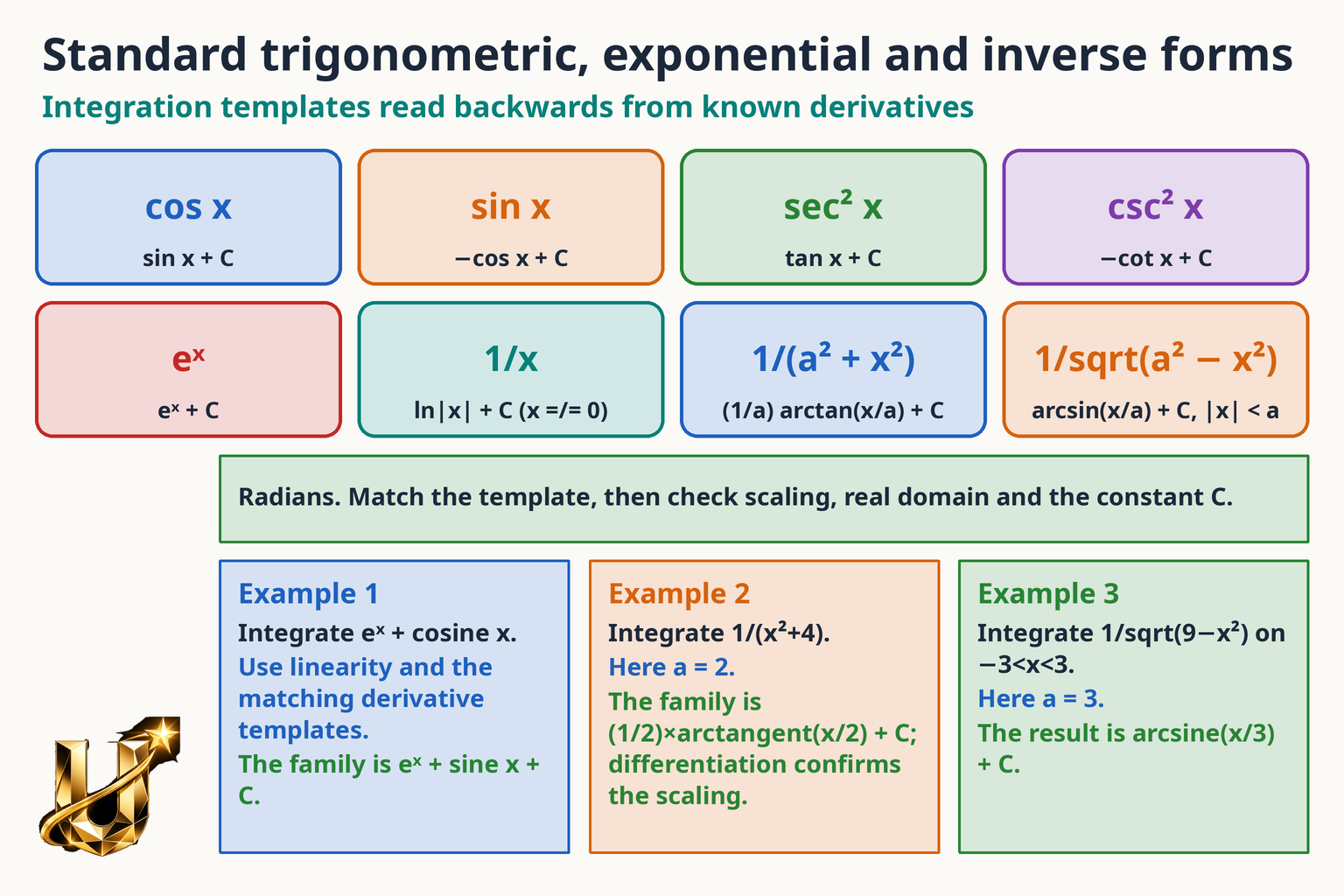
In radians, cosine integrates to sine, sine to negative cosine, secant squared to tangent, and cosecant squared to negative cotangent, each plus C. The natural exponential integrates to itself. The reciprocal 1/x integrates to natural logarithm of absolute x on intervals avoiding zero.
Integrate e^x+cosine x.
For positive a, 1/(a^2+x^2) integrates to (1/a) times arctangent(x/a), while 1/√(a^2−x^2) integrates to arcsine(x/a) where |x|<a. Root-denominator forms 1/√(x^2+a^2) and 1/√(x^2−a^2) use natural logarithm of absolute (x+√(x^2+a^2)) or the minus-version root, respectively, on their real open domains.
Integrate 1/(x^2+4).
General antiderivative of sine x in radians?
Integrate 1/√(9−x^2) on −3<x<3.
General antiderivative of 1/x for x nonzero?
Match a derivative template and check scaling, real domains and the constant.