
Explore the question
Enlarge image
Priya puts the same number of counters on every tray. How can she predict the total without starting at one each time?
Chapter 8: Grouping and Sharing
Priya puts the same number of counters on every tray. How can she predict the total without starting at one each time?
A sequence of totals formed by adding one more equal group each time.
Review lesson not available yet.
Priya puts the same number of counters on every tray. How can she predict the total without starting at one each time?
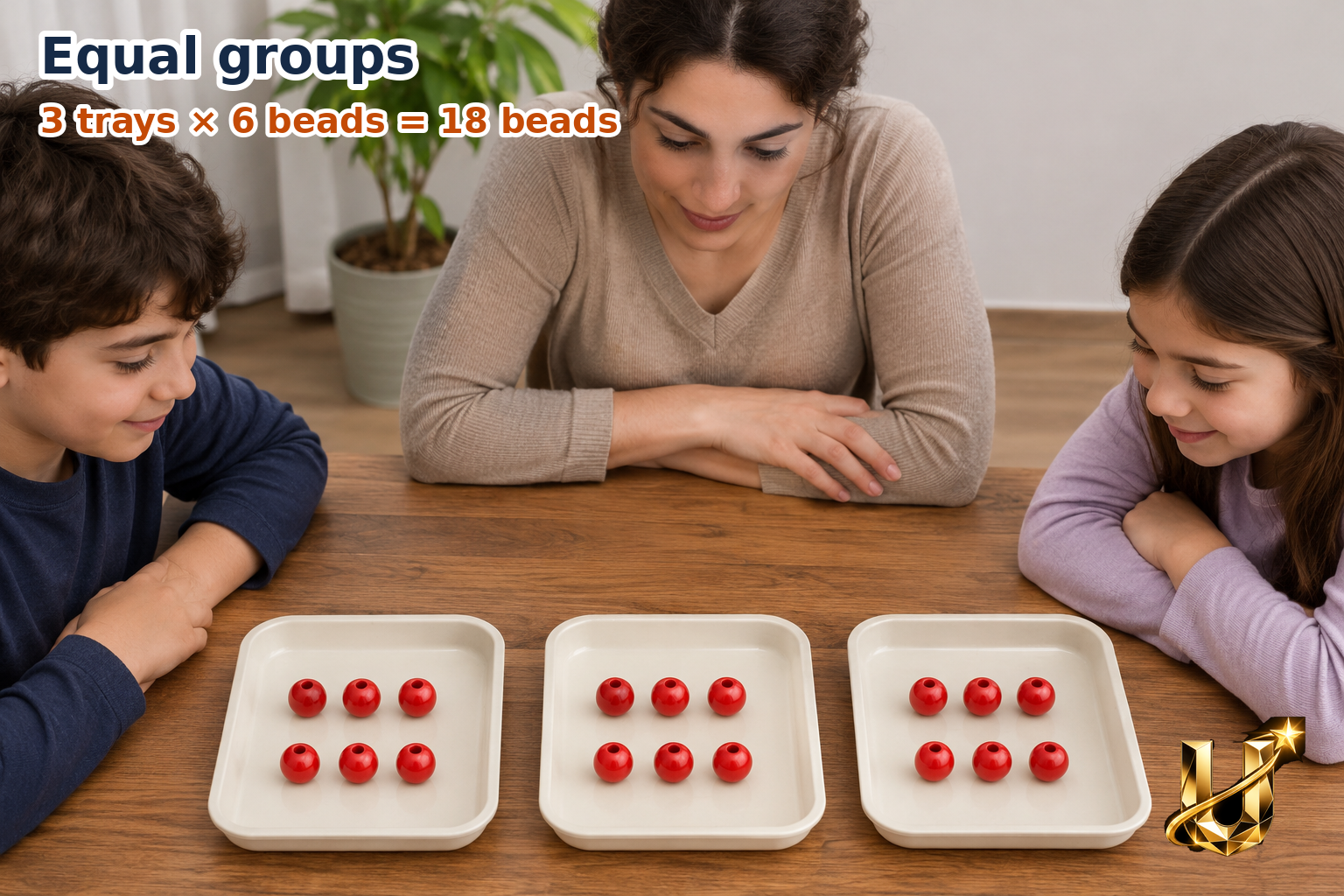
Equal groups contain the same number in each group. Say the number of groups and the number in each. Three groups of four means four plus four plus four, a total of twelve. Multiplication records repeated equal groups; switching the grouping can keep the same total but changes its description.
Find three groups of four counters.
Build one multiplication table at a time. Start with one equal group, add one more group, and count the new total. Use objects or a drawing for each step. Practise two and three before moving gradually through eight.
For one through ten groups of two, the totals are 2, 4, 6, 8, 10, 12, 14, 16, 18, 20. Add two for each new group.
For one through ten groups of three, the totals are 3, 6, 9, 12, 15, 18, 21, 24, 27, 30. Add three for each new group.
For one through ten groups of four, the totals are 4, 8, 12, 16, 20, 24, 28, 32, 36, 40. Add four for each new group.
For one through ten groups of five, the totals are 5, 10, 15, 20, 25, 30, 35, 40, 45, 50. Add five for each new group.
For one through ten groups of six, the totals are 6, 12, 18, 24, 30, 36, 42, 48, 54, 60. Add six for each new group.
For one through ten groups of seven, the totals are 7, 14, 21, 28, 35, 42, 49, 56, 63, 70. Add seven for each new group.
For one through ten groups of eight, the totals are 8, 16, 24, 32, 40, 48, 56, 64, 72, 80. Add eight for each new group.
Five groups of six total thirty. What do six groups of six total?
Four groups of five total:
Use a drawing, objects or the stated relationship to explain each step before checking the answer.
Find seven groups of eight using five groups and two more groups.
One more group of seven after twenty-one gives:
Build multiplication facts from equal groups, repeated addition and facts you already know.
Build one short table at a time with drawings or large counters; avoid small swallowing hazards.