
A question from life
Enlarge image
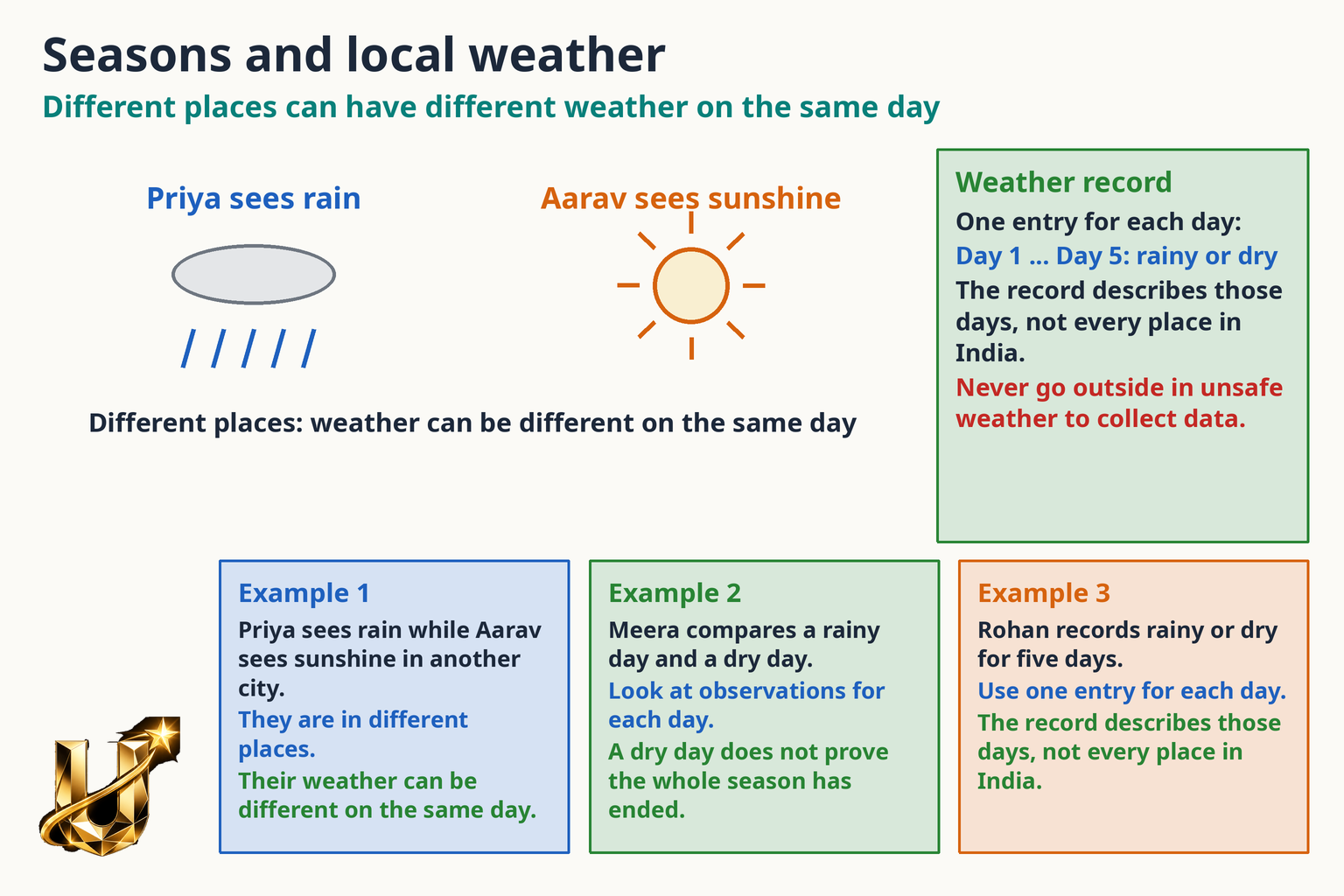
Aarav in Delhi and Priya in Chennai describe different weather on the same day. Can both be right?
Chapter 9: Which Season is it?
Aarav in Delhi and Priya in Chennai describe different weather on the same day. Can both be right?
An arrangement that follows a rule.
Review lesson not available yet.
Aarav in Delhi and Priya in Chennai describe different weather on the same day. Can both be right?
Weather describes conditions we notice now, such as rain, sunshine or cool air. Seasons describe recurring parts of a year.
Priya sees rain while Aarav sees sunshine in another city.
India has different climates. Some places have colder winters or wetter rainy periods than others. Do not assume every place has the same weather or exact seasonal dates.
Meera compares a rainy day and a dry day.
Does every Indian city have identical weather on one day?
Use a calendar and observations to compare days. Record what you see safely; never go outside during unsafe weather just to collect data.
Rohan records rainy or dry for five days.
A safe weather record uses:
North, east, south and west name directions. On a map whose north arrow points up, east is right, south is down and west is left. Left and right depend on which way you face; compass directions stay fixed. Use the map's north arrow rather than assuming the top is always north.
A map marks north upwards. The library is directly right of the school. Which direction is it from the school?
Aarav faces east. Which compass direction is behind him?
Which direction is opposite north?
Seasons are recurring parts of a year. In this story, a family records a hot summer period, then a monsoon rainy period, then a cooler winter period. Use the order stated in the record. Other places may have different local patterns and dates.
In the family's record, a rainy period comes after hot months and before cooler months. What comes between the hot and cooler periods?
Use day and month records to describe local weather. Seasonal experiences vary across India.
With an adult, record rainy or dry for a few days from a safe place. Talk about local seasonal experiences without fixed dates.