
A question from life
Enlarge image
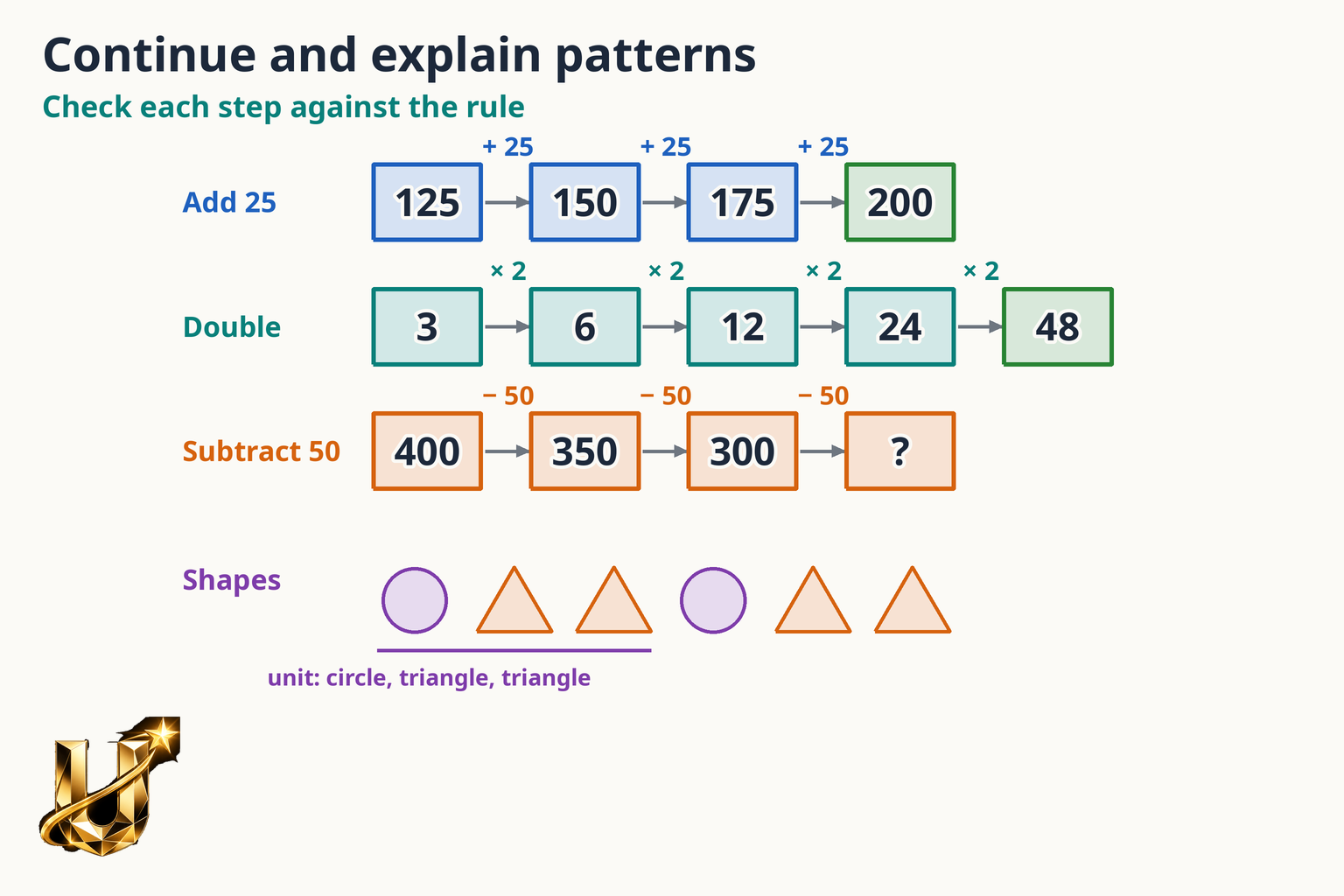
Meera builds a display with counts 125,150,175. She states: add 25 each time. What comes next?
Chapter 3: Pattern Around Us
Meera builds a display with counts 125,150,175. She states: add 25 each time. What comes next?
A stated instruction describing how a pattern continues.
Review lesson not available yet.
Meera builds a display with counts 125,150,175. She states: add 25 each time. What comes next?
A numerical pattern follows a stated rule. Compare consecutive values to check it.
Rule add 25:125,150,175.
A rule can add, subtract or multiply. Check every step rather than guessing only from the last number.
Rule multiply by 2:3,6,12,24.
Rule subtract 50:400,350,300. Next:
A repeating shape pattern follows a complete unit. Keep a rule explicit, because a short unfinished sequence can allow several continuations.
Circle, triangle, triangle repeats. Circle, triangle, triangle, circle, triangle.
Rule double:5,10,20. Next:
An even whole number can be paired with no object left over. Its ones digit is zero, two, four, six or eight. An odd whole number leaves one object after pairing; its ones digit is one, three, five, seven or nine. Zero is even because it leaves no unpaired object.
Adding two keeps parity: two, four, six, eight are even; one, three, five, seven are odd. An even number plus one is odd; an odd number plus one is even. Check the ones digit or use pairs instead of relying on the number of digits.
State and check the rule. Repeating units and numerical operations are different kinds of pattern.
With an adult, make one repeating card pattern and one numerical pattern. Explain more than one possible rule if the clues are insufficient.