
A question from life
Enlarge image
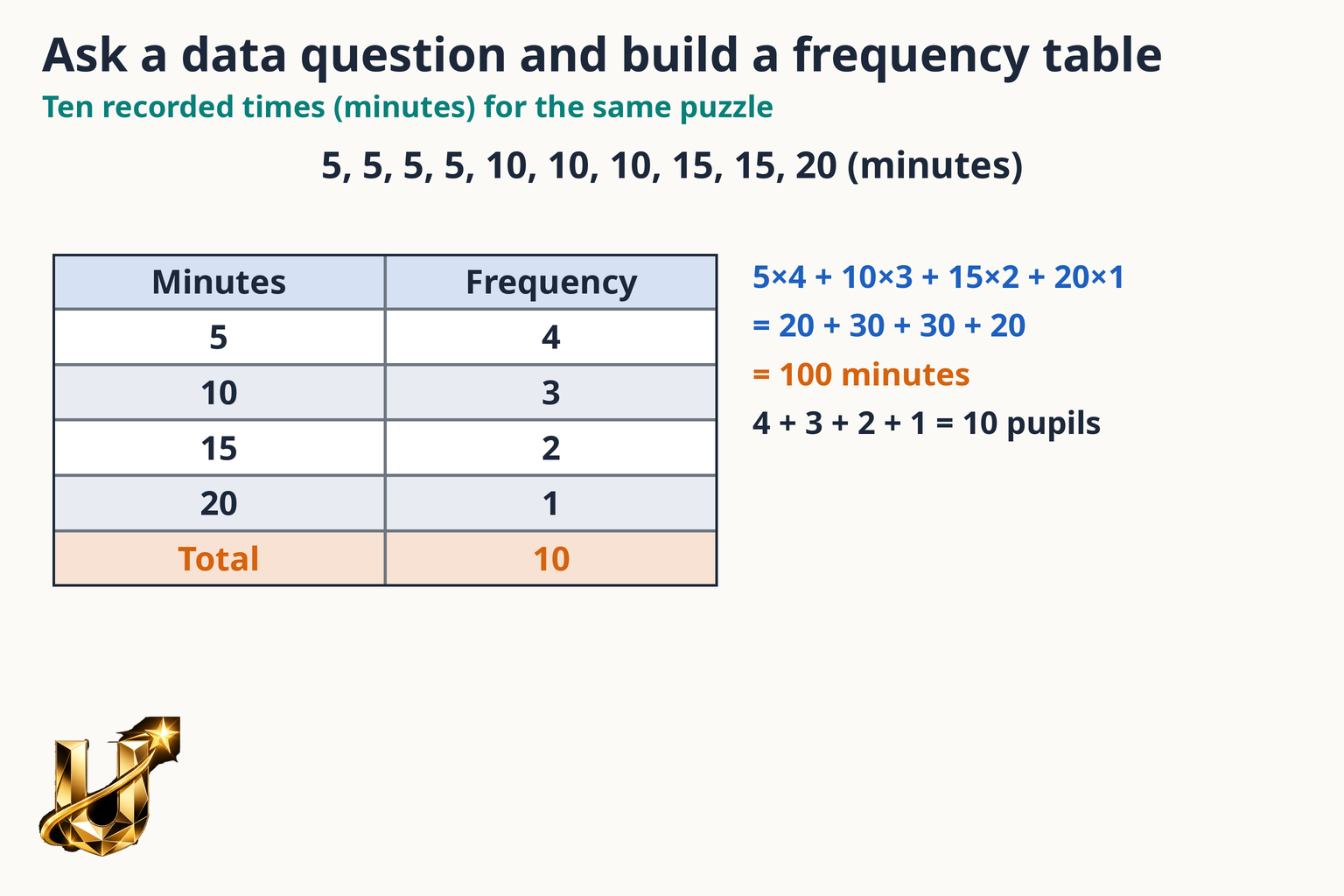
Priya studies fictional puzzle times for ten pupils:5,10,5,15,10,5,20,10,5,15 minutes. How can she organise them?
Chapter 15: Data Through Pictures
Priya studies fictional puzzle times for ten pupils:5,10,5,15,10,5,20,10,5,15 minutes. How can she organise them?
The number of observations having a stated value or category.
Review lesson not available yet.
Priya studies fictional puzzle times for ten pupils:5,10,5,15,10,5,20,10,5,15 minutes. How can she organise them?
A data question can anticipate variation across observations, such as how long different pupils take. State the unit and collect one observation under the agreed rule.
Choose a question expecting varied answers.
Frequency means how many times a value appears. Count every observation once, sum frequencies to check the sample size and avoid claiming a small sample proves a whole country's behaviour.
Make a frequency table for the ten stated times.
The frequency of 10 minutes is:
Find the total of the individual recorded durations.
Does this ten-pupil fictional sample establish a result for all pupils in India?
Ask clearly, record units, count frequencies and check totals. Describe what the sample can and cannot support.