
Explore the question
Enlarge image
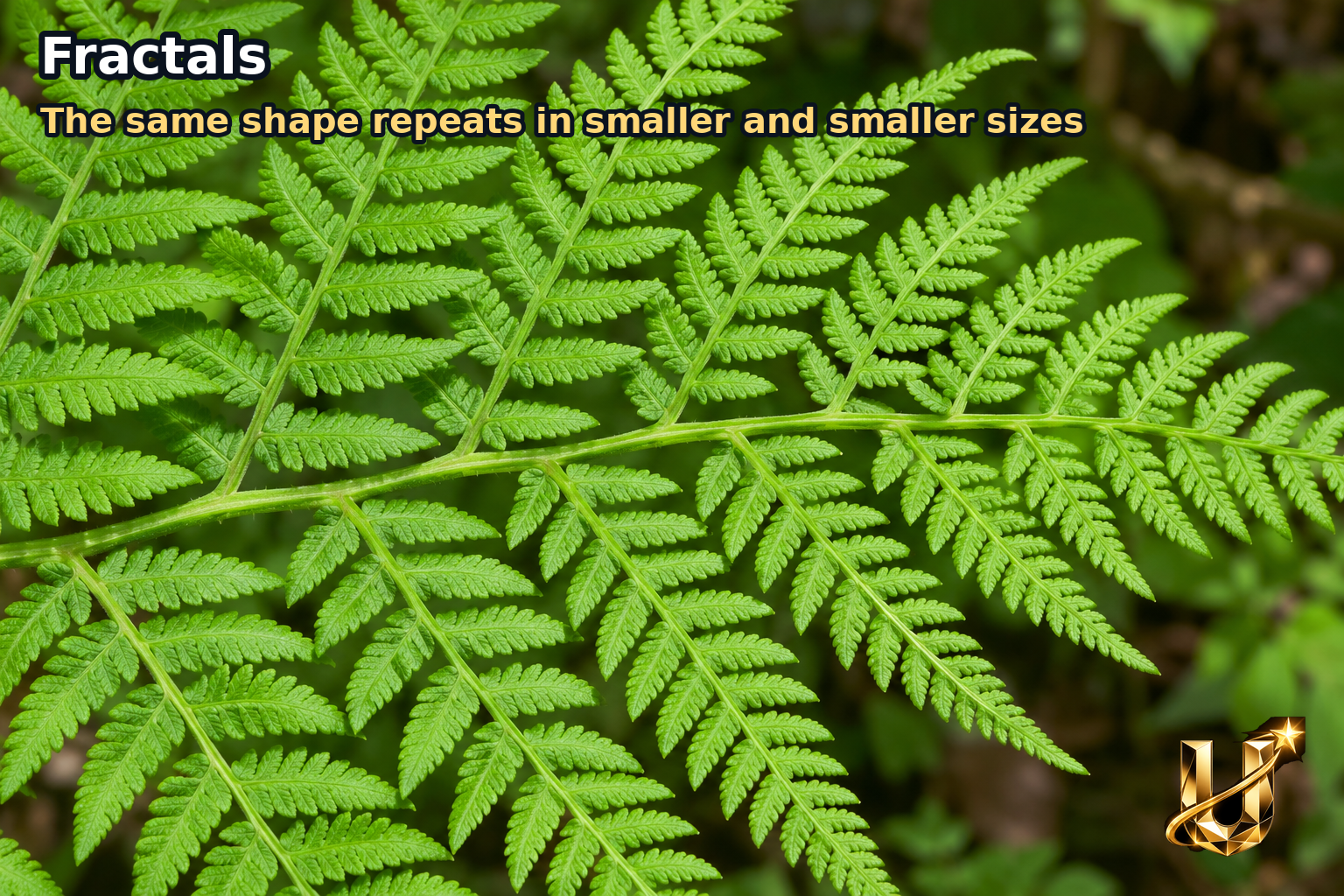
Aarav repeats the same branching pattern at smaller sizes. What can a repeated design tell us about mathematical shape?
Chapter 11: Exploring Some Geometric Themes
Aarav repeats the same branching pattern at smaller sizes. What can a repeated design tell us about mathematical shape?
A pattern with similar structure repeated at successively smaller or larger scales.
Review lesson not available yet.
Aarav repeats the same branching pattern at smaller sizes. What can a repeated design tell us about mathematical shape?
A fractal pattern repeats similar structure at different scales. A finite drawing can model successive stages without displaying an infinite object. In an ideal repeated triangle construction, join the midpoints of each triangle and remove its central triangle; repeat on the three remaining triangles. Natural branching or leaf patterns may resemble fractals approximately rather than exactly.
A triangle fractal starts with one filled triangle. Each step replaces every filled triangle with three smaller ones. Count through three replacements.
A solid occupies three-dimensional space. Its front, top and side views are two-dimensional representations that can hide depth or hidden blocks. A net is a flat arrangement of faces that folds into a solid. A cube has six square faces, twelve edges and eight vertices. Not every arrangement of six squares folds into a cube; check for overlaps.
A block model has two unit cubes in a row, with one more cube stacked on the left cube. Describe its views.
After counts 1, 3 and 9, the next count in this fractal is:
A net has four squares in one row, with one extra square above the second and one below the second. Can it form a cube?
A cube has how many square faces?
Look for repeated structure across scales; use views and foldable nets to reason about solids and hidden parts.
A regular polygon has equal sides and equal interior angles. To construct a regular hexagon, draw a circle and, without changing the compass opening from its radius, step that chord length around the circle. Join consecutive marked points. The six equal chords form six equilateral triangles with the centre.
Construct and check a regular hexagon in a circle of radius three centimetres.
When stepping the circle radius to construct the regular hexagon, should the compass opening change?