
A question from life
Enlarge image
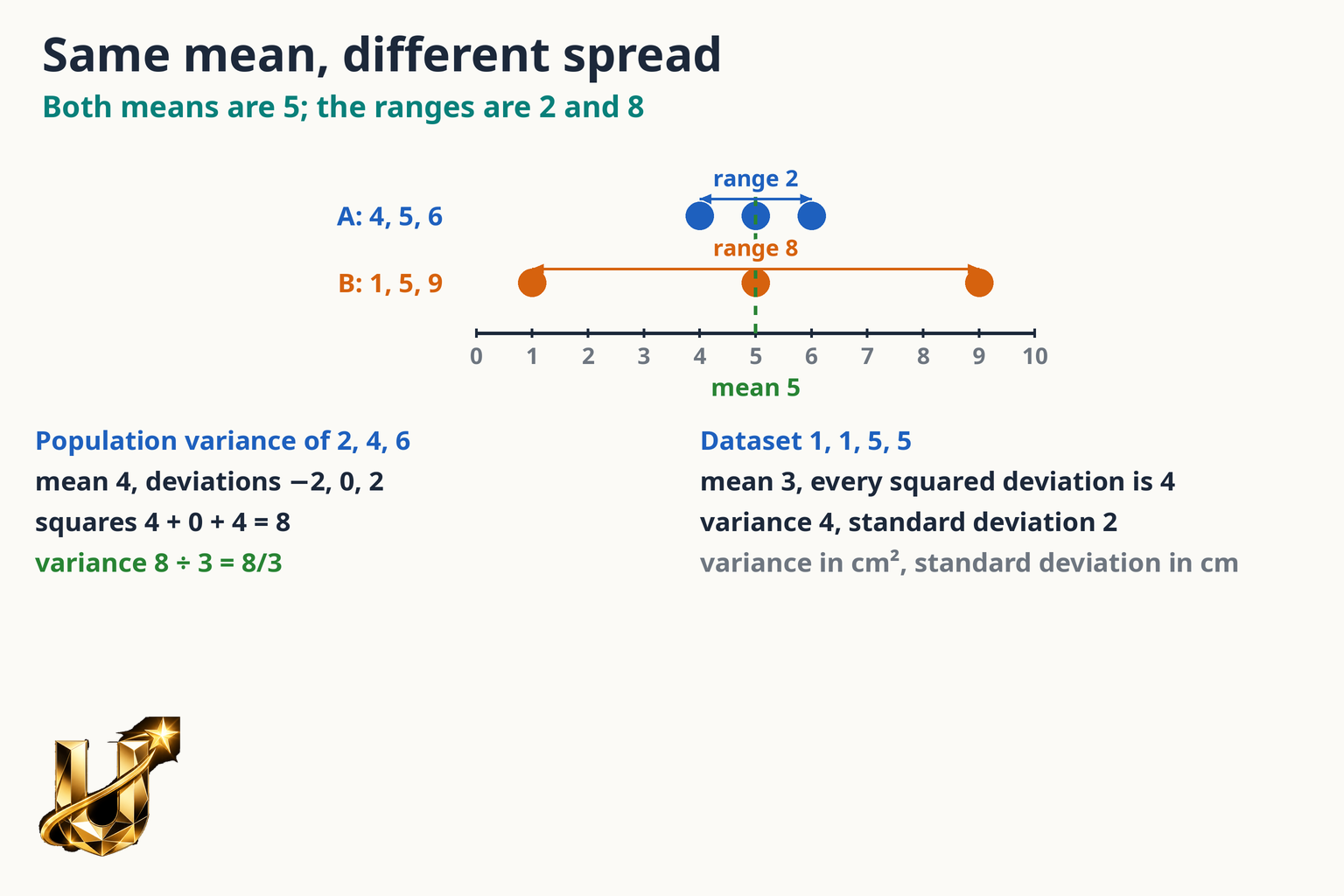
Aarav compares datasets 4, 5, 6 and 1, 5, 9. Their means agree; how do their spreads differ?
Chapter 10: How Quantities Combine: Understanding Data
Aarav compares datasets 4, 5, 6 and 1, 5, 9. Their means agree; how do their spreads differ?
The mean squared deviation from the mean for the complete dataset under study.
Review lesson not available yet.
Aarav compares datasets 4, 5, 6 and 1, 5, 9. Their means agree; how do their spreads differ?
Range is largest minus smallest. A dataset's centre alone does not describe its variability. For a complete finite dataset treated as the population, variance is the average of squared deviations from its mean.
Compare the ranges of 4, 5, 6 and 1, 5, 9.
Standard deviation is the nonnegative square root of variance and uses the original measurement units. This lesson divides by the dataset count; sample variance using count minus one is a different convention and is not silently substituted.
Find population variance of 2, 4, 6.
Range of 3, 8, 10?
Find variance and standard deviation of 1, 1, 5, 5.
Why square deviations for variance?
Describe spread as well as centre, state the variance convention and preserve units.